View Charts

1838-1907 Liberty Head $10 Gold Coin
As the US gold eagle coin recommenced in 1838, the coin featured a new design known as the Liberty Head gold coin. This was first made in 1848 and produced through 1907 before being replaced with the $10 Indian Head Gold Coin. These $10 gold coins, also known as the US gold eagle coin or Coronet Head, were minted to consume the vast gold supply mined during the California Gold Rush.
Assembling a complete collection of Liberty Head 10 dollar gold coins is unfortunately an impossible feat if you are collecting based on mintmarks and dates. There are so many rarities of these US Gold Eagle coins, and earlier issues are incredibly difficult to locate. After the early 1880s, more uncirculated Liberty Head 10 dollar gold coins are readily available.
The first Liberty Head 10 dollar gold coin debuted in 1838, with the face value of “TEN D” printed on the obverse. To maintain consistency with the other denominations of the series, the illustration features Lady Liberty wearing a coronet that reads “LIBERTY” on it. As a result, the name of this gold coin is the Liberty Head 10 dollar gold coin. It contains 16.70 grams of 90% (.900) gold. Few of the original Liberty Head $10 gold coins survive today, and the many variations of mintmark and year make collecting the entire series nearly impossible.
Historic Facts About The 10 Dollar Liberty Head Gold Coin
This US gold eagle coin was an important issue because it was the first gold eagle in 34 years after the mint took a hiatus from striking this type of coin. The reason this long hiatus ended was because of the famous California Gold Rush. This sudden gold supply breathed new life into the American economy, and this influx called for a new gold coin to be minted.
The reason this 10 dollar Liberty Head gold coin is so elusive is because Congress was hesitant to authorize the production of new $10 gold coins. In the first few years of trading, silver coins were already being subjected to hoarding. Then when the new US gold eagle coin appeared, it quickly became a rarity by 1853 as Congress ruled that new coins should be made lighter. This made the US gold eagle coins a rare commerce tool long before federal coins went missing. Thanks to the American Civil War, citizens continued to hoard these coins based on fears around the capabilities of the US government. So although this $10 Liberty Head gold coin was continuously minted, it saw lower mintages during the years of the Civil War, and many more were widely secured and stored away for later use.
The historic end of the $10 Liberty Head gold coin came when President Theodore Roosevelt, commissioned a full redesign of the US coinage in the early 1900s. Augustus Saint-Gaudens created the Indian Head gold coin as its successor.
Liberty Head 10 Dollar Gold Coin Design History
The Liberty Head illustration features Lady Liberty with a coronet inscribed with her name. There were a few major design changes for this issue: the portrait of Lady Liberty was modified in 1839 and the motto “IN GOD WE TRUST” was added in 1866. Therefore, US Mint Chief Engraver Christian Gobrecht designed the Liberty Head gold eagle coin and the $5 and $2.5 gold eagle coins releases. The other side showcases an early rendition of the US Seal with a bald eagle bearing a flag shield on its chest and carrying an olive branch and bundle of arrows in either talon.
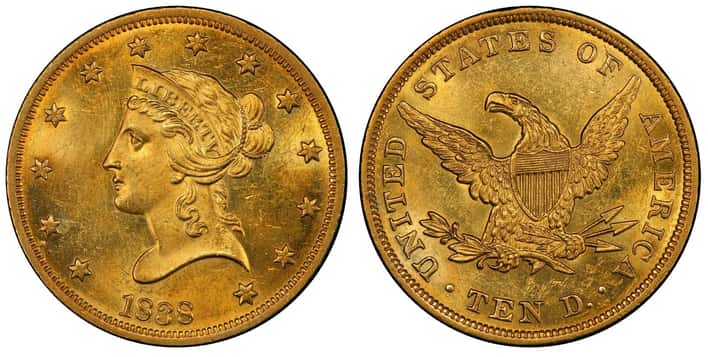
Images from PCGS.com
The Type 1 Liberty Head $10 gold coin was minted for only two years: 1838-1839. This short-lived run was known as the Covered Ear design. Afterward, the second type issued featured a minor modification of the portrait with Liberty’s ear uncovered. The final design type was released in 1866 and ran until 1907. As you can see, for the most part, the design remained the same throughout its run. Regular strike, proof, and special strike coins can be found only for the Type 2 and Type 3 designs, whereas only Regular and Proof were struck for Type 1.
Where is the Mintmark on the 10 Dollar Liberty Head Gold Coin?
The US Mint struck the US gold eagle coins in Philadelphia, San Francisco, Carson City, Denver, and New Orleans. Although Philadelphia Mint Liberty Head coins do not feature a mintmark, you can find mintmarks in varieties of “S”, “O”, “CC”, or “D” on the reverse of the Liberty Head $10 gold coin above the face value. Please note, these US eagle gold coins may vary in value depending on mintmark, design type, year, and condition.
What is the Value of a Liberty Head 10 Dollar Gold Coin?
Although US gold eagle coins were struck in large amounts, citizens hoarding the gold coins and the disruption by the American Civil War greatly impacted the surviving mintage. Many issues, especially in the early years of this coin, are remarkably difficult if not impossible to find. Therefore, the value of a Liberty Head 10 dollar gold coin can vary, but the rarity of this program is what helps define its worth. It is important to note that the better condition of the Liberty Head coin, and which mintmark and year it is marked with, the more it is worth.
Liberty Head - Type 1, Covered Ear (1838-1839)
$10 Liberty Head Gold Coin Value: At least $3,250 USD depending on the condition of the coin
Designer - Engraver: Christian Gobrecht Metal Composition: 90% Gold - 10% Copper
Diameter: 26.80 mm Mass / Weight: 16.70 grams
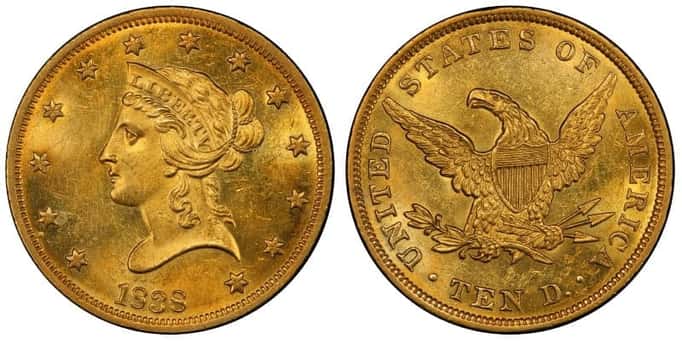
Liberty Head - Type 2 - No Motto (1839-1866)
$10 Liberty Head Gold Coin Value: At least $1,100 USD depending on the coin
Designer - Engraver: Christian Gobrect Metal Composition: 90% Gold - 10% Copper
Diameter: 26.80 mm Mass / Weight: 16.70 grams
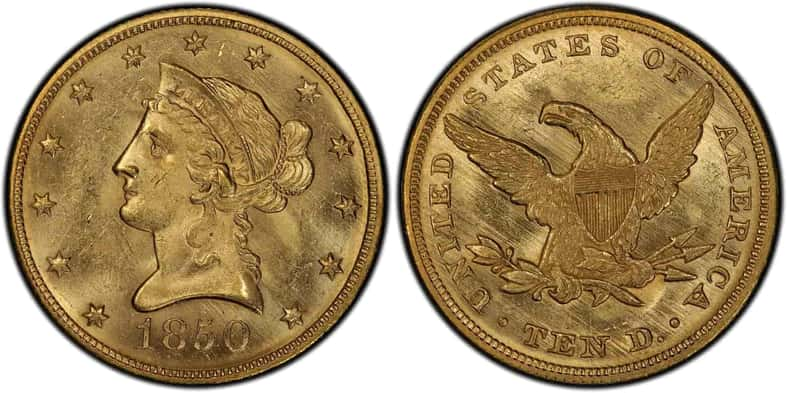
Liberty Head - Type 3 - With Motto (1866-1907)
$10 Liberty Head Gold Coin Value: At least $1,000 USD depending on the coin
Designer - Engraver: Christian Gobrect Metal Composition: 90% Gold - 10% Copper
Diameter: 26.80 mm Mass / Weight: 16.70 grams
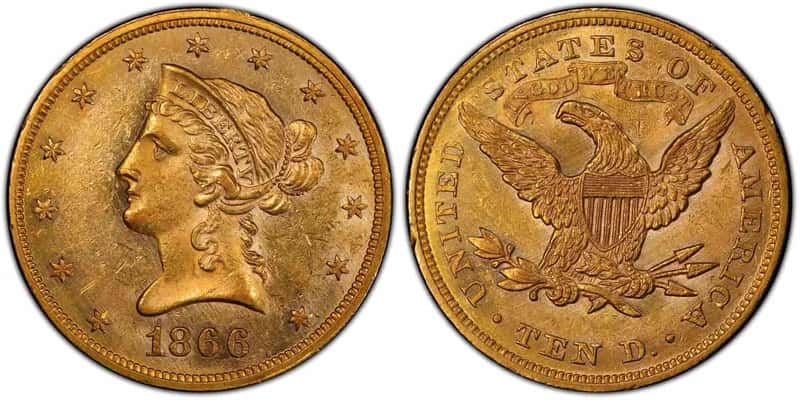
Images from PCGS.com
The Liberty Head $10 gold coins are particularly rare for many factors, but especially because of the Civil War and President FDR’s executive order that outlawed private ownership of gold. As a result, the Liberty Head gold coins, especially the 10 dollar gold eagle coins, are very difficult to find. As a result, trying to assemble a complete collection of this denomination is nearly impossible. We reiterate that US gold eagle coins’ worth will vary based on their mintmark, year, design type, and conditions.
Coins that are sent to professional grading companies such as PCGS or NGC may garner higher premiums if they receive a decent grade. Before you have your Liberty Head coin graded, you can get a sense of what the coin might be worth by inspecting the surface for wear and tear. The more pristine the coin is, the higher grade and value this coin may receive. If you locate a $10 Liberty Head Gold Eagle, you may wish to consult a professional to understand if you are getting the highest quote possible.