View Charts
Barber Quarter (1892-1916)
Formally known as “Liberty Head” quarters, Barber quarters were designed by Charles E. Barber in 1891. Struck from 1892 through 1916, Barber quarters received mixed reviews from the public during their production and were finally replaced in 1916 by the Standing Liberty quarter.
Barber Quarter History
Beginning in 1836, most regular-issue silver United States coinage featured the Seated Liberty designs. By the late 1880s, Mint Director Edward O. Leech felt increasing pressure from the public and politicians to replace the Seated Liberty design. Consequently, Leech ordered a competition to seek out a new look for the silver coins in 1891. Authorized by Congress to approve coin redesigns, Leech, along with newly appointed chief engraver Charles Barber, set the parameters of the competition, which included that only the sole winner would receive a cash prize. This upset the invited artists, who refused to participate. Because no entry from the public proved suitable, Leech instructed Charles Barber to prepare new designs for the dime, quarter, and half dollar. Barber’s designs were approved by President Benjamin Harrison in November 1891, and the coins began production the following January.
Barber Quarter Design and Varieties
What design is on the Barber Quarter?
The Barber quarters contained 90% Silver - 10% Copper. They feature a Liberty Head facing right on the obverse. She wears a pileus (a brimless felt cap worn in Ancient Greece) and a small headband inscribed with "Liberty". "In God We Trust" is inscribed above Liberty’s head, and 13 six-pointed stars also surround her. The reverse shows a heraldic eagle, based on the Great Seal. The bird holds a scroll in its beak inscribed with "E Pluribus Unum" and grips an olive branch and 13 arrows in its talons. Above the eagle are 13 five-pointed stars.
Barber Quarter: 1892-1916
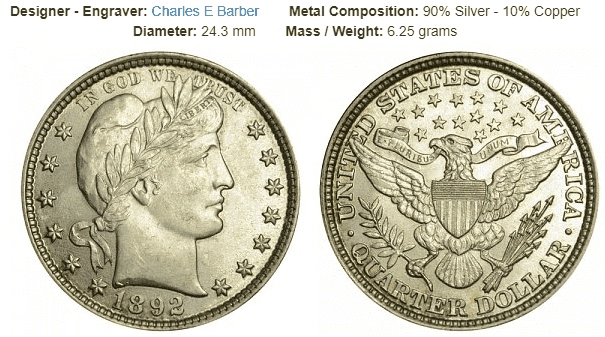
Image source: https://www.usacoinbook.com
What Is The Value of a Barber Quarter?
Barber Quarters are generally common coins in circulated condition, and in many cases, bullion dealers will categorize low-grade, common date Barber quarters as “junk silver. The value of a Barber Quarter will vary depending on the year of mintage, the coin’s condition, and the mintmark. While the price of these historic silver coins usually ranges from around $6 up to $100 in substandard conditions. a few rarer varieties in great condition can be worth between $1,000 and $54,000. During this coin’s production, about 4 varieties of this coin have been valued at $3,000 or higher (in certain conditions). These varieties are listed below:
1896 S Barber Quarter
Value: Between $1,000 and $19,960, depending on condition
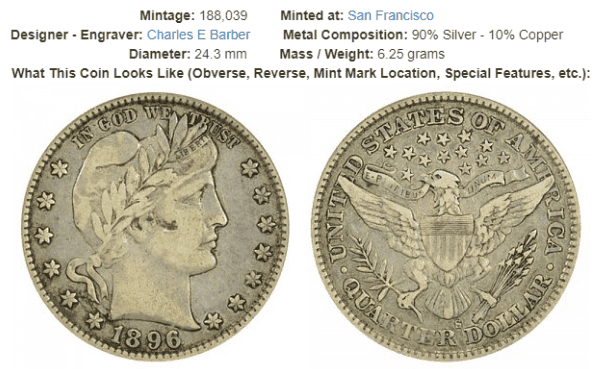
Image source: https://www.usacoinbook.com
1901 S Barber Quarter
Value: Between $5,840 and $53,400, depending on condition
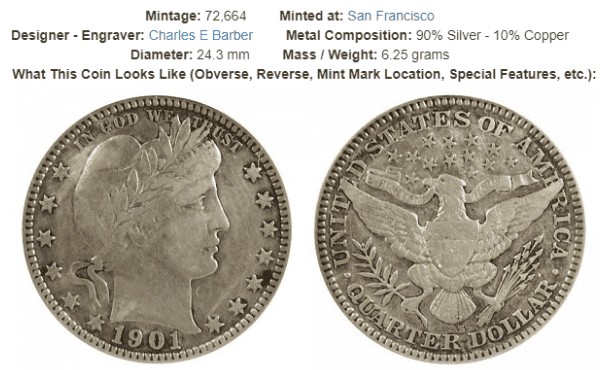
Image source: https://www.usacoinbook.com
1909 O Barber Quarter
Value: Between $45 and $3,875, depending on condition
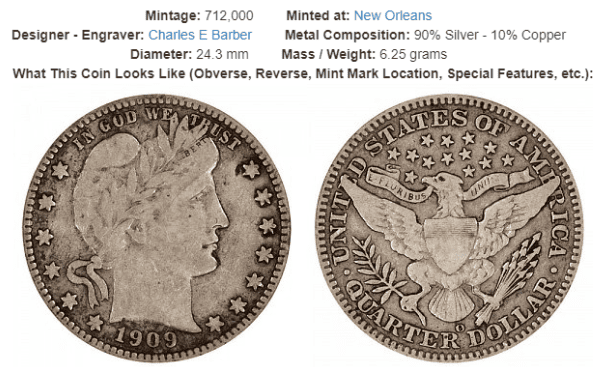
Image source: https://www.usacoinbook.com
1913 S Barber Quarter
Value: Between $1,850 and $22,440, depending on condition
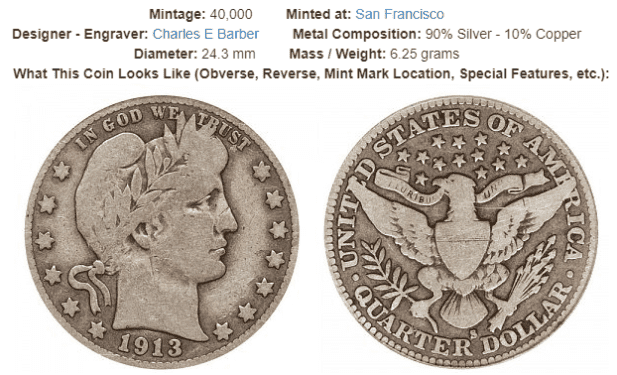
Image source: https://www.usacoinbook.com
Why Should I Collect Barber Quarters?
In comparison to other American silver coinage, Barber Quarters are fairly easy to find. This makes adding them to your collection a very attainable goal! Values for the common dates/ mintmarks usually range from $6-$50 in “Good” condition and up to $500-$2,000 or more in MS 63 condition. Despite their ease of attainment, Barber Quarters hold an undeniable historical and collector appeal. As always, we encourage you to seek the assistance of a numismatic professional when determining the value of your coin.