View Charts
1965 Roosevelt Dime: The First of the Clad Era
The Turning Point Between Silver and Modern Coinage
The 1965 U.S. Dime stands as one of the most important transitional coins in modern American history — marking the exact moment the United States Mint moved away from silver coinage. Following the final silver dime of 1964, the 1965 issue became the first clad dime ever struck for circulation, officially ending a 173-year tradition of precious metal coinage in everyday U.S. currency.
Collectors and historians view the 1965 dime as more than a simple ten-cent piece — it represents the economic and cultural shift from the silver-backed monetary era to the modern fiat system. While 1964 dimes were made of 90% silver, the 1965 dime introduced a durable copper-nickel composition that remains in use today. The change was driven by skyrocketing silver prices, which made it more profitable for Americans to hoard or melt coins than to spend them.
This transition created one of the most fascinating episodes in U.S. Mint history, producing both widespread confusion and a handful of rare silver 1965 error dimes — now worth thousands to collectors. For investors and numismatists alike, the 1965 dime bridges two eras: it closes the chapter on the final silver dime and begins the era of clad coinage that defines America’s circulating currency today.
This guide explores the 1965 dime’s history, design, specifications, and collector value, as well as its connection to the last silver dimes of 1964 — explaining why this modest coin remains a foundational piece in both U.S. Mint history and numismatic collections.
A Coin Born from Economic Crisis
In the early 1960s, silver prices surged, making the melt value of dimes, quarters, and half dollars nearly equal to their face value. As citizens hoarded coins for their silver content, commerce slowed, and vending machines sat empty. Congress responded with the Coinage Act of 1965, eliminating silver from dimes and quarters entirely and reducing silver content in half dollars to 40%.
The U.S. Mint immediately began producing 1965-dated dimes in massive quantities, even as the 1964 silver coins were still in circulation. To prevent speculative collecting, mintmarks were removed from all coins between 1965 and 1967. This allowed the Mint to produce coins at multiple facilities — Philadelphia, Denver, and San Francisco — without distinguishing origin.
The 1965 dime thus became the first U.S. coin to embody the post-silver monetary era, signaling a decisive shift in the nation’s economic and numismatic history.
A Design That Endures
-
Obverse: Portrait of President Franklin D. Roosevelt, designed by John R. Sinnock and introduced in 1946 to commemorate the late president’s leadership and founding of the March of Dimes.
-
Reverse: A torch flanked by olive and oak branches, symbolizing liberty, peace, and strength.
-
Inscriptions: “LIBERTY,” “IN GOD WE TRUST,” and “1965” appear on the obverse; “UNITED STATES OF AMERICA,” “E PLURIBUS UNUM,” and “ONE DIME” appear on the reverse.
-
Designer Initials: Sinnock’s initials “JS” appear below Roosevelt’s neck.
-
Edge: Reeded to deter clipping — a design carryover from the silver era.
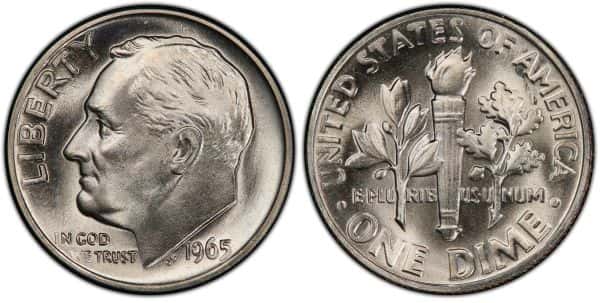
1965 Roosevelt Dime
The Roosevelt dime’s design remains unchanged to this day, making the 1965 issue a vital link between mid-century artistry and modern U.S. currency.
Specifications and Production of the First Clad Dime
-
Denomination: 10 cents (One Dime)
-
Composition: Outer layers of 75% copper and 25% nickel, bonded to a pure copper core
-
Weight: 2.268 grams (lighter than the 2.5-gram silver 1964 dimes)
-
Diameter: 17.91 mm
-
Thickness: 1.35 mm
-
Edge: Reeded
-
Mintmarks: None — mintmark moratorium (1965–1967)
-
Mintage: Approximately 1.65 billion coins struck across all mints
-
Finish: Business strikes only; proof production paused until 1968
This enormous mintage volume was a direct response to the coin shortage. The 1965 dime’s composition proved so effective that it remains the standard for circulating U.S. dimes today.
The 1965 Silver Dime Error and Other Rare Varieties
Although most 1965 dimes are clad, a handful of silver transitional errors were accidentally struck on leftover 90% silver planchets from 1964. These transitional pieces are among the rarest U.S. Mint errors, instantly recognizable by their lack of copper edges and a heavier weight of 2.5 grams.
-
1965 Silver Transitional Error: Only a few dozen are confirmed. In top mint state grades, these can command $6,000–$10,000+ at auction.
-
Wrong Planchet Strikes: A small number of 1965 dimes were mistakenly struck on foreign or smaller U.S. coin planchets.
-
Full Torch Designation: Coins graded MS67 FT (Full Torch) by PCGS or NGC show complete vertical lines on the torch — highly desirable to collectors.
-
Die Crack and Doubled Die Varieties: Minor varieties exist and add character to otherwise common circulation strikes.
The 1965 silver dime error stands alongside the 1943 copper penny and 1977-D silver Eisenhower dollar as one of the most famous modern transition coins in U.S. history.
Why Collectors Still Chase the 1965 Dime
Collectors are drawn to the 1965 dime because it bridges two distinct eras of U.S. coinage — the last silver dime (1964) and the first fully modern coin of the clad age.
For hobbyists, it offers an affordable and educational gateway into the Roosevelt dime series. For advanced numismatists, the hunt for transitional silver errors remains one of the most exciting pursuits in modern coin collecting.
Even circulated 1965 dimes hold historical value as part of this pivotal transition. High-grade examples, particularly with Full Torch designations, have steadily appreciated due to registry competition. Certified transitional silver pieces, on the other hand, have evolved into true trophy coins — combining rarity, historical significance, and public fascination.
Recent Auction Highlights and Market Trends
The market for 1965 silver transitional dimes remains strong, with high prices reflecting scarcity and collector demand. Notable auction results include:
-
$8,400 (PCGS MS62) at Heritage Auctions (March 2023)
-
$6,000 (PCGS MS63) at Stack’s Bowers (2021)
-
$4,200 (NGC AU58) at GreatCollections (2020)
Meanwhile, exceptional clad examples graded MS67 FT or higher often trade between $150–$400, depending on strike quality and luster.
As bullion awareness grows, renewed attention on the 1964–1965 silver transition has increased public curiosity — encouraging new collectors to weigh their change and check for these hidden silver rarities.
A Coin of Transition and Controversy
The 1965 dime represents one of the few coins struck over multiple years with a single date, as production extended into 1966 to satisfy demand. Public reaction to the switch from silver to clad was deeply divided: traditionalists saw it as debasement, while economists viewed it as necessary modernization.
This change marked a defining cultural moment. The dime, already iconic for bearing Roosevelt’s portrait, now became a symbol of postwar innovation and industrial adaptation. It linked patriotic design with pragmatic economics — reflecting the balance between national tradition and progress.
Collecting and Preserving 1965 Dimes Today
Even decades later, the 1965 dime continues to appeal to both educators and investors. To identify or preserve key examples:
-
Weigh your coins: Silver planchets weigh 2.5 g versus 2.268 g for clad.
-
Inspect edges: A solid silver edge indicates a silver planchet error.
-
Use magnification: Look for Full Torch details or doubling.
-
Certify rare pieces: PCGS or NGC certification can confirm genuine transitional errors.
-
Store properly: Use air-tight capsules and avoid PVC holders.
-
Watch the market: Rising silver spot prices tend to reignite interest in the 1964–1965 transitional coinage period.
The 1965 dime remains an accessible yet historically rich coin — one that turns pocket change into a tangible connection to America’s monetary evolution.
Why the 1965 Dime Still Matters
Sixty years after its release, the 1965 Roosevelt Dime continues to hold a special place in U.S. numismatic history. It marked the precise moment when the nation’s circulating coinage stepped away from silver, forever altering how Americans viewed the value of their money.
Collectors continue to seek the 1965 issue for what it represents — the end of the silver era and the start of modern U.S. coinage. Whether pursued for its history, design, or rare silver errors, the 1965 dime remains a tangible reminder of economic change and enduring artistry.
Image source: PCGS CoinFacts