View Charts
1840–1907 Liberty Head $2.50 Gold Coin: The American Quarter Eagle
A Symbol of Prosperity and Progress
The Liberty Head $2.50 Gold Coin, also known as the Quarter Eagle, represents one of the longest-running and most beloved series in U.S. numismatic history. Struck continuously from 1840 to 1907, it carried America through a transformative era — from the early days of westward expansion and the California Gold Rush to the post-Civil War recovery and the dawn of the 20th century.
Designed by Christian Gobrecht, Chief Engraver of the U.S. Mint (1840–1844), this enduring coin blended elegant artistry with everyday functionality. With a face value of $2.50 — one-quarter the value of the $10 “Eagle” — it became a cornerstone of 19th-century commerce and remains a treasured collectible today.
Historical Background: From the Gold Rush to the Civil War
The Liberty Head design replaced the earlier Classic Head Quarter Eagle (1834–1839), debuting just as America entered a period of explosive growth fueled by the California Gold Rush. The influx of newly mined gold transformed U.S. commerce and made gold coinage more abundant than ever before.
During the Civil War (1861–1865), gold coins vanished from circulation as citizens hoarded hard currency amid economic uncertainty. Although production slowed, the U.S. Mint continued limited strikes at select branches. In the war’s aftermath, Treasury Secretary Salmon P. Chase directed the addition of “IN GOD WE TRUST” to national coinage, reflecting the nation’s deepened religious sentiment.
Interestingly, the Quarter Eagle — because of its small size — never adopted this motto, making it the only Liberty Head denomination that did not undergo the change.
Design Details: Liberty and the American Eagle
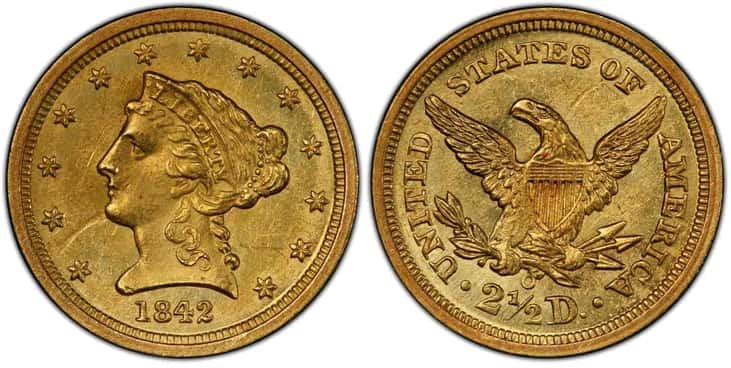
Obverse: Lady Liberty faces left, adorned with a coronet inscribed LIBERTY and surrounded by 13 stars representing the original colonies. Her hair is tied in a bun, secured by a string of pearls — a refined reflection of neoclassical grace.
Reverse: A heraldic eagle clutches an olive branch and arrows, symbolizing peace and strength, beneath the motto UNITED STATES OF AMERICA and denomination 2½ D..
This design remained remarkably consistent throughout the coin’s production — one of the few U.S. gold issues to maintain its original artwork for nearly seven decades.

Specifications and Composition
The Liberty Head Quarter Eagle was struck from the same alloy used in pre-1933 U.S. gold coins — .900 fine gold (90% gold, 10% copper).
-
Metal Content: 0.1209 troy oz (3.76 grams) of pure gold
-
Total Weight: 4.18 grams
-
Diameter: 18 millimeters
-
Edge: Reeded
-
Designer: Christian Gobrecht
The added copper provided the necessary durability for circulation, allowing these small but valuable coins to endure the rigors of everyday trade. At the time, their gold content was equal to their face value, making them both a practical currency and a store of wealth.
Mintmarks and Production Legacy
The Liberty Head $2.50 Gold Coin is remarkable for having been struck at five historic U.S. Mint facilities over its 67-year run:
-
Philadelphia (no mintmark) – The main production facility.
-
Charlotte (C) and Dahlonega (D) – Southern mints that used locally mined gold before closing in 1861 due to the Civil War.
-
New Orleans (O) – Limited early issues, now collectible rarities.
-
San Francisco (S) – Began production in the 1850s as Western gold poured in from California.
Mintmarks are found below the eagle on the reverse side. Coins without marks were struck in Philadelphia.
Rarities and Notable Issues
While many Liberty Head Quarter Eagles are affordable, a few standout rarities define the series:
-
1841 Quarter Eagle: Believed to exist only in proof, with extremely limited survivors.
-
1848 “CAL.” Quarter Eagle: Struck with California Gold Rush bullion and stamped CAL. above the eagle — widely regarded as the first U.S. commemorative coin. Fewer than 300 are known to exist today.
-
1854-S: One of the first San Francisco issues, with extremely low mintage and high desirability.
-
1875 Quarter Eagle: Minted in small quantities exclusively for collectors, now one of the most coveted dates in the series.
These rare issues command significant premiums, often fetching five- to six-figure prices at auction depending on condition and provenance.
Value and Market Overview
The Liberty Head Quarter Eagle remains a highly collectible entry point into pre-1933 U.S. gold. Value depends heavily on mintmark, date, and condition, but general market estimates are as follows:
-
Common-date circulated coins (VF–XF): $350 – $600
-
Choice AU to MS60: $700 – $1,200
-
Gem Mint State (MS63–MS65): $1,500 – $4,000+ for common dates
-
Rarities (such as Charlotte, Dahlonega, or CAL. issues): $10,000 – $100,000+
The Liberty Head $2.50 Gold Coin typically carries significant numismatic premiums above the gold spot price, far exceeding its intrinsic metal value and reflecting its historical importance, scarcity, and enduring collector appeal.
Collecting and Preservation Tips
When evaluating a Liberty Head $2.50 Gold Coin, inspect the high points for wear:
-
Liberty’s coronet, hairlines, and cheek on the obverse.
-
Eagle’s wingtips and talons on the reverse.
Original luster, minimal contact marks, and clear strike quality can dramatically increase a coin’s grade and market value. Because these coins were frequently gifted or used in jewelry, “ex-jewelry” examples may show mounting marks or surface polishing. For high-value coins, professional grading by PCGS, NGC, or CAC is strongly recommended.
Legacy of the Liberty Head Quarter Eagle
Production of the Liberty Head Quarter Eagle ended in 1907, replaced the following year by Bela Lyon Pratt’s innovative Indian Head Quarter Eagle, featuring an incuse (sunken) design unlike anything seen before on U.S. coinage.
The Liberty Head design, however, endures as a testament to an America built on ambition, faith, and gold. It remains one of the most approachable and meaningful ways to own a piece of 19th-century U.S. history — small in size, but immense in legacy.
Images sourced from: PCGS CoinFacts