View Charts
1908-1929 2.50 Indian Head Gold Coin
2.5-dollar gold coins are popular with numismatists and collectors today. Because of the variety of designs, quarter eagle gold coins are often searched for online. Forming a gold quarter eagle collection is not an impossible task, but it is also not an easy one. Many collectors enjoy the journey of finding any quarter eagle gold coin, especially the 2.50 Indian Head gold coin.
The Indian Head series was not long-lasting in the US. The US Mint only struck this particular quarter eagle gold coin from 1908 through 1915, and then from 1925 to 1929. The president at this time, Theodore Roosevelt, enlisted master sculptor Augustus Saint Gaudens as the artist to beautify the American coinage. However, Saint Gaudens was unable to finish the task as he suffered from cancer. His student, Bela Lyon Pratt, took over the redesign of the quarter and half gold eagle coins. He finished the gold quarter eagle with the same design as the gold half eagle from the same year to keep a somewhat uniform consistency across the program.
Gold quarter eagle coins are prized today because certain editions are harder to find, especially those in a higher condition. On top of that, in 1933, private ownership of gold was outlawed, and many Americans had to return their gold to banks. This was Executive Order 6102, and it was meant to help restart the economy since the US was still on the gold standard at this time. Although Americans were prohibited from holding gold until 1974, some people continued to hold their quarter eagle gold coins. This is partially why you can find a 2.5 Indian Head gold coin to this day. But, this is also why very few pre-1933 gold coins remain on the market.
Historic Facts About The 2.5 Indian Head Gold Coin
Augustus Saint Gaudens was tasked with creating beautiful US gold coins for everyday use, and he lived up to the task. But because his design of the 10-dollar Indian Head gold coin was so intricate, his illustration was not to scale when the US tried to mint it on smaller denomination coins. Therefore, his student created a new design with Saint Gaudens’ high-quality artistic influence in mind. This is why the illustration for the $2.5 and 5-dollar gold coin Indian Head releases differs from the 10-dollar gold coin edition.
The reverse of the 2.5 Indian Head gold coin displays an Indigenous American male wearing a feathered war bonnet. He gazes to the left side of the coin, so we can enjoy viewing his astonishing headdress. The other side displays the American Bald Eagle standing on a bundle of arrows with a vine creeping across them.
The regular mintage of the Indian Head 2.5 dollar gold coin froze from 1916 until 1925 because of economic hardships caused by WWI. The war effort spiked the gold price, which also increased the cost of production for US gold coins. Because of the increased price, people began to hoard their gold coins for their metal content. Consequently, the US Mint stopped manufacturing lower denomination gold dollar coins for a time before restriking the Indian Head 2.5 dollar gold coin again from 1925 until 1929. However, only proof edition coins were struck from 1908 through 1915.
About 532,000 of the Indian Head 2.5 dollar gold coins were made back in 1929, but PCGS believes that only 66,166 remain today. This low survival rate might be because of Executive Order 6102 which allowed the US to melt gold coins down to support the war effort. The Indian Head 2.5-dollar gold coin is a prized piece that numismatists and collectors covet today. Creating an entire collection of the $2.50 Indian gold quarter eagles is not impossible, but it is no easy feat. Are you up for the task?
Indian Head 2.5 Dollar Gold Coin Design History
Throughout its run history, few changes were added to the $2.50 Indian Gold Quarter Eagle. Aside from mintmarks that vary from Denver or Philadelphia, which did not use a mintmark, the design of the gold half eagle coins remained the same. What is most important about these innovative half and quarter gold eagle coins is that they use an incuse design. This means that the images, except for the mintmarks, were imprinted in the coin instead of raised above the surface. Also, this was the first time that a circulating US gold coin featured an incuse design.
2.50 Indian Head Gold Coin Value?
2.50 Indian Head gold coin values vary according to mintmark, year, finish, mintage, and condition.
Indian Head 2.5 Dollar Gold Coin (1908-1915, 1925-1929)
2.50 Indian Head Gold Coin Value: Varies
Designer - Engraver: Bela Lyon Pratt Metal Composition: 90% Gold - 10% Copper
Diameter: 18.00 mm Mass / Weight: 4.18 grams
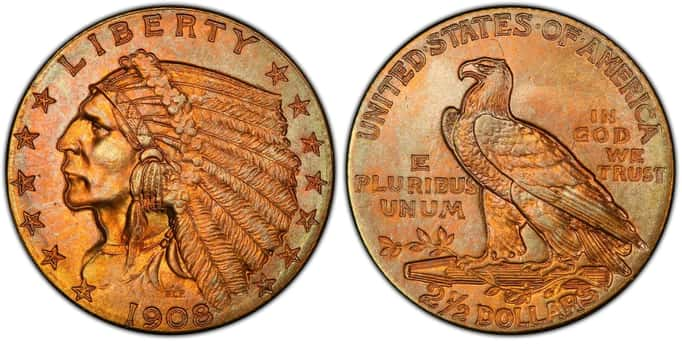
Proof Indian Head 2.5 Dollar Gold Coin (1908-1915)
2.50 Indian Head Gold Coin Value: Varies
Designer - Engraver: Bela Lyon Pratt Metal Composition: 90% Gold - 10% Copper
Diameter: 18.00 mm Mass / Weight: 4.18 grams
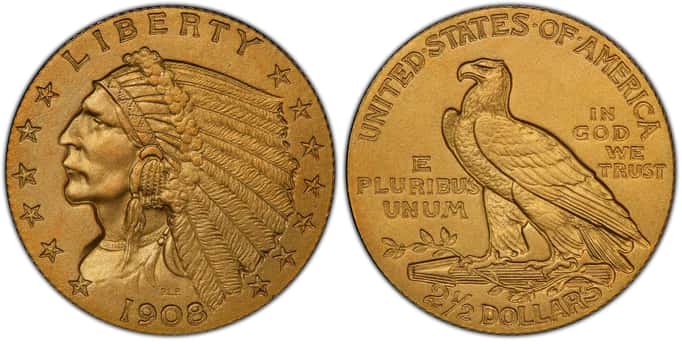
The Indian Head 2.5 dollar gold coin has a lower surviving mintage than other US gold coins. This is where the quarter gold eagle coins derive their higher premiums from! If certified, these gold quarter eagle coins can amount to a much higher price. The main factors that affect the 2.50 Indian Head gold coin value include whether or not it has a mintmark, what year it was minted, its finish, and especially its condition.
Before you send your Indian Head 2.5-dollar gold coin for certification, you can get a rough estimate of the value of your $2.5 gold coin by analyzing its surface for wear and tear. Coins that are certified by professional grading companies, such as PCGS or NGC, can potentially receive a higher premium and value increase. This is especially true if the coin has a decent grade. If you find one of these Indian Head 2.5-dollar gold coins, you may wish to contact a professional numismatist to grade your coin. This way, you can receive the highest quote possible for your $2.50 Indian Gold Quarter Eagle.