View Charts

1794 - 1837 Bust Half Dime
The Bust half dime or disme is part of a larger half dime program in the US. “Disme” comes from the French word, derived from the Latin “decimus” or “tenth.” This word was struck only on the 1792 half dismes, but never on any other US coins. Actually, the 1792 half disme was the first official US coin, but it was not made at the US Mint. Of the half dimes, the United States ever used, the major designs included the Bust half dime, Draped Bust with small eagle reverse, Draped Bust with large eagle reverse, and the Capped Bust.
Some of the Bust half dimes are rare today since many were small and easily lost. Others could have been melted down for their silver content, or be totally unrecognizable today after many years of exchanging hands. Eventually, this initial Bust Half Dime coin was replaced with the Seated Liberty Half Dime. After that historic program, the half dimes were completely redone with nickel instead of 90% silver and 10% copper. Thus, the nickels we have today began after this initial 5-cent piece.
Bust Half Dime Design History
There were three main design variations of the Bust half dimes including the Flowing Hair Bust, Draped Bust, and Capped Bust. However, there was one semi-unofficial Bust half disme from 1792, designed by Thomas Birch, an English-born American portrait and marine painter. This was the 1792 half disme, but the US Mint did not manufacture this coin at its facility. According to legend, George Washington himself provided the silver for the coinage of 1792 half dismes. This has since been debunked, but the other legend associated with this coin is that Martha Washington served as the model for the portrait on this coin. This has yet to be either denied or confirmed by historians.
This first coin is debated to be a pattern issue or regular issue since so many were made at the time (1,500+) and virtually all were distributed for circulation. Washington himself mentioned the 1792 half dismes in his Congressional Address in November 1792, indicating that the coins were already produced.
|
|
|
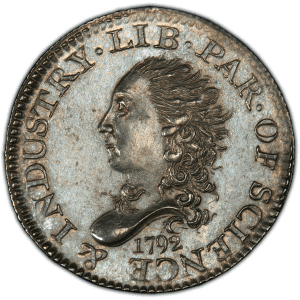
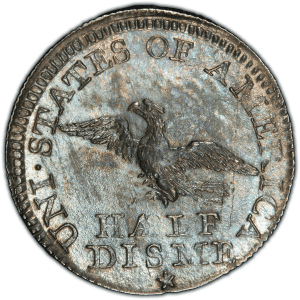
Images from PCGS.com
The first half dimes actually made at the US Mint were struck in 1793. Although no longer called dismes, the word “dime” also did not appear on the half dimes and dimes until 1837. These new half dimes coins all weighed about 1.35 grams and were made from .892 silver and balanced with .108 copper. However, mintage numbers vary for each release.
1794 - 1795 Flowing Hair Half Dime
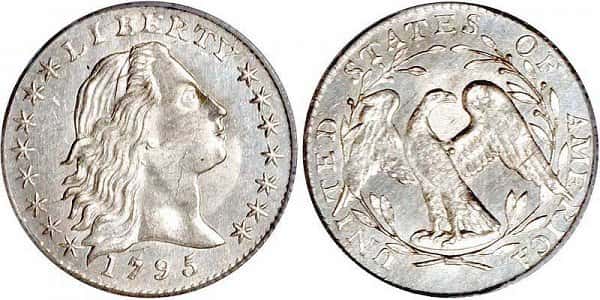
The first design was the Flowing Hair half dime which was minted from 1794-1795. Robert Scot, the Chief Engraver of the US Mint, created this design in 1793. This portrait featured Lady Liberty with flowing hair, which became the standard for all silver denominations at the time. The idea was to create a uniform US coin appearance. This concept to utilize identical illustrations was used throughout the 19th century on circulating American coinage. The obverse shows Lady Liberty, and the reverse displays a small eagle perched atop a cloud. People thought this eagle looked malnourished, which might be partly why this design was so short-lived.
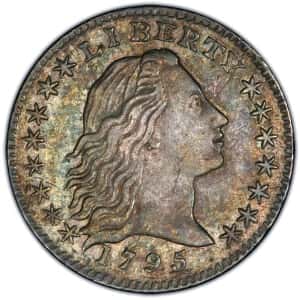 | 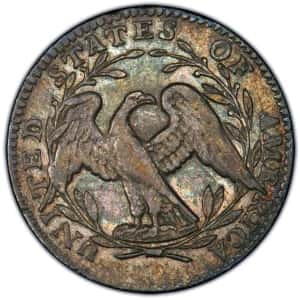 |
Image from PCGS.com
Only 7,756 of the 1794 half dimes were produced, but an estimated 78,660 were made the following year. Therefore, the 1794 half dime is rarer than the 1795 issue. This coin’s design changed so quickly because, apparently, the design was “lost.”
1796 - 1805 Draped Bust Half Dime
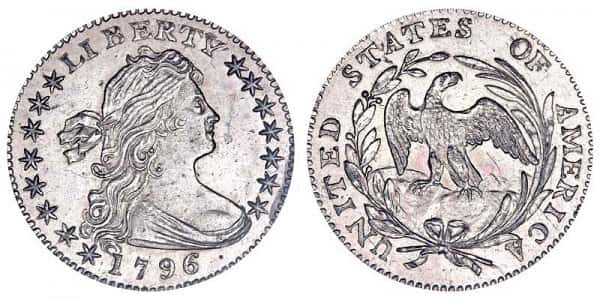
After the 1792 Flowing Hair Half Dime, the mint struck the half dimes in 1796 with the Draped Bust design, created by US Mint artist Gilbert Stuart. This man also painted Washington, whose portrait is the model for the vignette on the $1 US dollar we use today.
This new image features Lady Liberty wearing a “hairband” while surrounded by stars. On the other side is an open wreath around a small eagle atop a cloud. This eagle was actually significantly smaller than the one appearing on the 1794-95 half dime. There were thirteen, fifteen, and sixteen-star variations. Each was an update as the US continued to expand. Eventually, the mint decided not to add stars for each new state because updating the image was becoming more difficult.
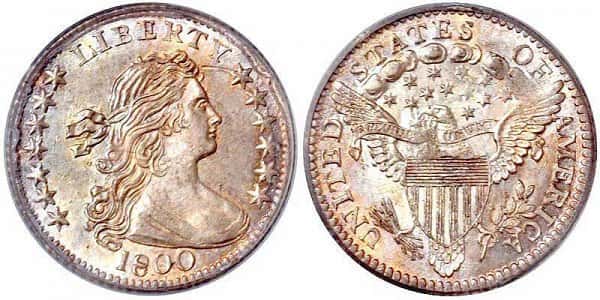
There are two major editions of the Draped Bust half dime, including the Small Eagle reverse (1796-1797) and the Heraldic or Large Eagle reverse (1800-1805). The newer reverse displayed an eagle with its wings outstretched and a flag shield on its chest. Actually, the design was based on the Great Seal of the US. Additionally, it was used on other silver denominations after this release. This heraldic design bears the eagle with arrows and an olive branch in its talons. Its beak grips a banner that reads E PLURIBUS UNUM.
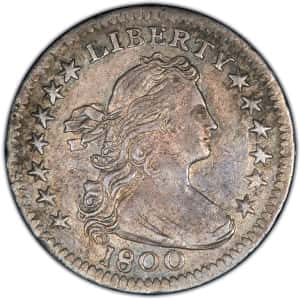 | 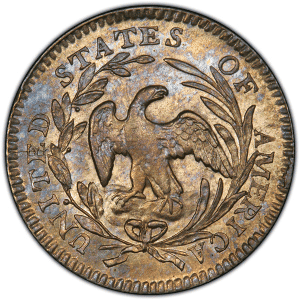 | 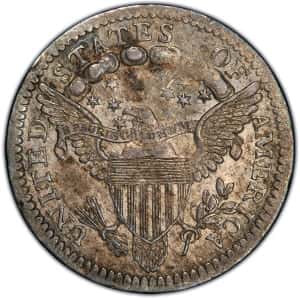 |
Image from PCGS.com
Mintage numbers for the Draped Bust half dimes never exceeded 45,000, and none were made in 1804. That being said, every year has different mintage numbers that can vary widely. All these coins originate from the Philadelphia Mint, which is why they do not have mintmarks. The 1802 Draped Bust, Heraldic Eagle half dime is one of the rarest coins of this series. Although 13,010 were made according to US Mint records, only 16 of them are known today.
Capped Bust Half Dime
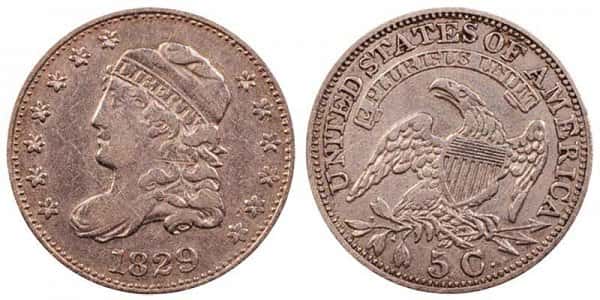
From 1806-1828, no half dimes were minted. Therefore, the final design is the Capped Bust half dime (1829-1837). The second US Mint Chief Engraver, William Kneass modified John Reich’s design of the 1809-1837 dime for the new coin. Again, only the Philadelphia Mint struck these coins, so there is no mintmark. This image spotlights Lady Liberty with a cloth cap and 13 stars around her. Her cap bears the word “LIBERTY” on its brim, and her hair falls around her shoulders. You can also see her neckline draped with a gown, which is secured with a brooch at the top of her shoulder.
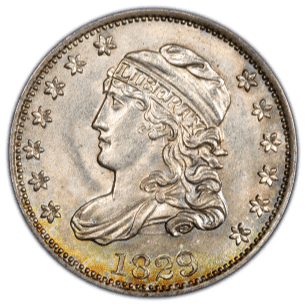 | 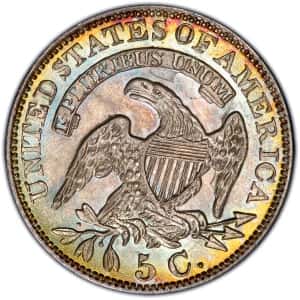 |
Image from PCGS.com
The reverse of the Capped Bust half dime bore an updated heraldic bald eagle image featuring all the same trademark symbols: the olive branch, arrows, shield, and banner. This eagle is perched atop a branch. Mintage numbers for each year vary, but they fell between 800,000 - 2.7 million. After the Bust Half Dime program came to the Seated Liberty Half Dime. With this 1837 issue, the term “half disme” was now antiquated and retired in favor of a 5-cent coin or half dime.
Value of a Bust Half Dime
The half dime’s condition and year play a major role in its numismatic value. This program was among the earliest US coinage ever made, therefore it can make a wonderful piece in your collection. 1794 Flowing Hair half dimes might be more expensive than any of the Capped Bust half dimes simply owing to their rarity.
Early Silver Half Dimes (1794-1795)
Flowing Hair Half Dime Value: Between $1,400 - $37,000+ USD
Designer - Engraver: Robert Scot Metal Composition: 89% Silver - 11% Copper
Diameter: 16.5 mm Mass / Weight: 1.34 grams
Draped Bust Half Dime - Small Eagle Reverse (1796-1797)
Draped Bust Small Eagle Half Dime Value: Between $1,600 - $68,000+ USD
Designer - Engraver: Robert Scot Metal Composition: 89% Silver - 11% Copper
Diameter: 16.5 mm Mass / Weight: 1.35 grams
Draped Bust - Heraldic Eagle Reverse (1800-1805)
Draped Bust Heraldic Eagle Half Dime Value: Between $1,000 - $500,000+ USD
Designer - Engraver: Robert Scot Metal Composition: 89% Silver - 11% Copper
Diameter: 16.5 mm Mass / Weight: 1.35 grams
Capped Bust Half Dimes (1829-1837)
Capped Bust Half Dime Value: Between $60 - $2,000+ USD
Designer - Engraver: William Kneass Metal Composition: 89% Silver - 11% Copper
Diameter: 15.5 mm Mass / Weight: 1.35 grams
Images from usacoinbook.com
All the Bust half dimes have historical significance and are rare, making them incredibly desirable to collectors. As time progresses, these coins may become even rarer and will make fantastic pieces for large and small collections. Whenever you come across one of these coins, you might consider having it graded by PCGS or NGC in order to determine its true worth. However, you can get a rough estimate of the value of your half dime by examining the details and how they have aged over the years. Other major factors to consider include the coin’s mintage, rarity, year, and design.