View Charts
Why the 2026 American Palladium Eagle Stands Apart
 0
0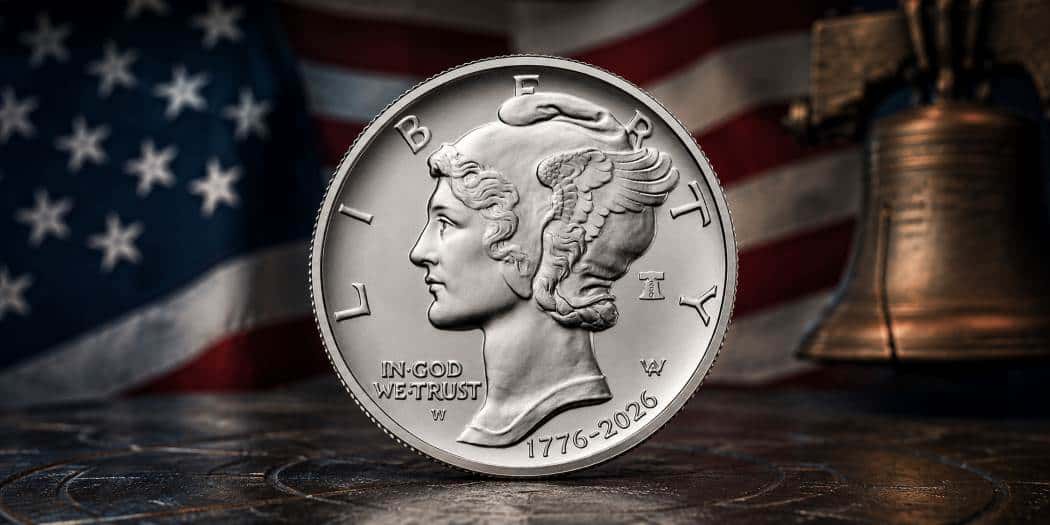
A Young American Eagle Series Meets a Historic Anniversary
Since its 2017 debut, the American Palladium Eagle has occupied a distinctive place in the American Eagle family, pairing one of the world's rarest precious metals with two historic designs by Adolph A. Weinman. For America's 250th anniversary, the U.S. Mint has built on that established identity rather than replacing it with an entirely new design. The result is a coin that remains immediately recognizable while carrying details unique to the Semiquincentennial.
The 2026 American Palladium Eagle Uncirculated Coin features the dual date 1776 ~ 2026 and a Liberty Bell privy mark containing the numeral 250. Struck at West Point from one troy ounce of .9995 fine palladium, it also carries a maximum mintage of just 5,000 coins. Together, the anniversary treatment, precious-metal content, historic artwork, and limited production give the 2026 issue an identity that extends beyond a routine annual release.
Anniversary Details Mark a One-Year Issue
Rather than introducing a completely new composition for the Semiquincentennial, the Mint incorporated its anniversary elements into the established Palladium Eagle design. The traditional date becomes 1776 ~ 2026, creating a direct link between the Declaration of Independence and its 250th anniversary, while the Liberty Bell privy reinforces that connection with one of the most recognizable symbols of American independence.
The relatively restrained treatment is particularly appropriate for a series built around historic artwork. Weinman's designs remain visually dominant instead of becoming a backdrop for anniversary decoration, yet collectors can readily distinguish the 2026 edition from earlier Palladium Eagles. It is an approach that allows the coin to participate in the broader Semiquincentennial program without sacrificing the artistic identity the series has developed since 2017.
Two Historic Weinman Designs Define the Coin
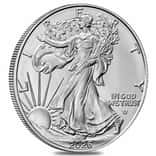
The obverse features Weinman's Winged Liberty, first introduced on the Mercury Dime in 1916. Despite the dime's familiar nickname, the portrait depicts Liberty rather than the Roman god Mercury, with the wings on her cap intended to represent freedom of thought. On the larger Palladium Eagle, the high-relief treatment gives Weinman's portrait greater sculptural presence, allowing details that appeared on a small circulating ten-cent coin to take on a different character.
The reverse reaches even further into Weinman's career. Its eagle perched on a rocky outcrop and grasping a branch was adapted from his 1907 American Institute of Architects Gold Medal, rather than from a circulating U.S. coin. Bringing these two works together gives the Palladium Eagle unusual artistic continuity among modern U.S. Mint products: both sides originated with the same sculptor, but were created years apart for entirely different purposes before being reunited on a 21st-century American Eagle.
Palladium Gives the Eagle Its Own Market Identity
Each 2026 coin contains one troy ounce of .9995 fine palladium, carries a $25 legal-tender denomination, and bears the W mint mark of the West Point Mint. That metal content distinguishes the series from the much larger markets for American Gold and Silver Eagles and connects the coin to a commodity whose fundamentals are shaped heavily by industrial demand and concentrated global production.
Palladium belongs to the platinum-group metals and is widely used in catalytic converters for gasoline-powered vehicles. Russia and South Africa account for much of global mine supply, while changing automotive technology, recycling, and substitution with platinum can also influence availability and demand. These competing forces have contributed to considerable volatility in the palladium price, making the coin's underlying metal an important part of its value alongside its finish, mintage, condition, and collector appeal.
A Series That Does Not Follow a Simple Annual Formula
The American Palladium Eagle is the youngest precious-metal series in the American Eagle family. It debuted in 2017 as a bullion coin, with a proof edition following in 2018, and the Mint has since used Weinman's designs across different collector finishes, including reverse proof and uncirculated issues. That changing approach means collectors have not simply received the same coin with a new date every year.
The 2026 uncirculated edition adds another layer to that relatively short history because its anniversary elements cannot be replicated by an ordinary future date. Earlier Palladium Eagles share the same foundational Weinman artwork, but only the Semiquincentennial issue combines it with 1776 ~ 2026 dating and the Liberty Bell 250 privy. This places the coin simultaneously within the developing Palladium Eagle series and the much broader group of U.S. Mint products commemorating America's 250th anniversary.
What the 5,000-Coin Mintage Means
The 5,000-coin maximum mintage is likely to be one of the most closely watched features of the 2026 release. It establishes a limited population from the outset for an official U.S. Mint coin containing a full ounce of palladium, while the one-year anniversary treatment gives collectors another reason to distinguish this issue from other dates in the series.
A low mintage, however, should not be treated as a guarantee of future appreciation. Secondary-market premiums ultimately depend on demand as well as supply, and factors including palladium prices, certified populations, condition, and the long-term popularity of both Palladium Eagles and Semiquincentennial coinage can influence value. What the 5,000-coin ceiling does provide is clearly defined scarcity: no more than that number can carry this particular combination of uncirculated finish, anniversary date, privy mark, and Weinman designs.
Several Collecting Traditions Meet in One Coin
The 2026 Palladium Eagle has relevance to several types of collectors without depending entirely on any single feature. American Eagle collectors may view it as an important addition to the youngest series in the family, while Weinman enthusiasts can appreciate the continued use of artwork originating in 1907 and 1916. Collectors focused on modern U.S. Mint issues have the anniversary treatment and limited mintage to consider, while precious-metals buyers gain exposure to one ounce of federally issued .9995 fine palladium.
Those interests overlap particularly well in 2026 because the coin's historical references operate on several levels. Its artwork reaches back more than a century, the Palladium Eagle series itself is less than a decade old, and the anniversary elements commemorate a national milestone dating to 1776. Rather than functioning as unrelated selling points, those features collectively explain why this issue occupies an unusual position within the year's extensive Semiquincentennial program.
A Distinctive Palladium Eagle for 2026
The 2026 American Palladium Eagle commemorates America's 250th anniversary without abandoning the qualities that already distinguish the series. Weinman's Winged Liberty and eagle remain at the center of the design, while the 1776 ~ 2026 dual date and Liberty Bell 250 privy identify the coin with a historical occasion that cannot be repeated on another annual issue. Its one ounce of .9995 fine palladium and maximum mintage of 5,000 further separate it from the higher-volume American Eagle programs familiar to most bullion buyers.
For a series introduced only in 2017, the Palladium Eagle carries an unusual amount of American numismatic history. The 2026 edition brings that history into the Semiquincentennial through carefully chosen additions rather than a dramatic redesign, creating a coin that connects Weinman's early 20th-century artistry, the modern American Eagle program, and America's 250th year in a single issue.
Image source: U.S. Mint
Related reading you may find interesting:
2026 Freedom 250 Race Medal Marks a First for Washington
What Is a Privy Mark and Why Do Collectors Care?