View Charts
2026 Freedom 250 Race Medal Marks a First for Washington
 2
2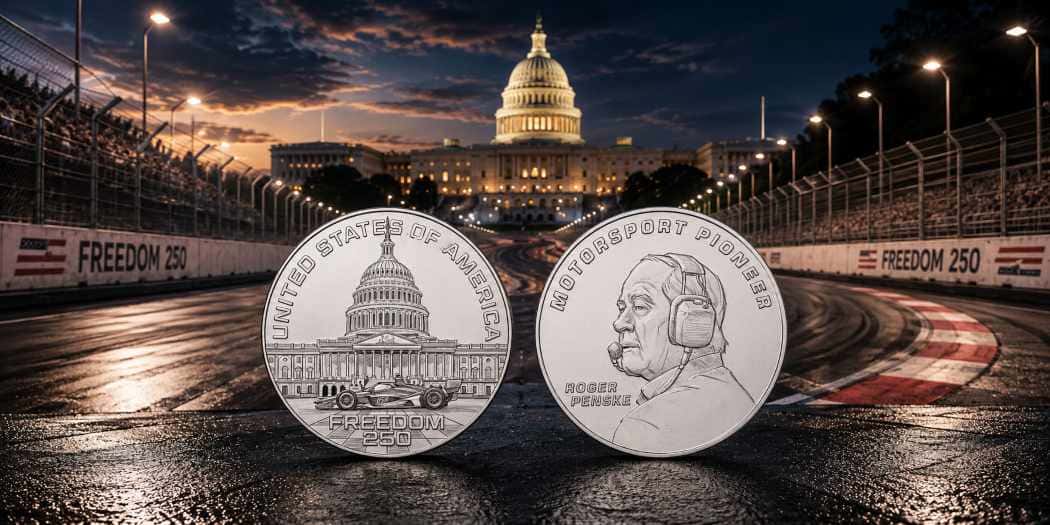
American Motorsports Meets the Semiquincentennial
America's 250th anniversary has produced U.S. Mint collectibles tied to some of the nation's most familiar symbols and traditions. The 2026 Freedom 250 Race Medal takes the Semiquincentennial program in a different direction, commemorating an event created specifically for the anniversary: the first NTT INDYCAR® Series race held on the National Mall in Washington, D.C.
The Freedom 250 Grand Prix brings open-wheel racing to a temporary circuit through the nation's capital, placing modern American motorsports against a backdrop that includes the U.S. Capitol and Washington Monument. The U.S. Mint's accompanying medal captures that unusual pairing through an Indy car and Capitol scene on the obverse and a portrait of motorsports entrepreneur Roger Penske on the reverse. Struck at the Philadelphia Mint with a matte finish, the medal has a maximum mintage of 15,000 pieces.
Rather than simply adding another patriotic design to the year's anniversary offerings, the medal records an event that is itself part of the Semiquincentennial celebration. That gives it a specific place within the Mint's extensive 2026 program and an audience extending beyond traditional numismatics.
A Race Created for America's 250th Anniversary
The story behind the medal begins with the Freedom 250 Grand Prix. President Donald Trump established the event through a January 2026 executive order calling for an INDYCAR street race in Washington as part of the nation's 250th-anniversary celebration. The order directed the Departments of Transportation and the Interior to establish a route showcasing the capital and described the event as the first motor race to be held in Washington near the National Mall.
The resulting circuit measures approximately 1.7 miles and includes seven turns, winding through the National Mall area past some of the country's most recognizable landmarks. Race organizers subsequently extended the competition to 147 laps and 250 miles, giving the distance itself a direct connection to the Semiquincentennial.
That setting is central to what the Mint chose to commemorate. The Freedom 250 is not simply another race receiving a commemorative medal; its location, distance, and creation are tied directly to America's 250th year. The medal consequently serves as a physical record of both a motorsports event and the broader national celebration surrounding it.
The Obverse Brings Speed to the Nation's Capital
The medal's obverse makes the relationship between racing and Washington immediately apparent. An Indy car inscribed with USA dominates the foreground, while the United States Capitol appears behind it. The inscriptions UNITED STATES OF AMERICA and FREEDOM 250 frame the composition.
Pairing the race car with the Capitol gives the design a sense of place that is important to the medal's purpose. A generic racing image could commemorate motorsports anywhere, but the Capitol identifies the event with Washington and reinforces why this particular race belongs within the Semiquincentennial program.
It is also a notably contemporary subject for a U.S. Mint medal. Much of American numismatics looks backward, portraying presidents, military leaders, historical events, monuments, or established national symbols. Here, the Mint is documenting history as it happens, using the medal to preserve an event conceived specifically for the anniversary year.
Roger Penske Represents the Other Side of the Story
The reverse shifts attention from the race itself to Roger Penske, whose portrait appears alongside the inscriptions MOTORSPORT PIONEER and ROGER PENSKE. The choice connects the Freedom 250 with a figure whose career spans several major areas of American motorsports, including team ownership, racing operations, and the broader business of professional competition.
Penske's inclusion also gives the medal a different character from a conventional event souvenir. One side records the setting and spectacle of the Freedom 250, while the other recognizes an individual associated with the development of American racing. Together, the designs broaden the medal's potential interest to collectors of U.S. Mint products, motorsports memorabilia, and pieces associated with America's 250th anniversary.
The contrast works particularly well because the two sides do not attempt to tell the same story twice. The obverse is about movement, location, and the event itself; the reverse provides a human connection to the American motorsports tradition the race is intended to celebrate.
A Copper-Nickel Medal Rather Than a Legal-Tender Coin
Although produced by the U.S. Mint, the Freedom 250 issue is a medal rather than a coin. That distinction matters. Medals do not carry a denomination and are not issued as legal tender, giving Mint artists greater freedom to commemorate people, institutions, and events outside the requirements of circulating or congressionally authorized commemorative coin programs.
The Freedom 250 Race Medal has a matte finish and a composition of 8.33% nickel with the balance copper. It measures 1.205 inches, or 30.61 mm, in diameter, weighs 11.340 grams, and has a plain edge. The medal is produced at the Philadelphia Mint and carries no mint mark.
Those specifications also clarify the nature of the collectible. Despite being a Mint product, it is not precious-metal bullion and should not be evaluated according to gold, silver, platinum, or palladium content. Its appeal instead rests on its design, subject, official U.S. Mint origin, limited production, and connection to an event unique to 2026.
Why the 15,000-Medal Limit Matters
The U.S. Mint has established a 15,000-piece mintage limit for the Freedom 250 Race Medal. As with any modern collectible, a limited mintage does not guarantee future value. Long-term demand depends on factors such as collector interest, availability, condition, and how the event itself is remembered after the anniversary year has passed.
The limit nevertheless gives the medal a clearly defined population and separates it from an open-ended souvenir program. That may be particularly relevant because the potential collector base reaches into several areas. Numismatists may approach it as part of the Mint's Semiquincentennial output, while racing enthusiasts may see it as memorabilia from the first INDYCAR race staged on the National Mall. Collectors building broader America 250 collections have another reason to consider an issue tied to one of the anniversary year's most unusual events.
That crossover is important. The Freedom 250 medal does not need to appeal to every traditional coin collector to establish an identity of its own; its strongest distinction may be the way it connects communities that do not usually collect the same material.
A Different Kind of Semiquincentennial Collectible
The 2026 U.S. Mint program encompasses coins and medals drawing from centuries of American history, but the Freedom 250 Race Medal commemorates something happening for the first time. The Grand Prix transforms streets around the National Mall into a racing circuit, combining a modern sporting spectacle with landmarks that represent much older chapters of the American story. Federal and local sources describe it as the first NTT INDYCAR Series race on the National Mall and part of the official celebration of the nation's 250th anniversary.
That distinction gives the medal a different perspective on the Semiquincentennial. Instead of asking collectors to remember an event from 1776 or revisit an established piece of American iconography, it records how the country chose to celebrate the anniversary in 2026. The Indy car, Capitol, Freedom 250 name, and Roger Penske portrait collectively document a specific moment rather than offering a generalized statement about American history.
For collectors, that may ultimately be the medal's strongest attribute. Decades from now, its imagery will still point directly to the event it was created to commemorate.
Where the Freedom 250 Medal Fits for Collectors
The Freedom 250 Race Medal occupies an unusual intersection of modern U.S. Mint collecting, American motorsports, and Semiquincentennial memorabilia. Its 15,000-piece maximum mintage provides a finite supply, but the more compelling story lies in what those pieces represent: a purpose-built 250-mile race through Washington created as part of America's 250th-birthday celebration.
That makes the medal fundamentally different from the 2026 American Palladium Eagle and other anniversary issues whose roots extend through established coin programs. The Freedom 250 medal begins with an event unique to this year and turns it into an official Mint collectible. Its combination of an Indy car and the Capitol on one side and Roger Penske on the other preserves both the spectacle and the motorsports heritage behind it.
Within a year filled with historically themed numismatic releases, the 2026 Freedom 250 Race Medal offers something distinctly contemporary: a U.S. Mint record of new history being made during America's 250th year.
Image source: U.S. Mint
Trademark Notice: INDYCAR® is a registered trademark of Brickyard Trademarks, Inc. Bullion Exchanges is not affiliated with or endorsed by INDYCAR, Brickyard Trademarks, Inc., or the NTT INDYCAR SERIES.
2 Comments