View Charts
What Is a Privy Mark and Why Do Collectors Care?
 0
0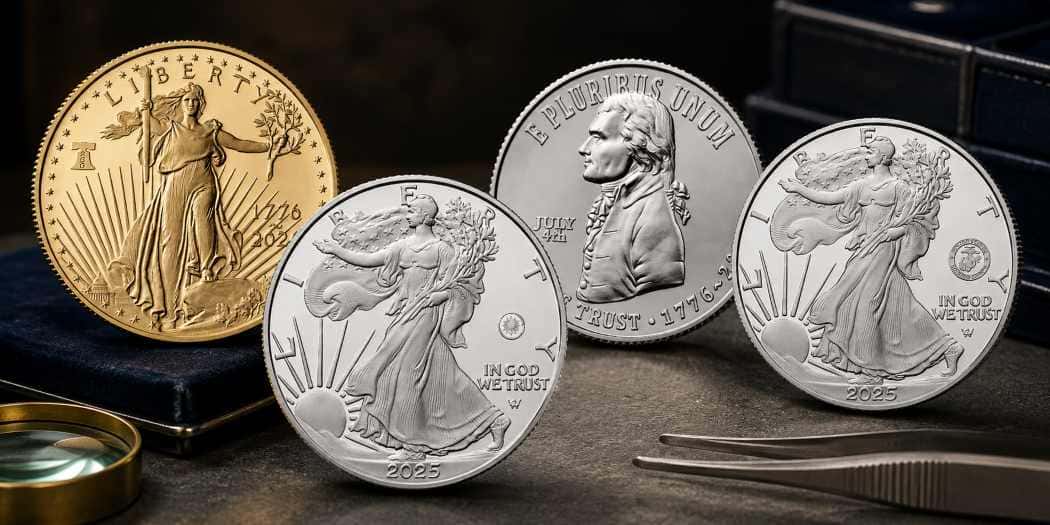
A Small Mark Is Becoming a Bigger Part of U.S. Coin Collecting
One of the most interesting U.S. coins of 2026 looks, at first glance, like ordinary pocket change. The Declaration of Independence quarter was already created for America's 250th anniversary, but 250,000 examples received an additional 'July 4' privy mark and were mixed randomly into circulation. Unlike a commemorative sold only to collectors, these quarters entered the banking system, turning a centuries-old minting device into a nationwide coin hunt.
That experiment captures why privy marks have become increasingly important to modern collectors. A tiny symbol can distinguish one issue from millions of otherwise similar coins, connect it to an anniversary or production method, and create a collectible subtype without replacing the underlying design. Privy marks once communicated practical information about a coin's origin or manufacture. Today, they can also tell a story—and sometimes transform a familiar coin into the version collectors most want to find.
Privy Marks Began as Information, Not Decoration
A privy mark is a symbol or small design added to a coin to communicate something specific about its production, origin, purpose or commemorative context. That makes it different from the main design and, importantly, different from a mint mark. A mint mark such as 'W,' 'S,' 'D' or 'P' identifies the facility associated with a coin's production; a privy mark can convey an entirely different layer of information.
The idea is much older than modern American coin collecting. Mints around the world have used distinctive marks for centuries to identify moneyers, workshops, artists or other aspects of production. The U.S. Mint points to 19th-century silver coins as an early American parallel: arrows placed beside the date in the 1850s and again in the 1870s signaled changes in weight. Contemporary records did not call those symbols privy marks, but they performed much the same informational function.
By the 20th century, the purpose had expanded. Certain early commemoratives used special symbols or devices to distinguish varieties, while later U.S. issues made the privy mark a deliberate part of the collector experience. The mark was no longer merely technical shorthand. It could identify a particular chapter within a larger coin program.
Modern Privy Mark Coins Turn Familiar Designs Into Distinct Issues
The U.S. Mint's recent use of privy marks shows how flexible the concept has become. In 2020, the Mint placed a 'V75' privy mark inside an outline based on the Rainbow Pool at the National World War II Memorial on selected coins honoring the 75th anniversary of the end of World War II. The mark appeared on West Point America the Beautiful quarters released into circulation and on special proof American Eagles.
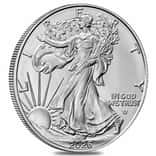
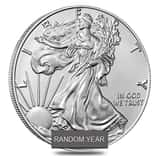
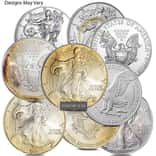
Privy marks have since moved into even more varied territory. The American Innovation $1 Coin Program has used them as a visual thread across changing designs. More recently, a Star privy appeared on a limited-mintage American Silver Eagle bullion issue—the first bullion Silver Eagle to carry a privy mark. Then 2025 brought Proof Silver Eagles honoring the 250th anniversaries of the U.S. Army, Navy and Marine Corps, each distinguished by the appropriate service symbol or emblem.
Another 2025 Silver Eagle demonstrated that a privy does not have to commemorate an institution or anniversary at all. The Mint's first American Eagle Silver Proof Coin produced using laser-engraved master dies carried a sunburst-like laser privy, linking the symbol directly to the technology used in its production. Taken together, these issues show how a small mark can now identify history, affiliation, scarcity, technology or a special distribution strategy.
The 2026 July 4 Quarter Brings the Hunt Back to Pocket Change
America's Semiquincentennial has pushed that strategy into everyday circulation. The Mint is issuing five quarter designs during 2026, but the Declaration of Independence quarter received an especially unusual variant: 250,000 coins bearing a 'July 4' privy mark. They have no mint mark and were randomly mixed with regular Declaration quarters for distribution through banks and financial institutions nationwide.
The distinction is easy to miss but significant. Standard circulating Declaration of Independence quarters do not have the July 4 privy. With only 250,000 special pieces released into a vastly larger pool of circulating coinage, finding one depends on chance rather than ordering the product directly from the Mint. That changes the collector experience. A quarter received in change can suddenly demand the same careful inspection normally reserved for a dealer tray or newly opened Mint shipment.
The program also revives one of coin collecting's simplest attractions: discovery. The Mint's 2020 V75 quarters used a similar circulation model, but the 2026 issue ties the search directly to the nation's 250th anniversary. For established collectors, the mark creates a clearly differentiated variety. For someone who has never purchased a collectible coin, it provides a reason to look twice at a quarter.
Does a Privy Mark Make a Coin More Valuable?
Not automatically. A privy mark creates distinction, but distinction and market value are not the same thing. Collectors still consider mintage, survival, condition, demand, historical importance and the popularity of the underlying series. A relatively available privy-marked issue can remain inexpensive, while a tightly limited version of a widely collected coin may attract a substantial premium.
Context matters just as much as the symbol itself. The 2026 July 4 quarters have an announced production of 250,000, giving collectors a fixed starting point when judging scarcity. Proof Silver Eagles with military or technology-themed privies appeal to a different audience because they combine a major bullion-coin series with limited production and a specific story. Certification can further separate exceptional examples by grade, designation or documented release status, but the holder does not create rarity that the coin itself lacks.
That is why collectors should resist treating 'privy mark' as a synonym for 'valuable.' The better question is what the mark distinguishes and how difficult that particular coin is to obtain. A privy can be one ingredient in collectability; the surrounding issue determines how important that ingredient becomes.
What Collectors Should Check Before Buying Privy Mark Coins
The growing number of modern privy issues makes identification more important, not less. Before buying, confirm what the mark represents, where the coin was struck, its stated mintage or product limit, and whether the privy version differs from a standard issue in finish or distribution. The U.S. Mint is a useful primary reference, particularly when similar-looking coins exist without the mark.
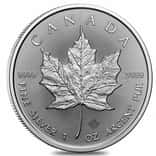
Collectors should also separate numismatic premium from metal value. A privy-marked Silver Eagle still contains the same stated silver weight as the corresponding one-ounce issue, but its market price may reflect scarcity, condition, certification and collector demand in addition to bullion value. Comparing raw and certified silver coins can help show how much of the asking price is attached to grade, designation or provenance rather than the privy alone.
Privy marks work because they reward attention. From weight-change arrows and V75 quarters to military Silver Eagles, laser engraving and a July 4 quarter hiding in circulation, the mark turns a small patch of a coin's surface into evidence of a particular moment. In 2026, that idea feels especially appropriate: collectors are being asked not merely to acquire anniversary coinage, but to notice the history placed directly in their hands.