View Charts
Why the 1804 Silver Dollar Is Called the King of American Coins
 0
0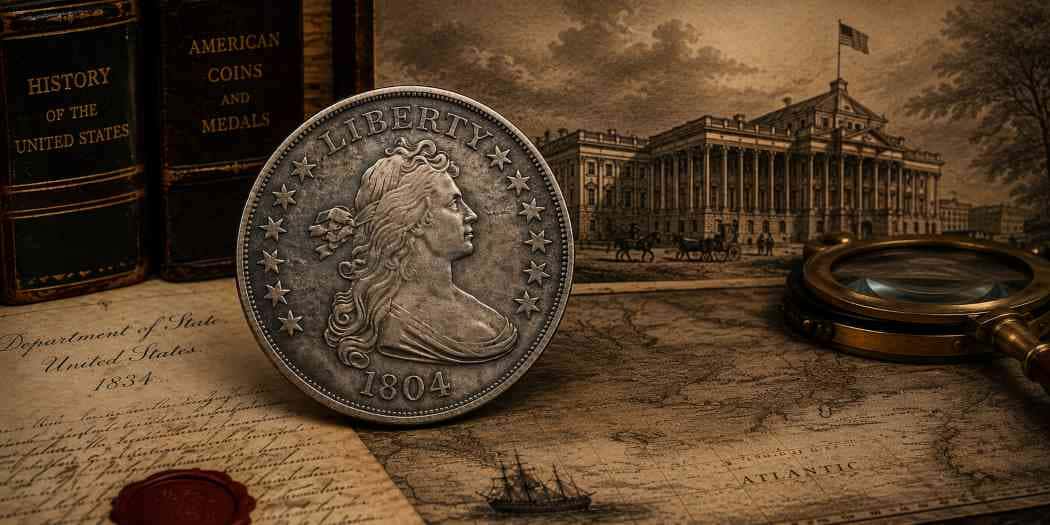
The 1804 Dollar Returns to the Mint—This Time on Purpose
The U.S. Mint has revived one of the most famous dates in American numismatics with the fourth release in its 2026 Best of the Mint series. The new set pairs a high-relief, one-ounce 24-karat gold coin recreating the 1804 Silver Dollar with a one-ounce silver medal inspired by the diplomatic mission behind the original. Limited to 15,000 sets, the release gives collectors a modern encounter with a coin whose reputation has been built on rarity, intrigue and one wonderfully inconvenient fact: the celebrated 1804 Silver Dollar was not struck in 1804.
That contradiction is central to the coin’s appeal. The 1804 dollar is not simply one of the rarest silver dollars in U.S. numismatics; its history reaches from the recordkeeping practices of the early Philadelphia Mint to Andrew Jackson-era diplomacy, unauthorized restrikes and modern multimillion-dollar auctions. Sixteen examples are now known, yet the story behind those coins has been unfolding for nearly two centuries.
The Mint Made Dollars in 1804, Just Not 1804 Dollars
Mint records appear, at first, to make the story straightforward. They report 19,570 silver dollars struck during calendar year 1804. One might reasonably expect at least a few to survive bearing that date. None do.
The explanation lies in the working practices of the early Mint. Dies were expensive and laborious to make, and usable dies did not automatically become obsolete when the calendar changed. The dollars delivered in 1804 were apparently struck from dies dated 1803. Silver dollar production then stopped, leaving no contemporary 1804-dated dollar to enter circulation. The Draped Bust Dollar, with Robert Scot’s portrait of Liberty and heraldic eagle reverse, effectively disappeared from production.
Three decades later, that mundane accounting detail produced an extraordinary result. Government records said dollars had been made in 1804. When officials needed an 1804 dollar, they relied on the records rather than on a surviving coin. The date that had never appeared on a circulating dollar was about to become one of the most famous dates in American collecting.
A Diplomatic Gift Creates a Numismatic Rarity
In 1834, the Jackson administration prepared special sets of American coins for presentation to foreign rulers as part of diplomatic missions intended to expand U.S. trade. The sets required examples of the nation's coinage, including a silver dollar. Because Mint records identified 1804 as the last year of dollar production, new dies were prepared bearing that date.
Eight of these coins, struck in 1834 and 1835, are known today as Class I 1804 dollars. They were not counterfeits, nor were they ordinary circulation coins made thirty years late. They were official Mint products created for presentation purposes. Examples were included in diplomatic sets intended for such recipients as the King of Siam and the Sultan of Muscat, giving the coins an international history almost from the moment they were made.
The misunderstanding over the date had therefore created something unprecedented: an official U.S. coin that looked backward three decades while serving a contemporary diplomatic purpose. Once collectors became aware of the issue, its combination of official status, tiny population and mysterious origins proved irresistible.
Then the 1804 Dollar Story Became Stranger
The eight diplomatic pieces might have been enough to secure the 1804 dollar’s fame. But in the late 1850s, additional examples were struck at the Philadelphia Mint without official authorization, creating the Class II and Class III dollars and adding another layer to the mystery.
The single known Class II specimen has a plain edge and was struck over an 1856 Swiss Shooting Thaler. It is now held by the Smithsonian Institution. Class III examples were also produced from the later dies, but with edge lettering added separately; some were artificially worn, apparently to make them look as though they had circulated. For generations, six Class III pieces were known, bringing the accepted population of all 1804 dollars to 15.
Then the census changed. In 2025, a previously unrecorded Class III dollar from the collection of James A. Stack, Sr. emerged publicly. Graded PCGS Proof-65, it became the 16th known 1804 Silver Dollar and the seventh Class III example. When sold in December 2025, it realized $6 million, setting a new auction record for the issue. The discovery was particularly striking because this is not an obscure series with an uncertain census; the 1804 dollar has been scrutinized by generations of specialists. Even the King of American Coins, it turned out, could still produce a surprise.
How the 1804 Dollar Became the “King”
Rarity alone does not explain the title. There are American coins with fewer known examples, yet few have accumulated the mythology of the 1804 Silver Dollar. Its status developed early in organized U.S. coin collecting. By the 1880s, numismatic literature and auction catalogs were already describing it as the “king” of American rarities, and celebrated dealer B. Max Mehl helped cement “King of American Coins” in the numismatic vocabulary during the 20th century.
The coin had everything the growing hobby valued: extreme rarity, a dramatic date, famous owners, mysterious origins and a connection to the U.S. Mint itself. Unlike many rare silver dollars, its scarcity was not the result of a tiny ordinary mintage followed by heavy circulation or melting. The 1804 dollar was unusual from the beginning. The Class I pieces existed because of a historical misunderstanding and diplomatic initiative; the later restrikes existed under very different and more questionable circumstances.
Prices followed the fame. Individual specimens have repeatedly occupied the top tier of the U.S. rare-coin market, including a Class I example that sold for $7.68 million in 2021 and the newly revealed Class III coin that brought $6 million in 2025. Those figures measure collector demand, but they also reflect something harder to quantify: ownership of an 1804 dollar means possessing one of the artifacts around which American numismatic culture was built.
Best of the Mint Brings the Story Full Circle
The 2026 Best of the Mint 1804 Silver Dollar set turns that history back on itself. The original Class I dollars were retrospective creations, made in the 1830s with an 1804 date because officials were reconstructing an earlier chapter of U.S. coinage. Nearly two centuries later, the Mint is deliberately revisiting the same design for America's 250th anniversary—this time with no ambiguity about when or why it was struck.
The gold coin recreates the Draped Bust Liberty obverse and heraldic eagle reverse, while a Liberty Bell “250” privy mark identifies it with the Semiquincentennial. Its companion silver medal takes a more interpretive approach, drawing on the diplomatic journey that gave the original rarity its reason for existing. That pairing is fitting. The 1804 dollar became the King of American Coins not because of silver content or even rarity alone, but because the circumstances surrounding its creation became inseparable from the coin itself.
Few dates illustrate the difference between a rare coin and a legendary one as clearly as 1804. The number on the coin is historically misleading, yet it is also the source of the entire story. What began as an interpretation of old Mint records produced diplomatic gifts, unauthorized restrikes, generations of scholarship and some of the most valuable coins in America. The new Best of the Mint release cannot reproduce that history—and that is precisely why the originals remain kings.
Related reading you may find interesting:
The 1905 Indian Head Cent Struck on a Gold Planchet
Rare 1796 Half Dollar Sells for $671,000: What Makes It So Valuable?
7 U.S. Coins Whose Rarity Changed Long After They Were Minted