View Charts
The 1905 Indian Head Cent Struck on a Gold Planchet
 0
0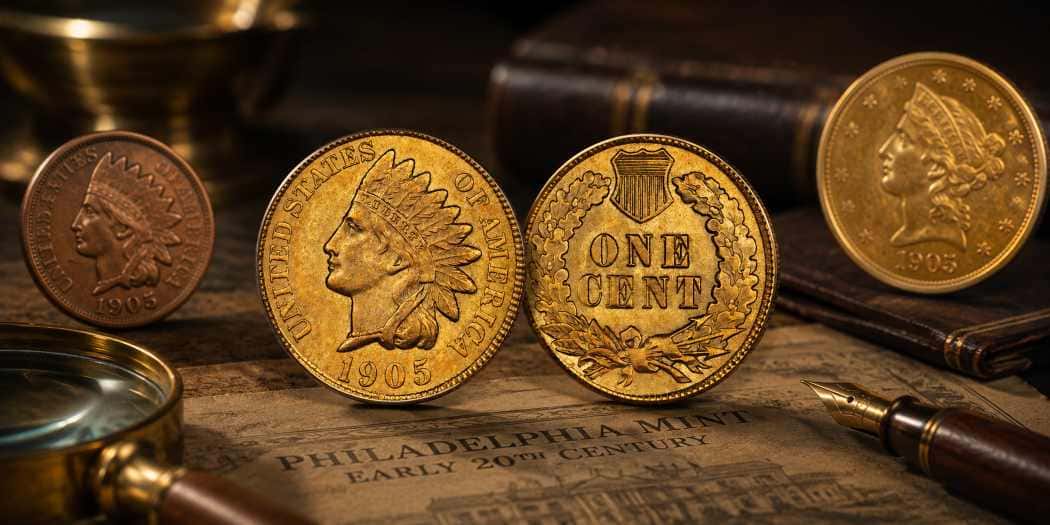
A Penny That Should Never Have Been Gold
At first glance, the 1905 Indian Head cent struck on gold seems almost impossible. The Philadelphia Mint produced more than 80 million Indian cents that year, normally using bronze planchets weighing 3.11 grams. Yet at least two surviving 1905 cents were struck on gold planchets intended for an entirely different denomination: a $2.50 Liberty Head Quarter Eagle.
For years, only one 1905 example was known. Graded MS64 by PCGS, it weighs 64.5 grains, the standard weight of a Quarter Eagle planchet. Heritage Auctions described the coin as the sole gold Indian cent known of the date when it appeared at auction.
That census has now changed. A second 1905 Indian Head cent struck on a gold planchet has recently been discovered and graded MS62 by PCGS. Significantly, the newly discovered coin also weighs 64.5 grains, exactly matching the standard Quarter Eagle planchet weight. The MS62 specimen has not yet been offered at auction.
The discovery makes an already remarkable wrong-planchet issue even more intriguing. Gold planchets were valuable, carefully controlled pieces of Mint stock, not blanks that should casually wander into a cent press. Other Indian cents struck in gold are known, and their existence has fueled a long-running debate: are these spectacular pieces genuine production mistakes, or were some deliberately created inside the Mint for collectors?
The Planchet Tells a Different Story
A normal 1905 Indian Head cent provides the baseline. Designed by James B. Longacre, the bronze coin measures about 19 millimeters and weighs 3.11 grams. The gold blanks beneath the extraordinary 1905 errors correspond instead to the contemporary Liberty Head Quarter Eagle, a Christian Gobrecht design struck on an 18-millimeter planchet weighing 4.18 grams, or 64.5 grains.
That one-millimeter difference helps explain the errors' distinctive appearance. Because a Quarter Eagle planchet was smaller than a cent blank, it could not receive the complete Indian Head cent design. On the previously known MS64 specimen, the strike is also slightly off-center. Portions of the peripheral lettering and design are consequently absent or weak, while enough of Longacre's familiar portrait, date and reverse remains to make the intended cent dies unmistakable.
The metal is equally revealing. A 1905 Quarter Eagle was 90% gold and 10% copper, with an actual gold weight of roughly 0.1209 troy ounce. The errors therefore combine the dies of a one-cent coin with the physical foundation of a circulating U.S. gold denomination worth 250 times as much at face value.
Their modern significance, however, has almost nothing to do with that gold content. The value lies in the circumstances of the strikes—and in the mystery of how two Quarter Eagle-weight gold planchets came into contact with Indian Head cent dies.
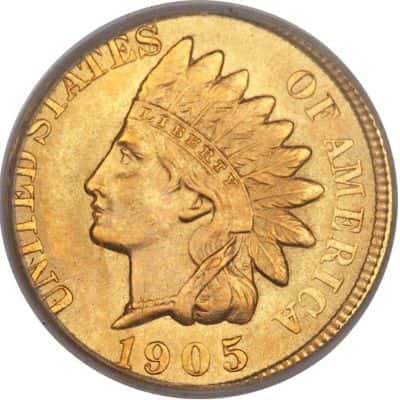
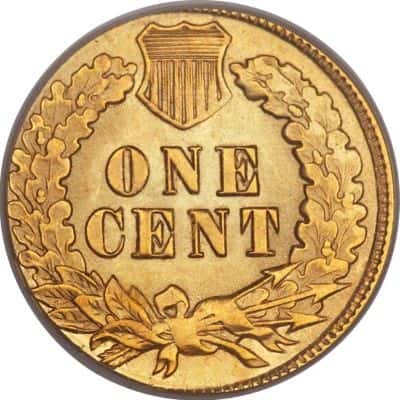
Image source: Heritage Auctions
A Second 1905 Gold Cent Changes the Census
For years, the accepted census of gold Indian Head cents included five examples: three dated 1900, one dated 1905 and one dated 1906. The newly discovered PCGS MS62 1905 example changes that count. Two 1905 gold cents are now known, bringing the established census to six confirmed pieces.
The new coin is especially notable because it weighs 64.5 grains, exactly the same as the previously known PCGS MS64 specimen and the standard weight of a Quarter Eagle planchet. By comparison, Heritage reported weights of 65.8 grains and 67.12 grains for two of the 1900 examples, while another was recorded at 61.6 grains. The known 1906 gold cent weighs 64.4 grains. The two 1905 pieces therefore stand out for matching the Quarter Eagle standard precisely, strengthening the physical case that they were struck on properly prepared $2.50 gold planchets.
Those measurements still do not resolve the larger question of intent. Numismatist Andrew W. Pollock III questioned whether some gold Indian cents, particularly the 1900 pieces, were accidental errors at all, suggesting that deliberate production for collectors was also possible. The second 1905 example adds another data point to that debate without settling it.
Error, Pattern, or a Mint Employee's Curiosity?
Wrong-planchet errors are straightforward in principle: a blank intended for one denomination enters a press fitted with dies for another. In ordinary coin production, such mistakes can happen. Gold coinage, however, was subject to much tighter controls because the planchets themselves carried substantial value and were closely regulated by weight.
That makes the existence of two 1905 cents struck on full-weight Quarter Eagle planchets especially difficult to explain. There is no surviving account identifying who placed the gold blanks into the cent press or whether it happened accidentally. Their physical characteristics make the Quarter Eagle-planchet identification convincing, but they cannot tell us why the strikes occurred.
The second example therefore sharpens rather than solves the mystery. If the coins were accidental, the same extraordinary mistake happened at least twice. If they were deliberately made, the discovery suggests that more than one 1905 specimen was produced outside normal coinage channels. Either possibility places them far outside routine Mint production.
The MS64 Specimen's Six-Figure Auction Trail
While the newly discovered PCGS MS62 specimen has not yet been offered at auction, the previously known MS64 has a substantial auction history. It realized $253,000 in Heritage's January 2010 FUN Signature Auction. Heritage offered it again in January 2015 without a sale, after which it returned to auction on April 23 and realized $123,375. At Heritage's Long Beach sale on September 17, 2015, it brought $105,750.
Those results illustrate how differently the market treats the gold-planchet error from an ordinary 1905 Indian Head cent. Philadelphia struck more than 80 million conventional cents that year, but the gold pieces belong to an entirely different category, valued for the extraordinary circumstances of their production rather than their precious-metal content alone. The MS62 discovery now introduces a second 1905 specimen into that market, though without an auction appearance there is not yet a public price record for comparison.
That combination also creates a potential naming confusion. Because the errors are Indian Head cents struck on Quarter Eagle planchets, collectors may naturally picture the later Indian Head Quarter Eagle. That gold coin, however, did not debut until 1908. In 1905, the $2.50 Quarter Eagle still carried Christian Gobrecht's Liberty Head design. The errors are therefore more precisely understood as Longacre Indian Head cents struck on gold planchets prepared for Liberty Head Quarter Eagles.
Collectors interested in the period can still encounter surviving pre-1933 U.S. gold coins, including Liberty Head Quarter Eagles, without entering the six-figure error market. The 1905 gold cents occupy a separate niche, where their significance comes from the improbable intersection of cent dies and Quarter Eagle planchets.
The Mystery Is Part of the Coins
Many famous rarities are important because few were minted or few survived. The 1905 gold Indian cent coins are compelling for a different reason: they preserve physical evidence of something that should not have happened, while leaving the circumstances behind it unresolved.
The discovery of the PCGS MS62 example changes a central fact about the issue. The MS64 is no longer unique by date. Two 1905 examples are now known, and both weigh exactly 64.5 grains, providing a remarkably consistent link to standard Quarter Eagle planchets. Their size, weight and incomplete cent designs make clear what happened mechanically. What remains unknown is whether the hand that put the gold planchets beneath those cent dies did so accidentally.
That unanswered question separates these pieces from ordinary wrong-planchet curiosities. The two known 1905 Indian Head cents struck in gold are simultaneously mint errors, pieces of pre-1933 American gold history and numismatic mysteries. More than a century after they left the Philadelphia Mint, collectors can establish what they are with remarkable precision. Why they exist remains the far more intriguing question.