View Charts
7 U.S. Coins Whose Rarity Changed Long After They Were Minted
 0
0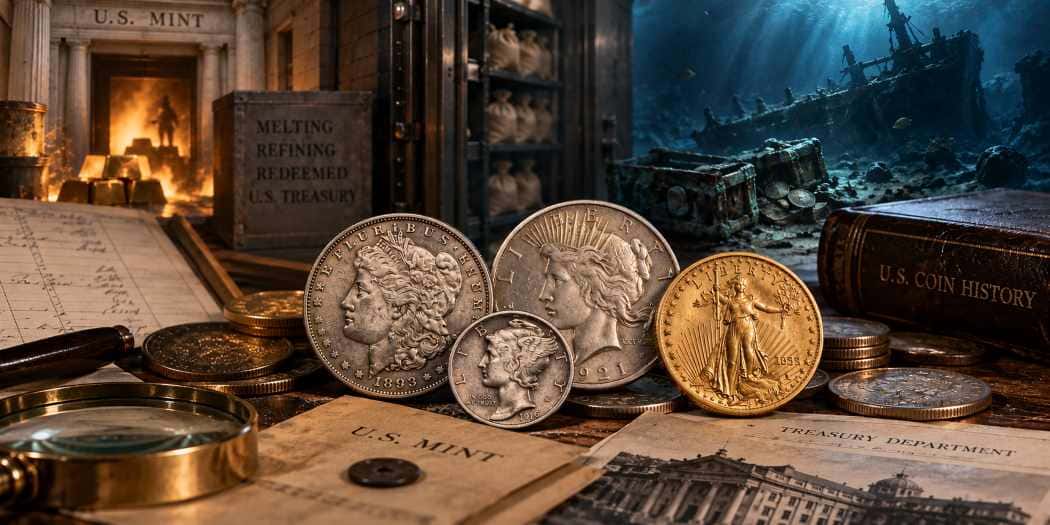
A Mintage Number Is Only the Beginning
Nearly three million 1931 Saint-Gaudens Double Eagles were struck at the Philadelphia Mint. Today, PCGS estimates that only about 100 to 120 survive. The 1903-O Morgan Dollar experienced almost the opposite transformation: once considered a formidable rarity, it became far more available when bags of previously inaccessible coins emerged from Treasury vaults.
Those stories expose the weakness in judging a coin by its original mintage alone. Production records tell us how many pieces were made—not how many entered circulation, escaped melting, survived decades of use, remained in high grade, or waited undiscovered in vaults and shipwrecks. For collectors, modern U.S. coin rarity is the product of everything that happened after the presses stopped.
1. The 1931 Double Eagle: Nearly Three Million Became About 100
Philadelphia struck 2,938,250 Saint-Gaudens Double Eagles in 1931, yet almost the entire production remained concentrated in Treasury storage as everyday use of $20 gold pieces was disappearing. According to PCGS research, none of the year's enormous output was distributed to the Federal Reserve Bank.
That concentration became decisive after federal gold policy changed in 1933. Stored coins could be destroyed far more easily than pieces already dispersed into private hands. Mint records cited by PCGS indicate that only 310 examples had been made available to collectors, and roughly 100 to 120 are now estimated to survive. The original mintage never changed; the population available to future collectors did.
2. The 1933 Double Eagle: Minted Does Not Always Mean Released
The 1933 Double Eagle pushes that distinction further. The Philadelphia Mint struck 445,500 pieces, but changes in federal gold policy intervened before they could enter normal circulation. The U.S. Mint states that none were issued or released to the public as legal tender, and nearly the entire production was subsequently ordered melted. Two examples were lawfully transferred to the Smithsonian Institution, while other pieces left the Mint without authorization and became the subjects of investigations, recoveries, and decades of litigation.
Today, 12 surviving 1933 Double Eagles are publicly documented. Eleven belong to the U.S. government, including the two Smithsonian specimens and nine held in Mint custody. Only one surviving example is legal for private ownership: the coin recovered in 1996 and later monetized and formally issued by the Mint under a unique legal settlement before its 2002 auction.
That extraordinary survival pattern makes the 1933 Double Eagle one of the clearest demonstrations that mintage and collectible availability are fundamentally different measurements. Hundreds of thousands of coins can leave the presses, yet almost none need ever reach collectors. For anyone interpreting historical mintage figures, the number struck is therefore only the beginning of the story.
3. The 1893-S Morgan Dollar: Decades of Attrition
The 1893-S Morgan Dollar followed a less dramatic path. Its original mintage of 100,000 was already the lowest among business-strike Morgan Dollars, but the coins were distributed rather than remaining almost entirely protected in government storage. From there, ordinary history took over. Coins circulated, became worn or damaged, were lost, and disappeared through later melting and attrition.
PCGS estimates that fewer than 10,000 examples now survive in all grades, with the population contracting sharply in Mint State and Gem condition. Unlike the 1931 and 1933 Double Eagles, no single event created this disparity. The 1893-S demonstrates how rarity can develop gradually, one disappearing or deteriorating coin at a time.
4. The 1916-D Mercury Dime: Before Collectors Knew What to Save
Collector behavior can reshape survival as well. Denver produced only 264,000 Mercury Dimes in 1916, but people spending those dimes did not have the hindsight modern collectors possess. Many entered commerce and accumulated wear before the 1916-D became firmly established as the series' famous key date.
PCGS estimates roughly 10,000 survivors across all grades but only about 100 at MS60 or better. The disparity demonstrates why a low mintage does not automatically produce a large population of well-preserved coins. When collectors recognize and protect an issue can matter almost as much as how many pieces were originally struck.
5. The 1921 Peace Dollar: The Coin Survived, but the Grade Didn’t
Sometimes the important loss is not the coin itself but its condition. The Philadelphia Mint produced 1,006,473 High Relief Peace Dollars in 1921, and PCGS estimates approximately 100,000 still survive. Yet only about 5,000 are estimated at MS65 or better.
That is condition rarity. Decades of handling, contact marks, circulation, storage, and other impairments can leave an issue readily obtainable overall but substantially scarcer at higher grades. It is why collectors evaluating certified coins must sometimes ask not simply how many examples survive, but how many survive in the condition they are seeking.
Up to this point, history has steadily reduced or narrowed our coin populations. But rarity can also move in the opposite direction.
6. The 1903-O Morgan Dollar: When a Rarity Came Back
For decades, the 1903-O Morgan Dollar appeared far scarcer than its 4.45 million-piece mintage suggested. Many coins were believed to have been destroyed under the Pittman Act, while an unknown quantity remained quietly stored in government vaults. Mint State examples became sufficiently elusive that the issue developed a formidable reputation among Morgan Dollar collectors.
Then Treasury bags began appearing in the early 1960s. Large quantities of previously inaccessible 1903-O dollars entered collector hands, overturning assumptions built over decades. PCGS now estimates approximately 445,000 survivors, including about 90,000 in Mint State. The coin had not suddenly become more numerous. Collectors had discovered that the surviving supply was much larger than the visible market had suggested.
7. The 1857-S Double Eagle: Thousands Return From the Ocean
The 1857-S Double Eagle offers an even more dramatic example of hidden supply. San Francisco struck 970,500 pieces during the California Gold Rush era, but high-grade survivors were considered difficult to obtain for generations.
Then came the recovery of the S.S. Central America, which sank in 1857 while carrying California gold eastward. PCGS records 5,193 recovered 1857-S Double Eagles, including many Uncirculated pieces. The wreck had effectively preserved an inaccessible population underwater for more than a century.
Those coins were never missing from the surviving population in a literal sense. They were missing from the market. Their eventual recovery demonstrates why survival and availability are not necessarily the same thing.
What Mintage Cannot Tell a Collector
Together, these coins reveal several different paths from original production to modern rarity. Government melting devastated the surviving populations of the 1931 and 1933 Double Eagles. Circulation and delayed preservation affected the 1893-S Morgan and 1916-D Mercury Dime, while the 1921 Peace Dollar shows how scarcity can develop within a particular grade even when many coins remain.
The final two examples turn that progression around. Treasury releases revealed that the 1903-O Morgan was not nearly as scarce as collectors had believed, while the S.S. Central America returned thousands of 1857-S Double Eagles to a market that had never counted on seeing them.
Survival estimates are therefore valuable, but they are not immutable. They incorporate certification data, auctions, historical research, known collections, and expert judgment rather than representing a literal census of every existing coin. New discoveries can change that evidence.
For collectors, the more useful questions extend well beyond how many coins were minted: How many were released? What happened to them afterward? How many survive today? And how many remain in the condition being sought?
The U.S. Mint's production ledger records the beginning of a coin's supply story. History writes everything that comes after.