View Charts
Why Is Most of the World’s Platinum Mined in South Africa?
 0
0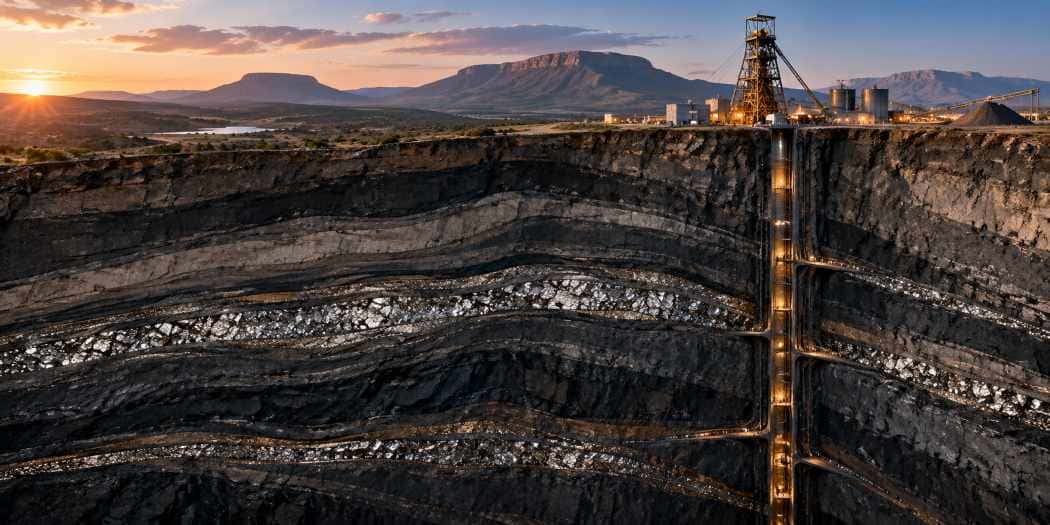
Platinum’s supply map was drawn by geology
If the world could choose where to mine platinum, it probably would not concentrate roughly 70% of annual production in one country. Yet that is effectively what geology has done. The latest U.S. Geological Survey data estimate that South Africa produced 120 metric tons of platinum in 2025 out of a world total of about 170 metric tons. Russia, the second-largest producer, supplied only 20 metric tons.
The reason is buried beneath northern South Africa. The Bushveld Complex contains an extraordinary concentration of platinum-group elements, or PGEs, assembled by magmatic processes roughly two billion years ago. Its scale created something unusual in mining: enormous mineralized horizons that can be followed across long distances and worked through multiple generations of mines.
That geological inheritance explains both platinum’s abundance underground and its vulnerability above ground. The world has substantial platinum resources, but many of its most economically important deposits occupy the same mining district. Understanding platinum supply therefore begins not with commodity markets, but with how the Bushveld formed.
A vast magma chamber created the Bushveld’s platinum reefs
The Bushveld Complex is a layered mafic-to-ultramafic intrusion, the remnant of an immense body of magma that cooled and crystallized underground. As minerals formed under changing chemical and physical conditions, they accumulated in distinct layers. Certain horizons became unusually enriched in platinum, palladium, rhodium and other PGEs. USGS identifies the Bushveld as one of only three geological features associated with almost all reported global PGE production and identified resources, alongside Zimbabwe’s Great Dyke and Russia’s Norilsk-Talnakh deposits.
Within the Bushveld, three names matter especially: the Merensky Reef, UG2 Reef and Platreef. The Merensky and UG2 are laterally extensive but often remarkably narrow ore bodies. Historical USGS research describes UG2 as generally only 0.6 to 1.5 meters thick and lying roughly 25 to 400 meters below the Merensky Reef. Platreef, located on the northern limb of the complex, is different. Mineralization can be much thicker, making mechanized and, where geometry permits, open-pit mining more practical.
This is why the answer to where platinum is mined cannot be separated from ore geology. Platinum deposits are not distributed evenly through Earth’s crust. The unusual processes needed to concentrate PGEs into economically recoverable quantities happened at exceptional scale in the Bushveld.
A platinum mine is really a multi-metal operation
The geology also complicates the idea of “platinum mining.” PGEs tend to occur together rather than in isolation. Ore from the Bushveld can contain platinum, palladium, rhodium, ruthenium, iridium and osmium, alongside metals such as nickel and copper. The exact mixture varies by reef and location.
That means miners do not simply decide how many ounces of platinum they want to produce and extract them independently. The economics of a mine depend on the combined value recovered from its particular ore body. Palladium, rhodium, chrome and base-metal prices can therefore affect the profitability of operations whose output ultimately contributes substantial platinum to world markets.
This co-production helps explain why platinum supply can respond slowly to a higher platinum spot price. A price increase may improve the economics of an existing operation, but miners cannot instantly isolate richer platinum material or change the geological proportions of metals underground. Expanding output may require new shafts, processing capacity and years of capital investment.
The effect is visible in current supply data. The World Platinum Investment Council expects global mine supply to remain broadly flat at about 5.55 million ounces in 2026, even after platinum’s substantial price appreciation during 2025. Its latest forecast expects modest South African gains to be offset by declines elsewhere; growth in total platinum supply is instead expected to come from recycling.
The richest geology does not make mining easy
The Bushveld’s enormous resource base can obscure a harder reality: having platinum underground is not the same as producing it cheaply. Much of South African PGM mining is underground because the narrow Merensky and UG2 reefs continue to considerable depths. USGS has estimated that underexplored extensions of stratabound Bushveld PGE deposits may extend to depths of three kilometers.
Depth changes the economics. Shafts must move workers, equipment and ore underground and back to surface. Mines require ventilation, cooling, pumping and extensive safety systems. Narrow ore bodies can also limit mechanization because extracting more surrounding waste rock dilutes the valuable material sent for processing. Mature mines may become progressively more expensive as accessible sections are exhausted and operations move deeper or farther from established infrastructure.
These pressures are not theoretical. The USGS reported that South African PGM production declined an estimated 9% in 2025, citing declining palladium prices, higher costs associated with deep-level mining and continuing electricity-supply disruptions.
The power situation has since improved substantially. Eskom reported in March 2026 that South Africa had gone more than 280 consecutive days without a supply interruption, apart from 26 hours of load shedding during April and May 2025. That improvement matters for mines, concentrators and smelters, but it does not erase the structural dependence of an energy-intensive mining industry on reliable electricity.
Why one mining district matters to the whole platinum market
Geographic concentration becomes economically important when geology and infrastructure overlap. South Africa does not merely possess large platinum resources; it also supplies most of the newly mined platinum entering the market each year. Zimbabwe contributes another important share from the geologically distinctive Great Dyke. Together, southern Africa occupies an exceptional position in primary platinum supply.
According to USGS, the Bushveld also contains the world’s largest PGM resources and reserves. Its 2026 assessment places South African PGM reserves at approximately 63 million kilograms, compared with more than 76 million kilograms identified globally in its country table. The constraint is therefore not simply that platinum is about to disappear underground. It is that bringing those resources to market requires functioning mines, power, processing facilities, skilled labor, transportation and sustained capital investment in a relatively concentrated region.
That distinction helps explain why platinum supply can remain tight even when known resources are enormous. A geological resource measures what exists; annual mine production measures what the industry can economically extract and process now. Those are very different quantities.
Recycling provides some geographic diversification because spent autocatalysts, jewelry and industrial material can be collected outside major mining regions. Bullion Exchanges’ examination of PGM recycling and secondary supply shows why recovered metal has become an increasingly important counterweight to concentrated mine production. WPIC currently expects recycling to provide all of the increase in total platinum supply forecast for 2026.
Platinum’s concentration cannot easily be engineered away
Other countries do mine platinum. Russia, Zimbabwe, Canada and the United States all contribute to global output. But duplicating South Africa’s position is not simply a matter of opening more mines elsewhere. A competing region first needs a sufficiently large and concentrated ore body, then the economics, infrastructure, permitting, processing expertise and investment required to develop it.
The Bushveld’s dominance is therefore more durable than a conventional market concentration created by corporate decisions. Companies can relocate factories; geology cannot relocate an ore body. Even substantial price increases do not manufacture another Bushveld Complex.
For investors following platinum supply, that changes what deserves attention. South African electricity reliability, mine investment, shaft closures, processing interruptions and the economics of the broader PGM basket are not peripheral mining stories. They influence the rate at which the world’s largest geological concentration of platinum becomes usable metal.
That is the deeper answer to why most platinum comes from South Africa. The country does not dominate because other nations have overlooked the metal. It dominates because a rare sequence of geological events concentrated PGEs on a scale that has few parallels anywhere on Earth. Modern mining inherited that geological map—and the global platinum supply chain still has to live with it.