View Charts
Why Did the U.S. Mint Create Pattern Coins?
 0
0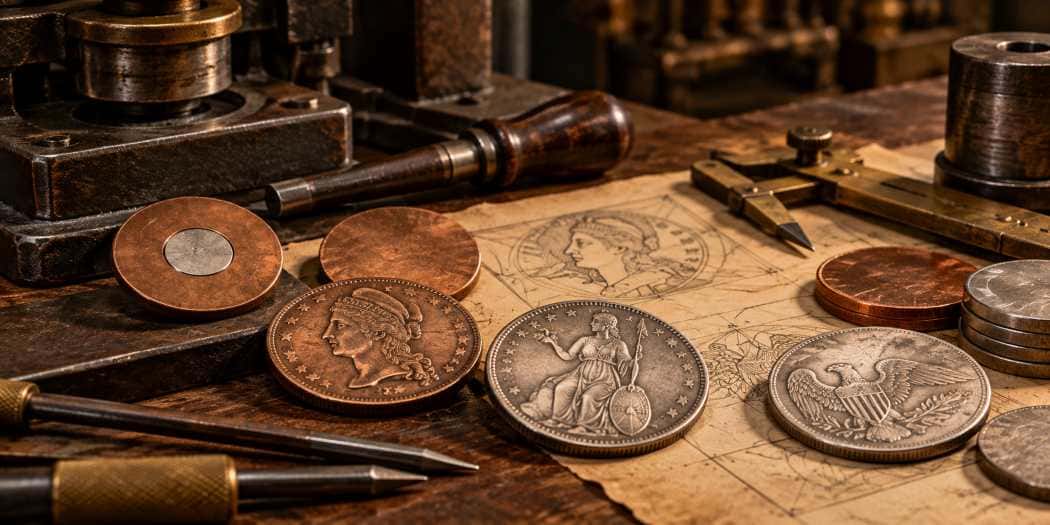
The Coins America Almost Used
Before Americans could spend a new coin, the United States Mint sometimes had to answer a more basic question: would the proposed coin work? An unfamiliar design might satisfy an engraver but fail to strike consistently. An alloy could reduce expenses yet create manufacturing problems. A denomination could make sense on paper and prove unwieldy in someone's pocket.
These experiments left behind pattern coins, pieces struck to evaluate a proposed design, composition, denomination, size, or production method. Some anticipated familiar circulating issues; others preserve decisions that government officials ultimately rejected. Reading them as miniature design proposals reveals something regular coins rarely show: the choices and compromises behind American money.
A Silver Plug in a Copper Cent
The problem was apparent almost immediately. The Coinage Act of 1792 established a decimal coinage system and specified that the cent contain enough copper to represent one cent's intrinsic value. The resulting copper blank was large, roughly 28 millimeters in diameter. Finding sufficient copper was difficult, too, making a small denomination surprisingly troublesome to manufacture.
The U.S. Mint's account of the 1792 silver-center cent describes a striking response. Chief Coiner Henry Voigt made a substantially smaller copper cent with a hole at its center. A plug of silver supplied most of the intended metallic value, allowing the surrounding copper to be reduced. The Mint also experimented with a copper-silver alloy. These were not damaged ordinary cents; their unusual construction was the purpose of the experiment.
The concept did not become the standard American cent. Combining two metals in a small coin posed complications, and copper cents eventually entered circulation in 1793. Yet the surviving proposals preserve an argument about money that the adopted cent cannot: how closely should a minor coin's metal value match its stated value when material costs and everyday convenience pull in different directions?
That underlying tension did not disappear. The Mint's later decisions about the cent's composition and dimensions arose from different circumstances, explored in how changing metal costs reshaped U.S. coins. A pattern, however, captures the testing stage before a solution becomes official policy.
Design Trials Could Shape a New Series
A pattern did not have to be a radical object. Sometimes the question was simply which portrait, eagle, inscription, or relief level should represent the country. Engravers could prepare competing dies and strike examples for examination by Mint officials and other decision-makers. The rejected candidate might look like a fully finished coin because evaluating its appearance required a convincing physical sample.
During the nineteenth century, changing denominations and technology created repeated opportunities for trials. The Gobrecht silver dollars of the 1830s became especially influential in bringing experimental coinage to wider notice. Later, proposals surrounding the smaller cent reflected the effort to replace a bulky copper denomination with something less costly and easier to carry. Flying Eagle and Indian Head designs emerged amid that process, though pattern examples and regular issues must be identified separately.
The distinction matters when a prototype resembles a familiar collectible. An experimental strike may feature recognizable national imagery, yet differ in its metal, reverse design, lettering, or intended function. A piece resembling a production coin is not necessarily a circulation strike, and unusual appearance alone does not establish pattern status. Attribution depends on specific dies, manufacturing evidence, and documented references.
The classic literature assigns many United States patterns Judd numbers, named for the catalog developed by J. Hewitt Judd. Specialists use those identifiers to separate closely related trials that otherwise share dates or general descriptions. For collectors accustomed to recognizing classic American coin rarities, that classification provides an additional layer: one proposed design can survive in several experimental compositions, each requiring independent identification.
Sometimes the Presses Rejected the Idea
The most revealing failures are not always artistic. A striking press must transfer a design into metal rapidly and consistently, and a beautiful model can be difficult to reproduce at production speed. Relief—the height of a coin's raised features—affects how readily metal fills a die's recesses under pressure. Deep designs can demand more force or repeated strikes than ordinary commerce permits.
The Peace Dollar offers an instructive twentieth-century case. Its original high-relief appearance gave the design a sculptural presence, but the Mint pursued modifications to make production practical. In 1922, George T. Morgan prepared a modified high-relief experiment; according to NGC's research on a surviving 1922 pattern, thousands of experimental pieces were struck before officials adopted a more extensively reduced relief.
This is a different sort of failure from the 1792 silver-center cent. There, the problem concerned a denomination's value and materials. With the Peace dollar, an appealing artistic treatment collided with the demands of high-volume manufacturing. Both cases show why working metal specimens provided evidence that drawings and written specifications alone could not supply.
They also caution against assuming that a rejected pattern represents inferior artistry. The production requirement may have changed, the cost calculation may have failed, or officials may have preferred a more practical alternative. Rejection often tells us more about the constraints confronting the Mint than about the artistic merits of the design.
The Complicated Journey From Mint Trial to Collectible
Pattern coins were not always preserved through a neat public release. Some remained in official collections, others were destroyed, and some entered private hands through exchanges or channels that were far less transparent than modern collectors might expect. That history complicates both authenticity and provenance.
Demand for unusual Mint pieces expanded in the nineteenth century. Collectors became interested not only in legitimate experiments but also in restrikes and pieces produced chiefly to satisfy numismatic demand. The NGC overview of early U.S. patterns describes how production for interested collectors grew alongside the Mint's own cabinet-building efforts. Consequently, an old experimental-looking coin must not automatically be accepted as a contemporary official design proposal.
A serious attribution asks when the piece was actually struck, why its dies were made, how many examples are known, and whether a documented chain of ownership exists. Die varieties, metallic composition, weight, and comparisons with established specimens can help. A reputable certification or reference attribution is valuable, but it should still be read carefully: labels such as pattern, die trial, experimental piece, and restrike convey different histories.
Scarcity alone does not establish a reliable price. Some patterns are known from only a handful of examples, yet demand differs dramatically among designs and denominations. Condition, historical importance, market exposure, and verified provenance can affect realized values. The Collector's Vault offers a view of how historic coins can attract buyers for reasons extending far beyond the metal they contain.
What an Unadopted Coin Can Still Tell Us
The completed U.S. Mint circulating coin records the decision that won. Its pattern counterparts document the arguments that were considered and discarded: cheaper materials, smaller dimensions, alternate national symbols, or a relief that stretched the equipment too far. Without surviving experiments, those questions could disappear behind the finished design.
That makes patterns unusually revealing primary objects for numismatic research. They should be studied with the same care given to ordinary issues, with additional attention to their purpose and sometimes uncertain route into private ownership. A visitor encountering a proposed cent or dollar in a collection is seeing more than a rarity. They are seeing an attempt to solve a real problem before the country knew which solution it would choose.