View Charts
8 Times Metal Prices and Shortages Changed U.S. Coins
 0
0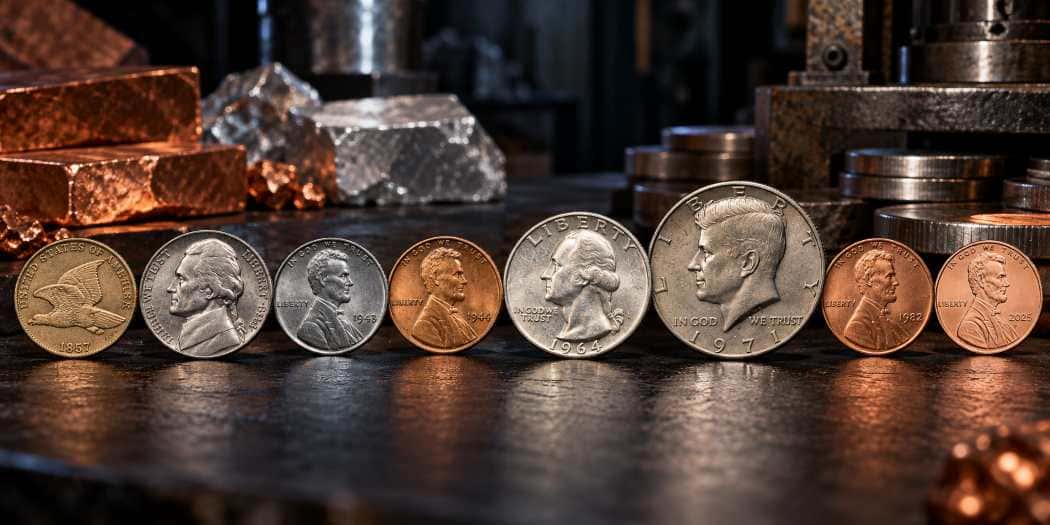
America’s Pocket Change Has Always Followed the Metals
America’s pocket change has never been completely separate from the metals market. Copper, nickel and silver have all been reduced, removed or replaced when war, rising commodity prices or production economics made an established composition difficult to maintain.
The familiar 1943 steel cent is the best-known example, but it belongs to a much longer history in which the availability and cost of metal influenced what Americans carried in their pockets. In 2025, that story reached a new endpoint: rather than changing the cent’s metal again, the U.S. Mint ended production of the circulating penny.
1. Rising Copper Costs Helped Shrink the Cent in 1857
Early U.S. cents were large because copper represented a meaningful part of their value. By the 1850s, however, rising copper costs made the traditional large cent increasingly impractical. Congress discontinued the half cent and authorized a much smaller cent in 1857, with the new Flying Eagle cent struck from 88% copper and 12% nickel.
The composition changed again in 1864, when the cent moved to a bronze alloy dominated by copper. It established a pattern that would recur for more than a century: when metal economics no longer suited a denomination, the coin could change. The U.S. Mint’s historical overview traces this progression from the early copper cent through its later composition changes.
2. World War II Took Nickel Out of the Nickel
The five-cent piece normally contained 75% copper and 25% nickel, but World War II turned nickel into a strategic material. Congress authorized a temporary replacement alloy, and from 1942 through 1945 the five-cent coin was struck from 56% copper, 35% silver and 9% manganese.
The change produced an unusual result: a base-metal denomination gained precious-metal content because nickel had become more important to the war effort. Large mint marks above Monticello identified the new composition, and Philadelphia used a “P” mint mark for the first time.
3. Copper Conservation Created the 1943 Steel Cent
Copper faced its own wartime pressure. Needed for ammunition, electrical equipment and other military uses, it was removed from the regular cent in 1943 and replaced with zinc-coated steel. The result was a pale, magnetic Lincoln cent unlike the bronze pieces Americans were accustomed to using.
More than a billion steel cents were produced, so ordinary examples are not rare. The famous exception is the small number of 1943 cents accidentally struck on bronze planchets left in the production system. Bullion Exchanges recently examined one such 1943 bronze cent after its authentication following decades in the same family.
4. Copper Returned in 1944 Through Wartime Recycling
The steel experiment lasted only through 1943. Copper-colored cents returned the following year, but wartime conservation had not simply disappeared. Recovered copper from spent cartridge cases contributed to the material used for cents as production shifted back toward the familiar appearance.
Together, the 1943 and 1944 cents show two responses to scarcity: substitution followed by recovery and reuse. Rare 1944 steel errors provide the mirror image of the 1943 bronze cent, with leftover planchets from the outgoing composition accidentally surviving into the next year. Contemporary Mint records confirm that the emergency zinc-coated steel cent was discontinued after 1943 and traditional copper-colored cents returned in 1944.
5. Silver Economics Ended 90% Silver Dimes and Quarters
By the early 1960s, the United States faced a growing coin shortage while demand and prices put pressure on government silver supplies. For generations, circulating dimes, quarters and half dollars had been struck in 90% silver, but maintaining that system was becoming increasingly difficult.
The Coinage Act of 1965 replaced silver in dimes and quarters with copper-nickel clad compositions built around copper cores. Half dollars moved to 40% silver instead of abandoning the metal immediately. The transition created a dividing line that still matters to bullion buyers: pre-1965 dimes and quarters remain sought after for their 90% silver content and make up much of the market commonly called 90% or “junk” silver.
6. Silver Left the Circulating Half Dollar in 1971
The Kennedy half dollar survived the 1965 transition with reduced precious-metal content, but only temporarily. The 1964 issue contained 90% silver; half dollars dated 1965 through 1970 used a 40% silver composition. Beginning in 1971, regular circulating halves moved to copper-nickel clad. The U.S. Mint records 1971 as the point when circulating U.S. coins no longer contained silver.
The progression happened in stages: dimes and quarters lost their silver first, while the half dollar retained a reduced amount for several more years. What had been an ordinary feature of American circulating money for generations had effectively become a dividing line between older precious-metal coinage and modern clad coins.
7. Copper Prices Changed the Cent Again in 1982
The cent eventually returned to the same problem that had reshaped it in the 19th century. Higher copper prices made a copper-rich one-cent coin increasingly uneconomical, prompting experiments with alternatives, including an aluminum cent in 1974 that never entered regular circulation.
The lasting change came in 1982. The Mint shifted from a composition containing 95% copper to a copper-plated zinc cent containing 97.5% zinc and only 2.5% copper. Both compositions appeared in 1982. The switch also showed the limits of solving a low-denomination cost problem through composition: the cent could retain its familiar copper appearance while containing very little copper, but the underlying production economics had not disappeared.
8. In 2025, Production Costs Finally Ended the Circulating Penny
More than four decades after the zinc transition, changing the cent’s composition was no longer enough. The cost of manufacturing a penny had climbed from 1.42 cents a decade earlier to 3.69 cents, while the Mint estimated that roughly 300 billion pennies were already in circulation. Economic and production factors, combined with changing consumer behavior, ultimately made continued circulating production unsustainable.
On November 12, 2025, the U.S. Mint held a ceremonial strike in Philadelphia for the final circulating one-cent coin, ending a 232-year production run. Existing pennies remain legal tender, while limited numismatic production continues for collectors.
That makes 2025 different from the earlier seven episodes. There was no zinc or copper shortage forcing an emergency substitute. Instead, the economics that had repeatedly changed the cent—shrinking it in 1857 and reducing its copper content in 1982—eventually contributed to ending circulating production altogether.
Metal Markets Leave Their Mark on Coin History
The pattern is not simply one of ever-cheaper metals. At different moments, national security, supply constraints, intrinsic value and manufacturing cost carried different weight. What links the episodes is the same practical question: does the metal inside a circulating coin still make sense for the job the denomination is expected to perform?
Wartime scarcity drove the nickel and steel-cent changes; silver supply and monetary pressures reshaped dimes, quarters and half dollars; copper economics repeatedly altered the cent. By 2025, production cost and declining practical need had become more important than finding yet another metal formula.
A wartime nickel, steel cent, pre-1965 silver quarter or copper-rich Lincoln cent is therefore more than an older version of a modern coin. Its metal records something about the economic or political environment in which it was struck. Transitional errors make those boundaries even more visible when a planchet from the outgoing composition accidentally reaches the presses after specifications have changed. Bullion Exchanges’ guide to valuable U.S. Mint error coins explores why some of those accidental survivors became major numismatic rarities.
The cent provides the clearest long-term arc. Rising copper costs helped shrink it in 1857; wartime demand replaced copper with steel in 1943; metal economics pushed it toward zinc in 1982; and in 2025, circulating production ended. Wars pass and commodity markets change, but U.S. coins can preserve those pressures in metal for generations.