View Charts
What Is a Coin Die Clash and How Can You Recognize One?
 0
0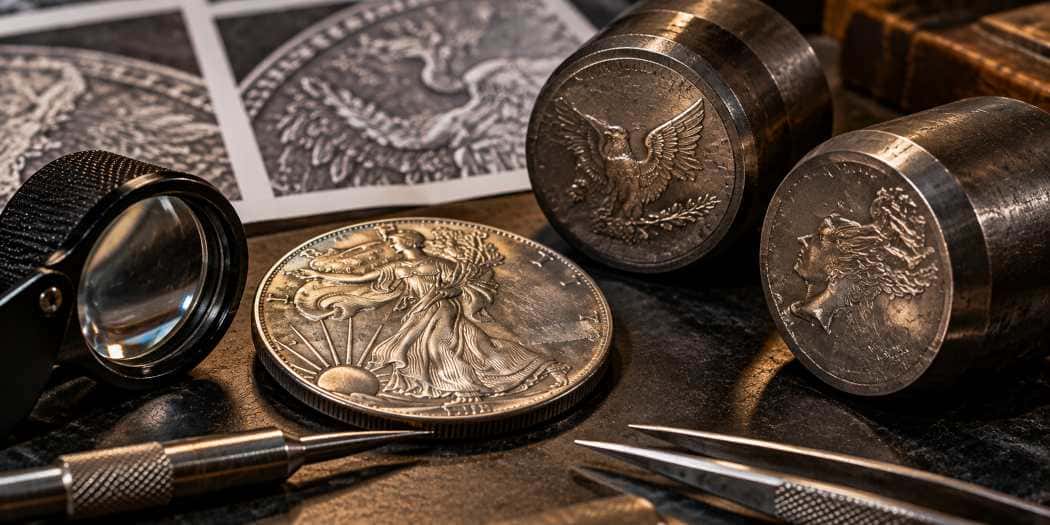
A Design That Appears on the Wrong Side
A silver eagle's feathers appear behind Liberty's figure. Benjamin Franklin seems to have grown an extra tooth. On another coin, faint lettering intrudes into an otherwise empty field. All three may trace to the steel dies that struck the coins.
A die clash occurs when the obverse and reverse dies collide without a coin blank, called a planchet, separating them. The impact can impress parts of one die's design into the other. Coins subsequently struck by the altered dies may carry those misplaced details. To identify one, collectors must establish where a mark originated.
The Collision Happens Before the Coin Is Struck
In normal operation, two hardened dies press designs into opposite faces of a planchet. The dies contain recessed, mirror-image versions of the finished coin's raised devices. When the feed mechanism fails to place a blank between them, the dies can meet directly. Raised portions of one die may contact the relatively flat field areas of its partner, leaving a shallow impression.
That transfer changes the striking tools themselves. When minting resumes, the altered die may impress an unintended design trace on multiple coins. The mark is made during a later strike. This distinguishes clashes from circulation damage.
The transferred trace is not usually a miniature second coin design. Relief and die geometry restrict which features can touch, and ordinary production may weaken evidence of the collision. Mint workers sometimes polish clash marks away, removing parts of the die's field and potentially changing the appearance of subsequent strikes. A die can also clash more than once, complicating attribution when several impressions overlap.
The important diagnostic is a relationship between the extra feature and the opposite die's actual design. Because the two dies face each other in a particular orientation, a suspected fragment should occupy a predictable location when the reverse is mentally aligned with the obverse. Random surface lines do not become clashes simply because they resemble letters or feathers.
Three Documented Examples Reveal Different Clues
One familiar example comes from the Franklin half dollar. Certain 1955 and 1956 pieces show a protrusion at Benjamin Franklin's mouth, commonly nicknamed the Bugs Bunny variety. The explanation is mechanical, not a redesigned portrait: contact involving the reverse eagle's wing affected the obverse die. PCGS documents the variety, including its distinctive appearance and the importance of correct attribution. Its subtlety makes comparison images indispensable.
A much more extensive clash appears on a 2016 American Silver Eagle certified by NGC as MS 69. NGC's examination of the coin identifies transferred eagle-feather details and fragments of the reverse motto visible on the obverse. The grading service described the specimen as an exceptionally dramatic clash for a U.S. bullion coin. Here the transferred design is substantial enough to demonstrate what happened inside the press without requiring a collector to interpret a single ambiguous line.
Even among ordinary circulating coins, clashing varies greatly in significance. NGC's educational materials show a 1913-S Type 1 Buffalo nickel with routine chin-whisker clash marks that add no appreciable value, and an 1888-O Morgan dollar whose transferred letter forms part of a recognized VAM variety. The same mechanical failure can produce very different collector premiums.
For a practical comparison, Bullion Exchanges' modern U.S. rarities selection includes an NGC-certified 1995 Silver Eagle identified as a clashed-die mint error. Attribution matters, but an unusual mark alone does not justify a comparable premium.
A Better Examination Starts With Position, Not Price
Place the coin under a consistent light and examine both sides without rubbing or cleaning the surfaces. Moderate magnification helps, but begin by identifying the normal design elements before chasing tiny anomalies. A photograph of an ordinary example from the same date and design provides a baseline: the reader needs to see what should be present before deciding what has been added.
Then locate the suspected clash and compare it with the reverse design. Does a curved mark coincide with part of a wing, portrait, or lettering once the die relationship is considered? Does the trace appear in a relatively open field where opposing raised elements could have contacted the die? Several aligned fragments support a hypothesis more convincingly than an isolated scratch. Certified close-up photographs offer a useful reference because reflected light can make a shallow mark look stronger or weaker.
A true die-origin feature may recur on coins struck from the same damaged die pair, though progressive polishing or wear can make later impressions less obvious. Matching marks on independently photographed specimens can therefore help confirm a variety. Collectors should note the exact date, mintmark, side, and placement, and preserve clear images rather than editing contrast until a mark resembles the expected shape.
Compare the result with documented quarter errors and varieties, including clashed-die examples, but remember that a familiar nickname is not a diagnostic test. Reconstruct how the press could have produced it.
Why Scratches, Doubling, and Die Cracks Cause Confusion
A scratch made after minting cuts into an already struck coin; it does not reproduce an identifiable element from the opposite design in a predictable position. Random gouges, contact marks, corrosion, and cleaning lines may cross devices indiscriminately. Such marks differ from die-transferred features shared across specimens.
Doubled dies have a different origin. Their doubled devices result from misregistration during the die-making process, not a collision between opposing striking dies. Machine doubling occurs during striking and usually creates a flatter, shelf-like duplication of existing details. Neither normally transfers a recognizable element from the opposite face into an unrelated field. Likewise, a die crack produces a line where fractured die steel allows metal to flow; its shape follows the break, not the reverse design.
The distinction is especially important on coins marketed as spectacular mint errors. Bullion Exchanges' earlier survey of valuable U.S. Mint errors includes the Bugs Bunny half dollar, but a general list cannot establish the authenticity of an individual coin. Close comparison, appropriate attribution guides, and professional examination become increasingly important as the claimed premium rises.
The Mark May Be Real Without Being Rare
The discovery of a clash is only the beginning of valuation. Its prominence, the number of surviving examples, collector recognition, grade, and any accepted variety attribution all influence demand. Routine clashes can be inexpensive curiosities, whereas dramatic, well-documented examples may attract specialists. Compare completed sales, not asking prices.
For unfamiliar pieces, document the evidence before submitting them for grading. Preserve the original surfaces, photograph both faces, record exactly which details appear transferred, and compare the proposed identification with authoritative images. Valuable candidates warrant independent authentication.
A good clash attribution is ultimately an explanation, not a guess. When the supposedly misplaced line maps to the opposite die's design, the coin preserves evidence of a brief mechanical failure that continued to shape later strikes. That reconstruction is what turns a curious surface mark into a defensible numismatic finding.