View Charts
The Industrial Uses of Gold Beyond Jewelry and Investment
 0
0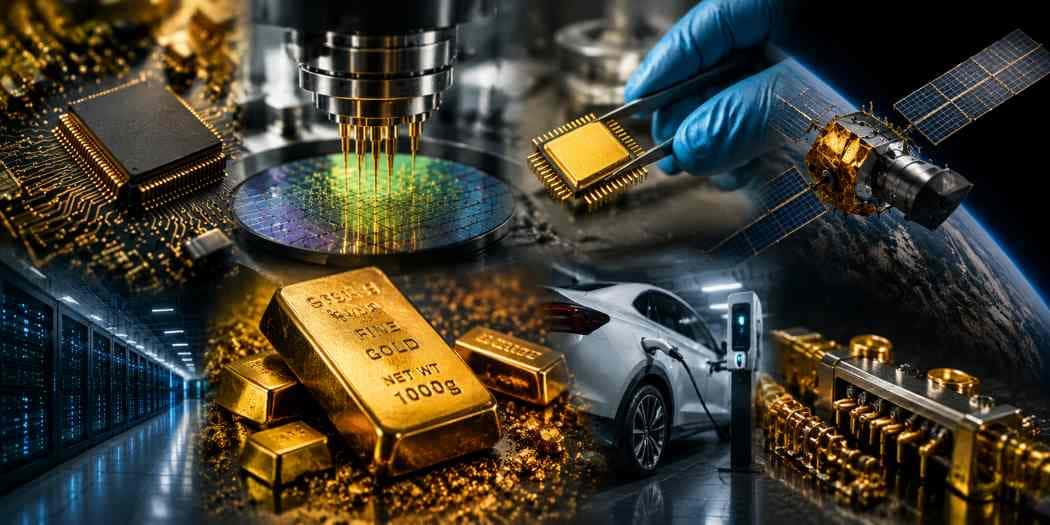
Gold’s Role in Modern Industry Is Expanding Beyond Its Monetary Identity
Gold’s reputation has long been anchored in its monetary and ornamental value, yet that framing increasingly underestimates its importance inside modern industrial systems. Beneath the surface of bullion markets and investment demand, a quieter but structurally significant layer of consumption continues to develop across electronics, semiconductors, aerospace engineering, and advanced computing infrastructure.
What makes this shift particularly relevant in 2026 is not simply the growth of industrial usage, but the nature of that usage. Gold is no longer confined to legacy applications where it serves as a luxury input. Instead, it is embedded within precision-driven environments where failure tolerance is effectively zero. This distinction has gradually repositioned gold as a functional industrial material that also happens to carry monetary value, rather than the reverse.
At the same time, this industrial layer exists alongside a more visible investment market that is driven by macro forces such as interest rates, inflation expectations, and central bank demand. The interaction between these two layers creates a dual-identity structure that few other commodities share at the same scale.
Electronics Manufacturing Continues to Anchor Industrial Gold Demand
One of the most established non-financial uses of gold remains within electronics manufacturing, where its conductivity and resistance to corrosion make it difficult to replace in high-reliability environments. While the actual quantities used in each device are small, the scale of global electronics production turns marginal usage into a structurally relevant demand stream.
Gold appears in connectors, bonding wires, switches, and plating applications where signal integrity must remain stable over long periods. These components are often invisible to end users, yet they play a critical role in ensuring that devices function consistently under thermal and mechanical stress. In many cases, substitution is technically possible but introduces tradeoffs that manufacturers are reluctant to accept in high-performance systems.
What is particularly notable is that electronics demand does not behave like traditional commodity cycles. It is tied more closely to technological adoption curves than to macroeconomic expansion alone, which gives it a different rhythm compared to investment-driven flows in bullion markets.
Semiconductor Manufacturing Has Become a High-Precision Demand Channel
The semiconductor industry represents one of the most technically demanding applications for gold, even if it does not account for the largest volume of consumption. Within chip production, gold is used in bonding wires and microscopic interconnects where stability and precision matter more than cost efficiency.
As chip architectures become more complex, especially in AI-related computing systems and high-performance data processing, the tolerance for signal degradation continues to narrow. This environment reinforces the role of gold in select components where long-term reliability outweighs substitution economics.
Unlike broader industrial commodities, semiconductor-related gold demand is not directly visible in end-product pricing. Instead, it is embedded within supply chains that prioritize performance continuity. This makes it less sensitive to short-term price fluctuations and more dependent on long-term technological investment cycles.
Aerospace and Advanced Engineering Depend on Reliability Under Stress
Aerospace applications introduce another dimension to gold demand, where performance requirements are defined by extreme environmental conditions rather than scale. In these systems, gold is used in electrical contacts, thermal management components, and specialized coatings designed to maintain functionality under stress.
The aerospace sector does not consume gold in large volumes relative to global investment demand, but its usage is strategically significant. Components used in satellites, spacecraft, and high-altitude systems must operate reliably for extended durations without maintenance access, which elevates the importance of corrosion resistance and signal stability.
This creates a demand profile that is less cyclical and more structural. Even during broader industrial slowdowns, aerospace-related consumption tends to remain relatively stable due to long development and deployment timelines.
Data Centers and AI Infrastructure Are Reshaping Indirect Gold Consumption
A more recent layer of industrial demand is emerging through data centers and artificial intelligence infrastructure. While these systems do not consume gold in large visible quantities, they rely on high-density electronic components where gold is embedded in connectors, circuit interfaces, and power distribution systems.
The expansion of AI-driven computing has accelerated hardware deployment cycles, leading to more frequent infrastructure upgrades. Over time, this increases both primary demand for electronic components and secondary recovery streams as older systems are retired.
The key dynamic here is indirect influence. Data centers do not drive gold demand in isolation, but their rapid scaling contributes to broader electronics consumption patterns that ultimately feed into industrial gold usage. This relationship is gradual rather than immediate, which makes it difficult to observe in short-term market data but meaningful over longer cycles.
Gold vs Silver Industrial Consumption Reveals Structural Differences
Comparing gold with silver highlights a fundamental difference in industrial behavior. Silver is heavily exposed to volume-driven demand from solar energy, photovoltaics, and industrial manufacturing, making its price more sensitive to economic cycles and physical throughput.
Gold, by contrast, operates in a narrower but more precision-focused set of applications. Its industrial demand is not driven by bulk usage but by performance-critical requirements where substitution is limited. This creates a more stable but less visibly expanding demand profile.
The contrast between the two metals reflects their broader market identities. Silver behaves more like an industrial input with cyclical sensitivity, while gold maintains a hybrid structure where industrial demand acts as a stabilizing layer beneath a dominant financial market narrative.
Substitution Pressure Has Not Eliminated Gold’s Industrial Role
Despite ongoing efforts to reduce costs in manufacturing, substitution away from gold has been gradual rather than disruptive. Alternative materials such as copper and aluminum have replaced gold in certain applications, particularly where performance thresholds are less stringent.
However, in environments where reliability is critical, substitution often introduces risks that outweigh marginal cost savings. This is particularly evident in aerospace systems, semiconductor bonding, and high-performance electronics, where failure rates must remain extremely low.
As a result, gold has not been displaced from industrial usage. Instead, it has become more selectively deployed, concentrated in areas where its physical properties remain difficult to replicate.
Industrial Demand Adds Depth to Gold’s Long-Term Market Structure
While investment demand continues to dominate short-term gold spot price action, industrial usage contributes an important structural layer to gold’s long-term profile. It reinforces the idea that gold is not solely a monetary asset but also a functional material embedded within modern technology systems.
This dual role does not typically drive day-to-day volatility, but it does influence long-term demand stability. As electronics, aerospace, and computing infrastructure expand, they reinforce baseline consumption levels that exist independently of financial market cycles.
In this context, industrial demand should not be viewed as a competing narrative to investment demand, but rather as a parallel layer that supports gold’s relevance across both economic and technological systems.
Precision Demand Over Volume Expansion
Looking ahead, industrial gold consumption is unlikely to experience explosive growth in volume terms. Instead, its importance lies in precision-driven applications that continue to evolve alongside technological complexity.
As manufacturing systems become more advanced, the requirements for stability, conductivity, and durability will remain central to material selection. Gold’s role in these environments is therefore more likely to persist in targeted applications rather than expand broadly across new categories.
This creates a long-term structure where gold maintains relevance not through scale, but through necessity in high-performance environments.
Related reading you may find interesting:
How Much Gold and Silver Does the Average Investor Own?