View Charts
The Greatest Gold Hoards Ever Unearthed
 0
0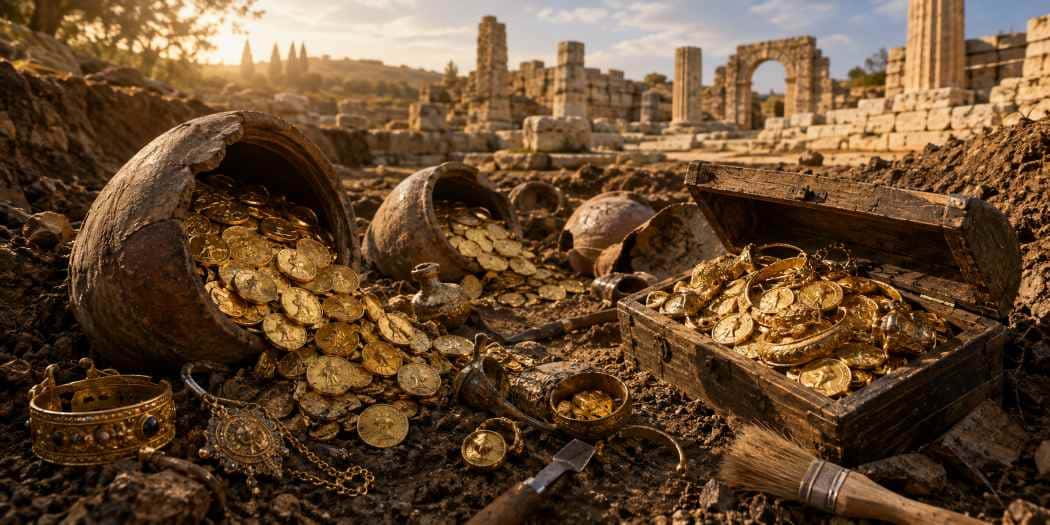
Some Treasures Were Never Meant to Be Found
Gold hoards rarely began as treasures. More often, they started as desperate decisions.
Throughout history, merchants, rulers, soldiers, and ordinary families buried their wealth to protect it from invading armies, political upheaval, piracy, or theft. Many expected to return once the danger had passed. Instead, wars ended differently than anticipated, kingdoms disappeared, trade routes shifted, and entire communities vanished, leaving their hidden fortunes untouched beneath fields, forests, riverbanks, and even city streets.
Centuries later, these forgotten caches have become some of archaeology's most remarkable discoveries. Every unearthed hoard tells two stories at once: the dramatic circumstances that led someone to conceal immense wealth and the accidental moment when it finally returned to daylight. Together, they offer an unusually personal glimpse into history, revealing not just how people lived, but what they valued enough to hide.
For modern bullion investors, these discoveries also reinforce something remarkably consistent across civilizations. Whether buried during the Roman Empire or tucked beneath a California oak tree in the nineteenth century, gold has remained a trusted store of wealth long after governments, currencies, and political systems changed.
Buried Gold Often Changes More Than History Books
The excitement surrounding a gold discovery usually begins with headlines announcing its estimated value. Archaeologists, however, are often interested in something far different.
A well-preserved hoard can answer questions that written records cannot. Mint marks identify where coins were produced. Wear patterns reveal how widely they circulated. The mixture of currencies shows trade relationships between distant regions, while accompanying jewelry, weapons, or religious artifacts help reconstruct the lives of the people who concealed them.
The Staffordshire Hoard, discovered in England in 2009, illustrates that difference perfectly. Although celebrated for its extraordinary collection of Anglo-Saxon gold and silver artifacts, the find transformed historians' understanding of early medieval craftsmanship, warfare, and royal patronage. Rather than representing accumulated wealth alone, the objects provided evidence of cultural and political relationships that had remained largely speculative.
Other discoveries have challenged long-held assumptions about commerce. Roman coin hoards uncovered across Europe have helped historians map trade networks stretching hundreds of miles beyond imperial centers, demonstrating how extensively gold circulated despite political instability.
In many cases, the greatest value of a buried hoard isn't measured in ounces—it lies in the historical questions it finally answers.
The Discoveries That Continue to Fascinate Collectors
Few modern discoveries captured public attention like California's Saddle Ridge Hoard. In 2013, a couple walking their property noticed the edge of a rusted metal container protruding from the ground. What followed became one of the largest known discoveries of buried U.S. gold coins, with more than 1,400 Liberty Head and Double Eagle coins hidden inside eight decaying cans.
Unlike ancient archaeological finds, the Saddle Ridge Hoard reminded collectors that remarkable discoveries are still possible today. Many of the coins remained in exceptional condition after spending well over a century underground, and their preservation sparked renewed interest in nineteenth-century American gold coinage.
Shipwrecks have produced equally extraordinary recoveries. The S.S. Central America, which sank during a hurricane in 1857 while transporting California Gold Rush treasure, yielded thousands of gold coins, bars, and ingots when explorers located the wreck more than a century later. Beyond its enormous bullion value, the discovery preserved a unique snapshot of America's rapidly expanding economy during the Gold Rush era.
Across the Atlantic, Poland's Środa Treasure revealed another kind of historical fortune. Hidden during political unrest in the fourteenth century, the collection included spectacular medieval gold coins, jewelry, and royal regalia believed to have connections with the Luxembourg dynasty. Rather than representing a pirate's cache or forgotten savings, it offered historians rare insight into medieval European nobility, diplomacy, and craftsmanship.
Each discovery differs in age, location, and circumstance, yet they all share one defining characteristic: gold survived where much else did not.
Why Gold Endures While Empires Fade
Gold has outlasted every civilization that buried it.
Unlike iron, bronze, or silver, gold resists corrosion, allowing coins and bullion to emerge from the ground centuries later with much of their original brilliance intact. That physical durability helps explain why ancient hoards remain so captivating, but it is only part of the story. Gold has also maintained its purchasing power across radically different political and economic systems. The rulers whose portraits appear on many buried coins may be forgotten, yet the metal itself continues to command value.
That continuity distinguishes gold from nearly every form of wealth throughout history. Paper currencies become obsolete, governments collapse, and financial systems evolve, but an ounce of gold remains an ounce of gold regardless of when—or where—it is discovered.
Collectors often appreciate historic hoards for their rarity and provenance, while investors see a broader lesson. Across thousands of years, people repeatedly reached the same conclusion during periods of uncertainty: tangible assets that cannot be created at will offered the greatest sense of security. The reasons for burying gold have changed over time, but confidence in the metal has remained remarkably consistent.
Even modern bullion reflects that legacy. Today's investment-grade gold bars and sovereign bullion coins may never become archaeological discoveries, yet they are purchased for many of the same reasons that inspired someone centuries ago to conceal their wealth beneath the ground.
Treasure Hunting Has Entered the Modern Age
The romantic image of stumbling across a chest of gold still captures the imagination, but most significant discoveries today result from patience, technology, and careful research rather than luck alone.
Metal detectors have become increasingly sophisticated, helping hobbyists locate coins and artifacts buried well beyond the reach of earlier equipment. Archaeologists now employ technologies such as ground-penetrating radar, aerial imaging, and LiDAR to identify promising sites without disturbing the landscape, while underwater exploration has transformed the search for historic shipwrecks carrying precious cargo.
Finding buried gold, however, is only the beginning. Ownership laws differ widely around the world, and many countries require historically important discoveries to be reported immediately. Archaeological significance often outweighs bullion value, with museums and researchers working alongside governments to preserve artifacts that can expand our understanding of the past.
Responsible treasure hunting has therefore become a balance between discovery and preservation. A gold hoard may represent substantial monetary value, but once its historical context is lost, an irreplaceable chapter of history disappears with it.
The Next Great Gold Hoard May Still Be Waiting
History suggests that many remarkable discoveries remain hidden.
Countless wars, migrations, and political upheavals have unfolded across regions where written records are incomplete or have disappeared entirely. Every year, construction projects, agricultural work, and archaeological excavations continue to uncover coins and precious-metal artifacts that had lain undisturbed for centuries. Advances in remote sensing and underwater exploration are also opening areas that were once considered impossible to investigate.
While spectacular finds make headlines, their greatest legacy extends beyond the value of the gold itself. They remind us that precious metals have served as trusted stores of wealth across civilizations, surviving long after the people who buried them were gone. Every recovered hoard strengthens gold's reputation as one of history's most enduring financial assets.
For modern investors, that continuity offers an intriguing perspective. The bullion products available today are created with advanced refining techniques and rigorous purity standards, yet they embody the same qualities that made gold worth protecting centuries ago: durability, scarcity, universal recognition, and lasting value. Whether displayed in a museum, recovered from a shipwreck, or stored in a personal collection, gold continues to connect the past with the present in a way few other assets ever can.
Related reading you may find interesting:
From Ore to Bullion: How Investment Gold Is Made