View Charts
From Ore to Bullion: How Investment Gold Is Made
 0
0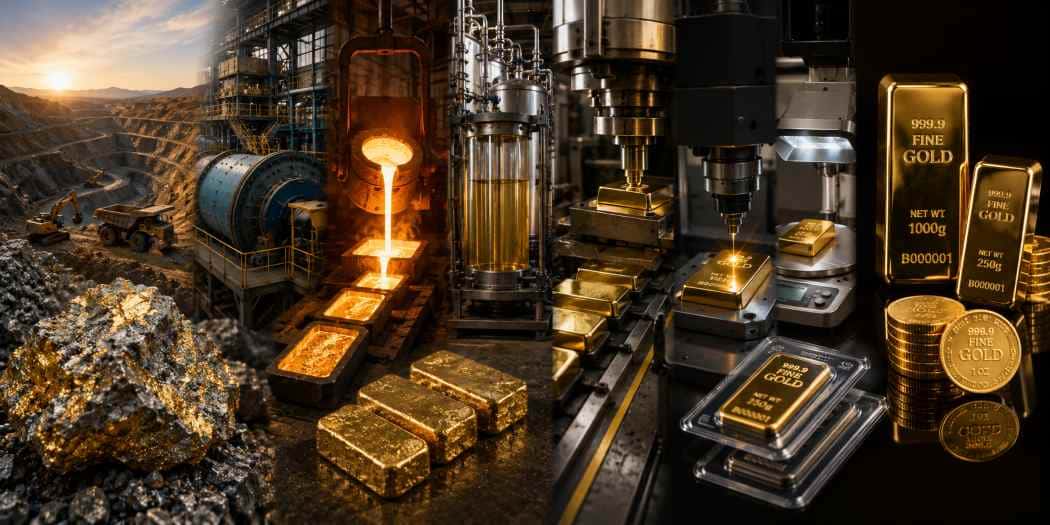
Every Gold Bar Begins Deep Underground
Long before a gold bar is sealed in protective packaging or placed inside a vault, it begins as microscopic particles locked within solid rock. The journey from raw ore to investment-grade bullion is one of the most sophisticated manufacturing processes in the precious metals industry, combining geology, mining, metallurgy, chemistry, and precision engineering.
Although investors often focus on a bullion product's weight, purity, or premium, those qualities represent the final stage of a much longer process. Every investment-grade gold bar has passed through numerous phases of extraction, refining, testing, and fabrication before reaching a dealer or private collection.
The result is a product trusted worldwide for its consistent purity, weight, and authenticity. Understanding how that transformation occurs helps explain why investment bullion commands confidence across global markets.
Mining Gold Is Only the First Step
The process begins where gold has naturally accumulated over millions of years.
Modern mining companies spend years identifying economically viable deposits through geological surveys, exploratory drilling, and extensive sampling before extraction ever begins. Once a deposit is confirmed, mining may take place through either open-pit operations, where large sections of earth are removed from the surface, or underground mines that follow deeper gold-bearing veins.
Contrary to popular images of solid gold nuggets, most mined ore contains surprisingly small concentrations of precious metal. In many operations, a single metric ton of rock may contain only a few grams of gold, requiring enormous quantities of material to be excavated and processed.
After extraction, the ore is crushed into progressively smaller pieces before undergoing additional processing designed to separate gold-bearing minerals from surrounding rock. Depending on the deposit, techniques such as gravity separation, flotation, or cyanide leaching concentrate the gold into a much richer material suitable for the next stage of production.
At this point, the material still contains significant amounts of silver, copper, and other metals. Producing investment-quality bullion requires much further refinement.
Refining Removes Everything Except Gold
Once concentrated material reaches a refinery, the focus shifts from extraction to purification.
The first stage often involves smelting, where concentrated ore is heated to extremely high temperatures. During this process, unwanted materials separate from the valuable metals, producing doré bars—semi-pure bars that typically contain a mixture of gold, silver, and trace elements. While valuable, doré bars fall well short of the purity required for investment bullion.
Refineries then employ specialized purification methods to remove the remaining impurities. One widely used technique is the Miller Process, which introduces chlorine gas into molten gold. The chlorine reacts with many of the remaining metals, allowing them to separate from the gold and produce purity levels approaching 99.5%.
For investment bullion requiring even higher purity, many refiners continue with the Wohlwill Process. This electrolytic refining method dissolves gold into a chemical solution before depositing nearly pure gold onto cathodes through an electric current. The process routinely produces gold with a purity of 99.99%, commonly referred to as four nines fine, which meets the standards expected for many investment-grade bars and coins.
Throughout refining, samples are continuously tested to verify composition, ensuring every batch meets strict purity specifications before moving to fabrication.
Turning Refined Gold Into Investment Bullion
Once gold reaches investment-grade purity, it can finally be transformed into the products familiar to investors.
The fabrication process begins by melting refined gold and casting it into forms appropriate for the intended product. Cast gold bars are created by pouring molten gold into precision molds, where the metal cools and solidifies before being cleaned, weighed, and finished. Their slightly textured appearance reflects the casting process and has made them a popular choice for larger investment bars.
Minted gold bars follow a different path. Instead of being poured individually, refined gold is rolled into long strips of uniform thickness. Precision machinery punches individual blanks from these strips, after which each blank is polished and struck under tremendous pressure using engraved dies. This process produces the smooth surfaces, sharp edges, and detailed designs commonly associated with premium minted bullion.
Investment gold coins undergo a similar manufacturing process. Carefully prepared blanks are inspected, cleaned, and struck multiple times to ensure crisp detail, consistent dimensions, and precise weight. Whether produced by government mints or private refineries, each product must meet exact specifications before leaving the production facility.
Many modern bullion bars also receive serial numbers, tamper-evident packaging, and certificates of authenticity, providing additional confidence for buyers and simplifying future verification.
Precision Testing Ensures Every Bar Meets the Standard
Refining alone does not guarantee investment-quality bullion. Every finished product must undergo rigorous testing before entering the marketplace.
One of the most important steps is assaying, the process of verifying a bullion product's precious metal content. Refineries employ several analytical methods, including fire assay, X-ray fluorescence (XRF), and advanced spectrometric testing, to confirm that each bar or coin meets its stated purity.
Weight and dimensions are measured with equal precision. Even slight deviations can prevent a product from meeting internationally recognized standards, particularly for larger wholesale bullion traded between financial institutions.
Many of the world's most respected refiners also adhere to the London Bullion Market Association (LBMA) Good Delivery standards. Although these specifications primarily govern large wholesale bars, LBMA accreditation has become an internationally recognized benchmark for refining excellence, quality control, and responsible sourcing. Bullion produced by well-established refiners often commands greater recognition because investors know it has passed through strict manufacturing and verification procedures.
These quality assurance measures help ensure that a one-ounce gold bar purchased in New York is trusted just as readily in London, Zurich, Singapore, or anywhere else precious metals are actively traded.
From the Refinery to Investors Around the World
The final stage of bullion production begins after manufacturing is complete.
Finished bars and coins are securely packaged before being transferred to vault operators, wholesalers, authorized distributors, and precious metals dealers. Along the way, inventory is carefully tracked to preserve chain of custody and maintain confidence in each product's authenticity.
From there, investment bullion enters the global marketplace, where it may be purchased by central banks, institutional investors, private wealth managers, collectors, or individuals seeking long-term wealth preservation. Some products are stored in professional vaulting facilities, while others become part of personal collections or retirement portfolios.
Although investors typically encounter only the finished product, every gold bar represents an extraordinary journey. It has traveled from ancient geological formations to modern mines, passed through sophisticated refining facilities, undergone meticulous testing, and been manufactured to exacting standards before finally reaching the marketplace.
That journey helps explain why investment-grade bullion has earned global trust. Behind every precisely stamped bar or beautifully struck gold bullion coin lies an extensive process designed to deliver one of the world's most recognized and enduring stores of value.
Related reading you may find interesting:
Artisanal Gold Mining: The Hidden Force in Global Gold Supply