View Charts
The Fugio Cent: America’s First Official Coin
 0
0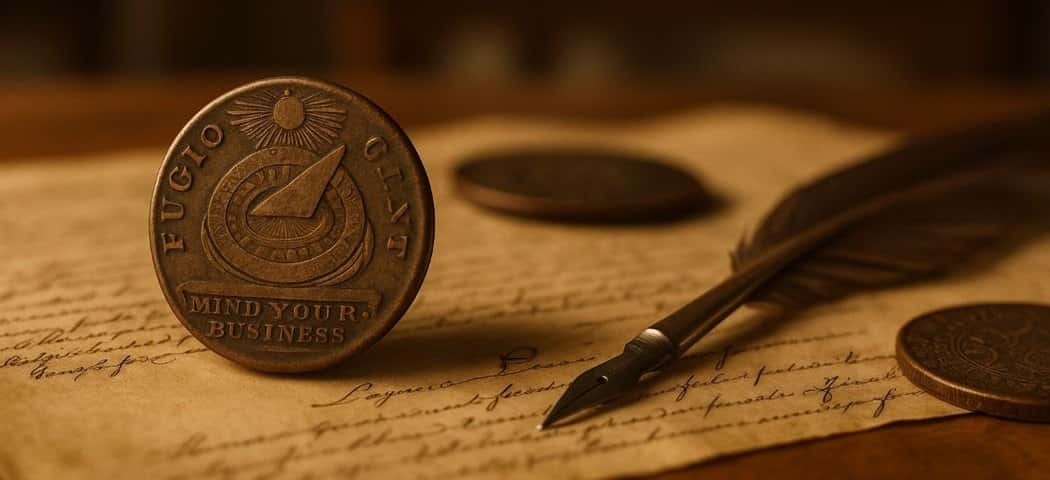
A Small Coin with Monumental Significance
Long before the familiar Lincoln cent or Jefferson nickel, the United States issued a bold and symbolic copper coin known as the Fugio Cent. Struck in 1787, this was the first official coin authorized by the U.S. government and remains a favorite among collectors for its unique design, powerful inscriptions, and rich historical significance.
Whether you’re a seasoned numismatist or a history lover, the Fugio Cent offers a tangible connection to the founding ideals of the nation - and an enduring reminder of its early struggles and ambitions.
The Birth of a National Currency
After the Revolutionary War, the newly formed United States faced the daunting challenge of stabilizing its economy and establishing a unified monetary system. Colonial coins, foreign currencies, and privately issued tokens were in wide circulation, creating confusion and a lack of trust in trade.
To bring order to this system, the Congress of the Confederation passed a resolution on April 21, 1787, authorizing the production of a national copper coin. This initiative would later become the Fugio Cent, making it the first official coin sanctioned by the U.S. government under the Articles of Confederation.
The Men Behind the Coin
Benjamin Franklin’s Vision
The coin’s design and inscriptions are widely attributed to Benjamin Franklin, whose wit and wisdom influenced the messaging on both sides of the Fugio Cent. Franklin, known for his emphasis on personal responsibility and unity, used the coin to convey moral and political values.
James Jarvis and the Minting Contract
The contract to strike the Fugio Cents was awarded to James Jarvis, a merchant who secured the agreement by paying a bribe to William Duer, the Secretary of the Board of Treasury. The coins were minted in New Haven, Connecticut, primarily by subcontracted workers at the small facility operated by Jarvis and partners.
A Closer Look at the Design
Obverse: Time Flies - Mind Your Business
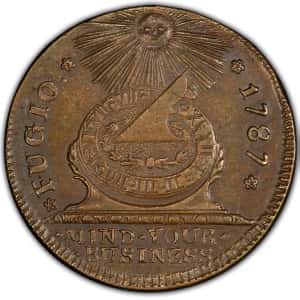
The obverse of the Fugio Cent features a striking design:
-
A sundial beneath a radiant sun - symbolizing the swift and inevitable passage of time.
-
The Latin word “FUGIO,” meaning “I fly,” appears next to the sundial - widely interpreted as “Time flies.”
-
The phrase “MIND YOUR BUSINESS” - a direct and witty piece of advice attributed to Benjamin Franklin, urging Americans to stay focused on their work, be industrious, and take personal responsibility for their financial well-being.
At first glance, “Mind your business” might sound like a caution against nosiness, but Franklin’s intention was more economically rooted. In his Poor Richard’s Almanack, Franklin frequently emphasized values like hard work, self-reliance, and frugality - ideals he saw as foundational to both personal success and a strong, self-governed society. Placing this motto on the nation’s first coin was a bold cultural message: a free people should build their prosperity through effort and enterprise, not dependence.
Together, these elements on the obverse of the Fugio Cent formed a miniature moral compass, encouraging early Americans to make wise use of their time, labor, and liberty as they shaped the nation’s future.
Reverse: Unity Among the States
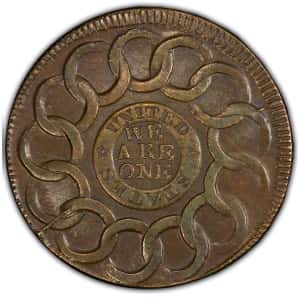
The reverse of the Fugio Cent reinforces the nation’s core values during its infancy:
-
Thirteen interlinked rings, each bearing the name of one of the original colonies, circle the central message.
-
The powerful inscription “WE ARE ONE” appears in bold lettering within the rings - a clear and emphatic call for unity.
These motifs weren’t just decorative - they were deeply symbolic. The linked chain visually represented the strength found in solidarity: thirteen distinct states bound together in common purpose, stronger as a whole than as individual parts. At a time when the newly independent colonies were still operating more like separate nations than unified states, this design served as a political statement and a rallying cry for cohesion under a shared national identity.
Franklin’s influence is evident here as well. A longtime advocate for colonial unity, he famously proposed the “Join, or Die” cartoon decades earlier, depicting a severed snake symbolizing the colonies' fate if they failed to unite. The Fugio Cent’s reverse echoed that same sentiment — in a new era and with a new message: unity was no longer just a goal; it was now the foundation of the republic.
In this way, the coin served not just as currency, but as a circulating declaration of the values that would shape the identity of the United States.
Minting, Mintage & Rarity
Approximately 398,577 Fugio Cents were struck, although estimates vary due to incomplete records. The production was cut short when Jarvis failed to meet his full contractual obligations. Additionally, many of the coins saw limited circulation, with some never being released to the public.
One of the most fascinating discoveries tied to this coin is the Bank of New York Hoard, where thousands of uncirculated Fugio Cents were found stored away in the 1850s. These coins had been held in storage for decades and later became a prized source of well-preserved examples for collectors.
Die Varieties and Collectibility
Collectors are drawn to the Fugio Cent not only for its historical importance but also for its remarkable variety of die types. Incredibly, despite being minted for just a single year - 1787 - the Fugio Cent exists in more than 15 distinct die varieties. These variations include differences in the positioning and style of the lettering, the number and angle of rays around the sundial, and even subtle differences in the interlinked rings and alignment on the reverse.
These inconsistencies are believed to have resulted from the use of multiple hand-engraved dies during production, each with slight differences. For collectors and specialists, identifying and comparing these variations turns the Fugio Cent into not just a historical artifact, but an exciting field of numismatic exploration.
Whether pursuing a particular die type or assembling a full variety set, numismatists appreciate the depth and diversity hidden within this foundational American coin.
Prices for Fugio Cents vary based on condition and rarity of the variety. Common circulated examples can be found for several hundred dollars, while high-grade or rare varieties have sold for thousands at auction.
Legacy and Lasting Impact
The Fugio Cent set the stage for what would later become the U.S. Mint and the regulated coinage system established under the Coinage Act of 1792. Although it was struck only in 1787, its influence rippled through future coin designs - especially in its symbolism of time, unity, and industry.
In 2022, the Professional Coin Grading Service (PCGS) reclassified the Fugio Cent as the first regular-issue federal coin, rather than a mere colonial token, cementing its rightful place in American numismatic history.
Final Thoughts: A Coin Worth Remembering
The Fugio Cent is more than just a coin - it’s a piece of early American identity. With its bold inscriptions, symbolic design, and deep connection to Benjamin Franklin and the founding era, it stands as a testament to the values that shaped a nation.
For collectors, owning a Fugio Cent is like holding a fragment of American independence in the palm of your hand.
Shop Historic U.S. Coins at Bullion Exchanges
Whether you're searching for a Fugio Cent, Pre-1933 U.S. gold, or other early American coins, Bullion Exchanges is your trusted source. Explore our growing collection of historic numismatics and invest in pieces that tell America’s story.
Source of coin images: PCGS CoinFacts