The Decline of High-Denomination Currency
The prominence of large notes faded quickly in the mid-20th century. After World War II, growing concerns emerged about their misuse in activities like money laundering, tax evasion, and organized crime. The Bureau of Engraving and Printing (BEP) stopped producing them in 1945, and in 1969 the Federal Reserve officially withdrew high-denomination notes due to “lack of use.”
This discontinuation coincided with the rise of electronic banking, which rendered physical high-value bills unnecessary. Digital transfers provided faster, more secure alternatives, making paper currency in these amounts obsolete. Retiring the $500 bill was both a modernization step and a response to risks tied to illicit use.
Is the $500 Bill Still Legal Tender?
Yes, the $500 bill remains legal tender in the United States. In theory, it could be used for payment, but in practice, these notes rarely change hands for face value. Collectors and investors typically pay far more, with well-preserved examples commanding several thousand dollars.
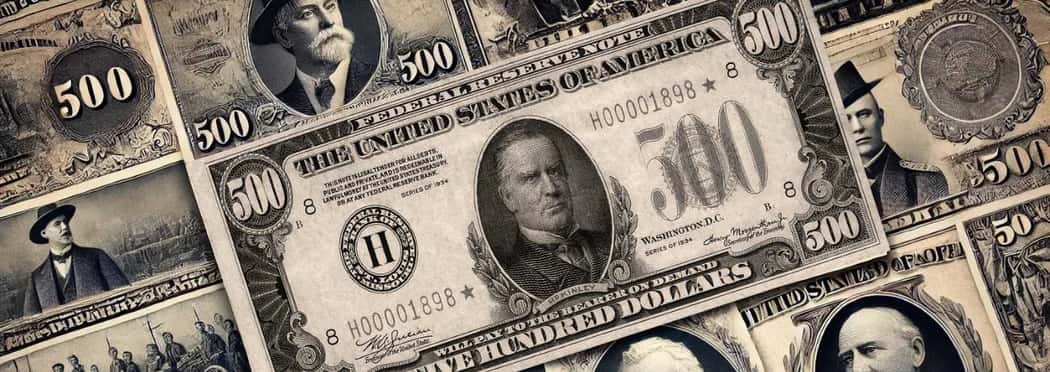
The bills are prized not only for their scarcity but also for their craftsmanship. The detailed portraits, engraving work, and historic themes embodied in their designs reflect a rich period in U.S. currency history. For collectors, each note is more than money—it is a story preserved in paper and ink.
Market Value & Notable Auction Sales
While the $500 bill technically retains its face value, the numismatic market tells a very different story. Condition, series, and rarity dramatically influence value, with collectors willing to pay thousands—or even six figures—for exceptional examples.
-
1918 Blue Seal $500 Bill – In 2019, Heritage Auctions sold a Gem Uncirculated 66 PPQ example for $180,000, setting a record for the denomination.
-
1934 $500 Federal Reserve Note – In 2024, a well-preserved note discovered inside a family Bible brought $20,000 at auction, a testament to condition and provenance.
-
Circulated Issues – Even lightly circulated notes typically trade between $3,000–$5,000, while rarer series in top grades command significantly more.
These results highlight how scarcity, grade, and collector demand drive value. For both seasoned collectors and new enthusiasts, the $500 bill represents not just money, but a historic asset and prized collectible.
The Lasting Significance of the $500 Bill
Though obsolete as a medium of exchange, the $500 bill endures as a coveted numismatic treasure. It recalls a time when large paper notes were essential tools of the banking system and illustrates how advances in technology reshaped the way money is moved and stored.
For collectors, owning one is about more than investment potential—it is a tangible connection to America’s financial past. Each $500 bill tells a unique story of transition: from indispensable banking tool to collectible artifact of monetary history.
The $500 Bill: A Timeless Numismatic Icon
The $500 bill represents far more than a piece of discontinued currency. Its journey from circulation to collector status encapsulates the evolution of American money—from physical high-denomination notes to today’s digital economy. Though no longer printed or needed for banking, its legacy continues through the passion of collectors and numismatists who safeguard these bills for future generations.
Whether admired for its artistry, its rarity, or its historical role, the $500 bill remains one of the most compelling pieces of U.S. paper money ever issued.
FAQ: The $500 Bill
Was there ever a real $500 bill in circulation?
Yes. The U.S. issued $500 bills beginning in the 18th century, with the most famous series printed between 1928 and 1945 featuring President William McKinley. Though discontinued in 1969, they remain legal tender but are rarely seen outside of collections.
Why was the $500 bill discontinued?
The $500 bill, along with other high-denomination notes, was discontinued in 1969 due to declining use. Advances in electronic transfers made them unnecessary, and concerns over money laundering and crime accelerated their withdrawal.
How much is a $500 bill worth today?
Most $500 bills are worth far more than face value, depending on condition, series, and rarity. Common circulated examples often sell for $1,000–$1,500, while uncirculated notes or rare varieties can bring several thousand dollars at auction.
Who is on the $500 bill?
The most widely recognized $500 bill features William McKinley, the 25th President of the United States. Earlier versions displayed historical figures such as John Quincy Adams and Chief Justice John Marshall.
Can I still spend a $500 bill?
Yes, technically $500 bills are still legal tender in the United States. However, using one for face value would be unwise since collectors typically pay multiples of that amount.
What is the rarest $500 bill?
The 1918 Blue Seal Federal Reserve Note featuring Chief Justice John Marshall is among the most collectible $500 bills. High-grade survivors of this issue can reach very high values at auction.
Did the U.S. issue bills larger than $500?
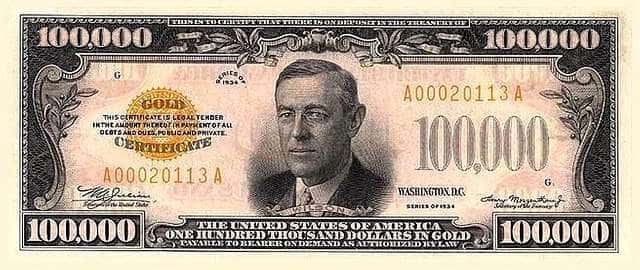
Yes. The U.S. produced $1,000, $5,000, and $10,000 bills, mainly for bank-to-bank transactions. The largest denomination ever printed was the $100,000 Gold Certificate featuring Woodrow Wilson, though it was never circulated to the public.
Where can I buy or sell a $500 bill?
Collectors and investors can find $500 bills through reputable coin and currency dealers, major auction houses, or numismatic shows. Authenticity is critical, so purchasing from a trusted source is essential.
How do I know if my $500 bill is authentic?
Check the paper quality, engraving detail, and serial numbers, and compare them with certified examples. Professional grading and authentication services like PMG (Paper Money Guaranty) can confirm authenticity and preserve value.
Why do collectors value the $500 bill?
Beyond its face value, the $500 bill embodies a fascinating piece of U.S. financial history. Its rarity, intricate designs, and connection to an era of large-denomination currency make it a prized addition to numismatic collections.

 View Charts
 3
3