View Charts
Silver Britannia Series: A Year-by-Year Design Evolution
 0
0
How the Silver Britannia Series Reflects Modern Silver Demand and Market Trends
With silver prices remaining elevated and investor demand driven by inflation concerns, industrial usage, and ETF inflows, the Silver Britannia series has become one of the most closely followed sovereign bullion programs globally. Since its debut in 1997, this series has evolved not only in design but in function—shifting from a collectible-driven format to a globally recognized investment-grade coin. As markets increasingly prioritize liquidity, security features, and sovereign backing, the Silver Britannia stands at the intersection of artistry and modern bullion demand, making its year-by-year design changes more relevant than ever.
From Debut to Global Recognition: The Early Years (1997–2012)
When the Royal Mint introduced the Silver Britannia series in 1997, it was positioned differently from today’s bullion coins. Early issues were struck in .958 fine silver, also known as Britannia silver, a traditional British standard that emphasized heritage over global bullion norms. During this period, the series was notable for its rotating reverse designs, with each year presenting a new artistic interpretation of Britannia—the enduring symbol of British strength and maritime power.
Designs ranged from classical seated figures to dynamic standing poses, often incorporating shields, tridents, and flowing robes. These variations created a strong numismatic appeal, attracting collectors rather than pure bullion investors. However, this approach also limited its adoption in global markets, where consistency and purity standards—typically .999—were becoming dominant.
The Purity Shift That Redefined Market Positioning (2013 Onward)
A major turning point came in 2013, when the Royal Mint transitioned the coin to .999 fine silver, aligning it with international bullion standards set by coins like the American Silver Eagle and Canadian Silver Maple Leaf. This change dramatically improved its competitiveness and accessibility.
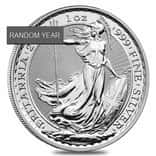
At the same time, the Mint moved away from annually changing designs to a fixed Britannia reverse, featuring a standing figure with shield and trident, facing the horizon. This shift signaled a clear repositioning—from collectible series to bullion staple.
The decision reflected broader market realities. Institutional investors, ETFs, and large-scale buyers prefer consistency for pricing efficiency and recognition. By standardizing both purity and design, the Britannia became easier to trade globally and more attractive for bulk accumulation.
Security Innovation and Modern Minting Advancements (2021–Present)
In response to rising demand and increasing concerns about counterfeiting, the Royal Mint introduced a suite of advanced security features in 2021, transforming the Britannia into one of the most technologically sophisticated silver coins available.
These features include:
-
A latent image that shifts between a trident and padlock
-
Micro-text engraving along the rim
-
Surface animation creating wave-like movement
-
Tincture lines on the shield for visual complexity
These enhancements were not merely aesthetic—they addressed a growing need for trust and verification in a market where counterfeit risks have increased alongside higher silver prices. For investors, these features provide an added layer of confidence, particularly in secondary market transactions.
Year-by-Year Design Highlights That Shaped Collector Demand
While modern issues maintain a consistent design, earlier years in the Silver Britannia series remain highly sought after due to their variety and limited mintages. Certain releases stand out:
-
1997–1999: Foundational designs establishing Britannia’s modern identity
-
2001 & 2003: Notable artistic reinterpretations with strong collector appeal
-
2011: A widely recognized design featuring a detailed, classical Britannia
-
2012: The final year of .958 silver, marking the end of an era
These coins often carry premiums above silver spot price due to their relative scarcity and artistic uniqueness. As collectors revisit the series, demand for these earlier issues has increased, particularly in higher-grade conditions.
Bullion vs Numismatic Value: Where Britannias Fit Today
The dual identity of the Silver Britannia series creates two distinct value tracks.
Modern issues (2013–present) function primarily as bullion investments, with pricing closely tied to silver spot price and relatively low premiums. Their appeal lies in liquidity, government backing, and advanced security.
Earlier issues (1997–2012), by contrast, occupy a more numismatic space. Their rotating designs and lower mintages introduce a collectible component, allowing them to trade at premiums that may expand independently of silver price movements.
This distinction is critical for investors. Those focused on accumulation and cost efficiency may prefer modern coins, while collectors and diversification-minded buyers may see value in earlier, design-driven releases.
Supply, Demand, and the Role of the Royal Mint
The Royal Mint plays a central role in shaping the availability and perception of Britannia coins. As one of the world’s oldest operating mints, it combines historical credibility with modern production capabilities.
Supply levels for bullion Britannias are adjusted based on market demand, which has surged in recent years due to:
-
Inflation-driven demand for tangible assets
-
Increased retail investor participation
-
Institutional interest in physical silver
At the same time, earlier coins are no longer in production, creating a natural scarcity that supports their long-term value. This balance between ongoing supply and finite historical inventory contributes to the series’ layered market dynamics.
Market Behavior: How Britannias Respond to Silver Price Trends
Silver Britannia coins tend to move in close alignment with silver spot price, particularly for modern bullion issues. However, their behavior can diverge under certain conditions.
During periods of rapid price increases, premiums may expand as supply tightens and retail demand accelerates. Conversely, in more stable markets, premiums often compress, making Britannias an efficient entry point for silver exposure.
Numismatic versions, however, can behave differently. Their value is influenced by collector demand, grading, and rarity, which can lead to price movements that are less correlated with the underlying metal.
This dual behavior makes the series particularly versatile, offering both price-sensitive exposure and potential upside through collectibility.
Where the Series Stands in a Changing Precious Metals Landscape
As global markets continue to evolve, the Silver Britannia series is positioned to remain a key player in both bullion and collectible segments. Its combination of sovereign backing, advanced security, and historical depth gives it a unique standing among silver coins.
Looking ahead, several factors are likely to influence its trajectory:
-
Continued demand for secure, verifiable bullion products
-
Expansion of silver’s industrial role in renewable energy and technology
-
Growing interest in historically significant coin series
For investors and collectors alike, Britannias offer a rare blend of stability and narrative—one that reflects both the past and the future of the silver market.
Related reading you may find interesting:
Somalian Silver Elephant: Annual Designs and Value Guide