View Charts
Roman Gold Coins: Aureus and Solidus from 100–400 AD
 0
0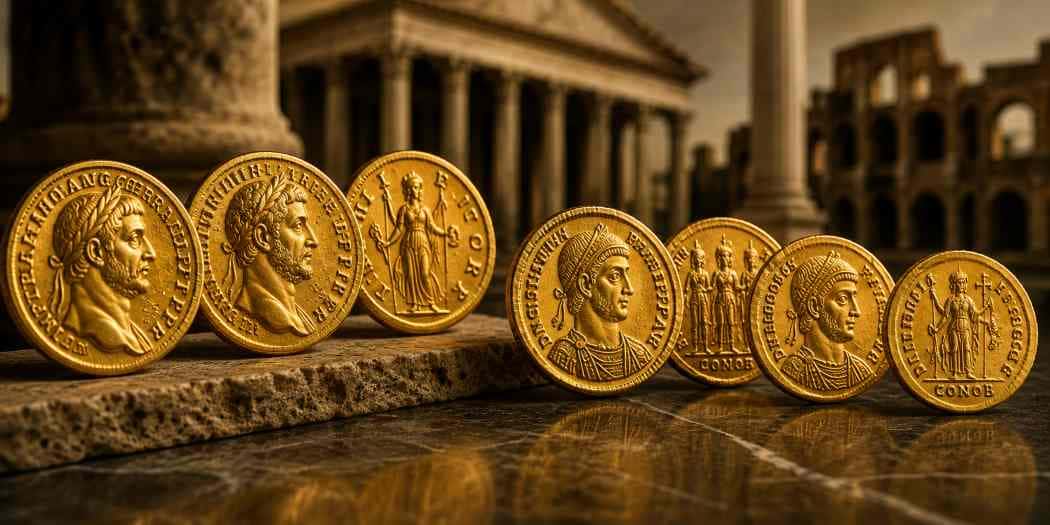
Imperial Gold That Still Shapes Collector Demand
Roman gold coins from 100 AD to 400 AD tell the story of an empire trying to preserve authority through metal, portraiture, and monetary reform. The aureus represented imperial prestige during Rome’s high empire, while the solidus became the more stable gold standard of late antiquity. For today’s collectors, these coins matter because they combine intrinsic gold value with historical scarcity, ruler-specific demand, and a direct connection to the economic pressures that reshaped the Roman world.
From Trajan and Hadrian to Constantine and Theodosius, gold coinage was never just money. It was an official statement of power. Each coin carried the emperor’s image, the state’s religious messaging, and a promise of value backed by high-purity gold. In modern collecting, that combination creates a market where condition, rarity, provenance, mint location, and historical importance can outweigh melt value by a wide margin.
The Aureus at Rome’s Commercial Peak
The aureus was the dominant high-value gold coin of the Roman Empire during the first centuries AD. Around 100 AD, under emperors such as Trajan and Hadrian, it served as a prestigious denomination used for military payments, imperial gifts, savings, and large-scale transactions. It was not everyday pocket change. In a society where bronze and silver handled most routine commerce, gold belonged to the upper layers of Roman finance.
During the early second century, the aureus generally remained close to the post-Nero weight standard, with examples often near the low-seven-gram range. Its value was traditionally tied to the denarius system, and its imagery carried official messages from the emperor to the empire. A single aureus could show military victory, divine favor, public generosity, dynastic legitimacy, or the emperor’s claimed role as guardian of stability.
The collector appeal of the aureus comes from this concentration of value and symbolism. A well-preserved gold coin of Trajan, Hadrian, Antoninus Pius, Marcus Aurelius, or Septimius Severus offers more than ancient gold content. It offers a miniature state document in precious metal. That is why strong portraits, rare reverse types, and historically important rulers can produce prices far above the coin’s bullion value.
Weight Changes Reveal the Pressure Behind the Portraits
The period from 100 AD to 400 AD was not economically static. The gold aureus gradually reflected a wider imperial problem: Rome needed reliable precious-metal money while its silver and bronze systems came under increasing strain. The denarius, once a trusted silver coin, was progressively debased over the second and third centuries. As confidence in lower denominations weakened, gold became even more important as a store of value and payment medium.
This is where the aureus becomes especially revealing. Its gold purity generally remained strong, but its weight became less stable over time. Under the high empire, the coin retained substantial prestige. By the third century, however, repeated civil wars, military spending, frontier pressure, and administrative costs pushed the Roman monetary system into crisis. Emperors needed money quickly, and the coinage system showed the strain.
For collectors, weight and ruler matter. A second-century aureus from the height of imperial stability carries a different market profile than a later third-century issue struck during military crisis. Both can be desirable, but for different reasons. Earlier coins may appeal for classical artistry and imperial confidence, while later coins often attract buyers because they represent crisis, rarity, and rapid political turnover.
The Third-Century Crisis Repriced Trust in Gold
The third century brought a dramatic shift in Roman monetary behavior. Emperors rose and fell quickly, armies demanded payment, and inflation damaged confidence in base-metal and silver coinage. The aureus survived, but it became harder for the state to maintain as a consistent standard. Gold remained trusted because gold itself remained trusted, yet the system around it became increasingly unstable.
This is one reason ancient Roman gold attracts modern attention during periods of inflation, currency anxiety, or heavy government debt. Collectors are not buying these coins as modern monetary instruments, but the historical parallel is hard to miss. Rome’s experience shows how precious metals can retain credibility when official currency systems become strained.
That does not mean ancient coins should be treated like standard bullion. Their prices depend on far more than spot gold. A rare emperor, short reign, exceptional strike, old collection pedigree, or museum-quality portrait can dramatically affect value. In many cases, the numismatic premium is the main reason a coin is expensive. The gold content provides a foundation, but history builds the market.
Constantine’s Solidus Reset the Empire’s Gold Standard
The solidus changed the direction of Roman gold coinage. Introduced in the early fourth century and standardized under Constantine, it replaced the declining aureus with a lighter, more consistent gold coin struck at 72 to the Roman pound, or roughly 4.5 grams. That reform gave the late Roman and later Byzantine economy a durable gold unit that would remain influential for centuries.
The genius of the solidus was consistency. Instead of trying to preserve the older aureus system, Constantine created a more practical gold standard suited to the empire’s new political and fiscal realities. The coin was smaller in gold weight than earlier imperial aurei, but it became trusted because it was reliable. In a world of fiscal reform, military reorganization, and shifting imperial capitals, that reliability mattered.
Collectors often view the solidus as more accessible than many aurei, particularly for common late Roman rulers. However, accessibility does not mean lack of importance. A solidus of Constantine, Constantius II, Valentinian, Valens, Theodosius, or Honorius represents one of the most successful monetary reforms in ancient history. Its market appeal comes from the fact that it was both beautiful and functional: a coin of empire, faith, taxation, diplomacy, and military pay.
Aureus vs. Solidus: Two Markets, Two Collector Profiles
The aureus and solidus appeal to collectors in different ways. The aureus often carries stronger prestige because it is associated with the high Roman Empire, heavier gold content in many periods, and portraits of famous emperors such as Trajan, Hadrian, Marcus Aurelius, Septimius Severus, and Caracalla. It is commonly viewed as the classic imperial gold coin.
The solidus, by contrast, appeals through reform, durability, and late Roman transformation. It belongs to the age of Constantine, Christian symbolism, divided imperial rule, and the transition from classical Rome to the medieval world. Its designs can be more standardized than earlier aurei, but its historical importance is enormous.
Price behavior also differs. An aureus is often more expensive when linked to a famous ruler, rare type, or high-grade portrait. A solidus may be more attainable in common issues, but scarce emperors, unusual mints, military usurpers, and exceptional condition can still command strong premiums. Buyers should compare each coin on its own merits rather than assume one denomination is automatically better than the other.
Scarcity, Provenance, and Condition Drive Modern Premiums
The most important value drivers for ancient gold are authenticity, condition, rarity, and provenance. Authenticity comes first because ancient gold coins have long attracted counterfeiters. Serious buyers should prioritize reputable sellers, professional authentication, and clear documentation. Weight, diameter, style, die characteristics, and metal quality all matter.
Condition is more complex than with modern bullion coins. Ancient coins were hand-struck, so centering, strike sharpness, flan quality, surface marks, wear, and portrait detail can all influence value. A slightly worn coin with a bold portrait and attractive surfaces may be more desirable than a technically higher-grade piece with weak centering or an unappealing strike.
Provenance has become increasingly important. Coins with documented old collection histories, auction records, or legally traceable ownership may receive stronger market confidence. This is especially true for high-value ancient gold, where export laws, cultural property rules, and buyer due diligence matter. A strong paper trail can support long-term liquidity and collector trust.
Imperial Portraits Turn Gold Into Political Messaging
Roman gold coinage was one of the empire’s most effective communication tools. In an age without newspapers, television, or digital media, coins carried the emperor’s image across provinces, military camps, trade networks, and elite circles. Gold amplified that message because high-value coins were associated with authority and trust.
From 100 AD to 400 AD, designs shifted with the empire’s priorities. Early imperial types emphasized victory, abundance, peace, and divine approval. Third-century coins often reflected military urgency, legitimacy, and restoration themes. Fourth-century solidi increasingly conveyed Christian symbolism, imperial unity, and ceremonial authority. The portrait itself changed as well, moving from naturalistic high imperial style toward more formal late Roman representation.
This institutional function helps explain why collectors respond so strongly to design. A coin with a powerful imperial portrait is not merely attractive; it reflects how the ruler wanted to be seen. A reverse type showing Victory, Roma, Sol, military standards, or Christian symbols can place the coin within a specific political and religious moment.
The Lasting Value Signal for Ancient Gold Buyers
The strongest case for collecting ancient Roman gold lies in the blend of metal value, historical depth, and finite supply. Unlike modern bullion coins, these pieces cannot be newly minted. Surviving examples are limited by ancient production, historical loss, hoarding patterns, excavation, legal ownership, and collector retention. When high-quality pieces enter the market, competition can be strong because buyers are not only purchasing gold; they are purchasing a physical link to imperial history.
For modern buyers, the best approach is selective and disciplined. Choose coins with clear attribution, attractive surfaces, reliable provenance when available, and a ruler or theme that supports long-term collector interest. Understand the difference between bullion value and numismatic premium. A gold coin from Rome’s imperial period may contain only a few grams of metal, yet its market value can far exceed melt because the coin carries historical significance that gold bars do not.
The aureus and solidus remain two of the most important gold denominations ever issued. One reflects Rome’s high imperial confidence; the other reflects a successful monetary reset that helped carry late Roman power into the Byzantine age. Together, they offer collectors a rare view of how gold, politics, and economic trust shaped four transformative centuries.
Related reading you may find interesting:
Spanish Doubloons: Shipwreck Gold With Collector Appeal