View Charts
Byzantine Solidus: Gold Coin of Empire and Stability
 0
0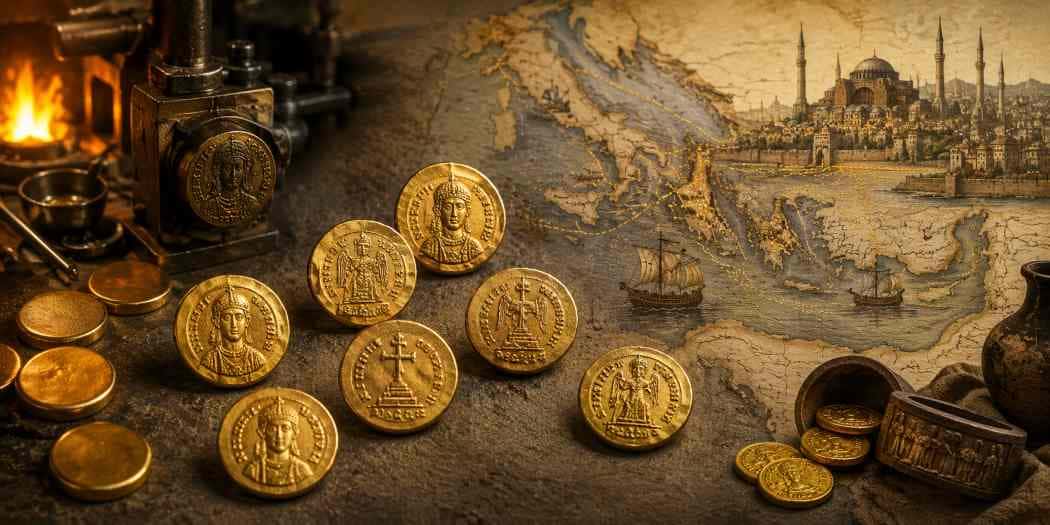
A Gold Standard That Held Trust for Nearly Seven Centuries
The Byzantine solidus was more than an ancient gold coin. It was one of the most successful monetary instruments in world history, helping support imperial finance, long-distance trade, military payments, and political authority from the late Roman Empire into the medieval Byzantine world. Introduced under Constantine I in the early fourth century, the solidus maintained a remarkably consistent weight of about 4.45 grams and a high gold standard for centuries, giving merchants, soldiers, tax collectors, and foreign traders confidence in its value.
That durability is what makes the coin so important to collectors today. In a modern market where gold prices respond to inflation, interest rates, central bank buying, currency risk, and geopolitical uncertainty, the solidus offers an older lesson: stable money builds trust. Its long life shows how a reliable gold coin could become a financial language across borders, linking Constantinople to Europe, the Near East, North Africa, and beyond.
Constantine’s Reform Gave Gold a New Imperial Anchor
The solidus emerged from a period of monetary disorder. Late Roman coinage had suffered from debasement, inflation, and public distrust, especially in lower-denomination silver and bronze issues. Constantine’s gold reform introduced a coin that could serve as a dependable high-value unit for taxation, army payments, and imperial spending.
The new gold coin weighed roughly 1/72 of a Roman pound, or about 4.45 to 4.48 grams, and was struck at a high standard of fineness. In the Greek-speaking Byzantine world, it became known as the nomisma, a word that itself came to mean money or coin. That linguistic importance hints at the coin’s broader role: the solidus was not just one denomination among many. It became the foundation of Byzantine monetary credibility.
Collectors often focus on portraits, inscriptions, and mints, but the solidus’ true achievement was institutional. Its success depended on the state’s ability to preserve a reliable gold standard over generations. That level of consistency made it useful not only inside the empire, but also far beyond imperial borders.
Why the Solidus Stayed Stable for So Long
The solidus remained stable because the Byzantine state understood the political value of credible gold. A dependable coin made it easier to pay troops, collect taxes, settle large obligations, and conduct diplomacy. It also projected imperial power. A gold coin bearing the emperor’s image was both money and message.
Unlike many ancient and medieval currencies that declined quickly through debasement, the solidus kept its weight, purity, and reputation for an extraordinary period. Numismatic references commonly note that its weight remained relatively constant for about seven centuries, while the coin’s gold content stayed high until serious debasement began in the 11th century.
That does not mean every issue was identical. Lightweight solidi existed for particular trade or payment purposes, and later reforms introduced related denominations. Still, the central standard held long enough to make the coin a benchmark of medieval financial reliability.
A Coin That Moved Through Trade, Tribute, and Diplomacy
The solidus traveled widely because people trusted it. Western Europe, the Mediterranean, the Near East, and regions connected to Byzantine trade all recognized its value. In Western Europe, it became known as the bezant, a name derived from Byzantium. The term later took on symbolic life in heraldry, where a gold roundel could be called a bezant.
Its circulation outside the empire reveals how powerful monetary reputation can be. A merchant did not need to be Byzantine to trust the coin. Gold content, imperial recognition, and long-term consistency gave it international credibility. In that sense, the solidus functioned like a medieval reserve currency.
It also influenced later gold coinage. Islamic gold dinars and other regional issues developed in a world where Byzantine gold had already set expectations for weight, purity, and commercial acceptance. The solidus’ reach was not limited to Byzantine borders; it helped shape how neighboring economies understood reliable gold money.
Design, Authority, and the Image of Empire
The solidus carried more than metal value. Its designs communicated legitimacy. Early issues often followed Roman imperial portrait traditions, while later Byzantine examples incorporated Christian imagery, imperial symbolism, and increasingly stylized portraits. Over time, the designs reflected the transformation from Roman imperial coinage to a distinctly Byzantine visual language.
Inscriptions also changed. Although the Eastern Roman Empire was largely Greek-speaking, Latin inscriptions continued on coins for centuries. Later, as Byzantine culture and administration became more explicitly Greek in expression, coin legends evolved as well. This gradual change makes solidi especially interesting for collectors because the series preserves political, linguistic, and religious transitions within the empire.
For modern collectors, design differences can affect both historical appeal and market value. A solidus of Constantine, Justinian, Heraclius, Basil II, or later Byzantine rulers may attract buyers for different reasons. Some collectors want early imperial reform issues. Others prefer coins tied to famous reigns, major wars, religious iconography, or the empire’s medieval peak.
Bullion Value vs Numismatic Value
A solidus contains meaningful gold, but it should not be valued only as bullion. Its melt value depends on the current gold spot price and the coin’s actual weight and fineness. Its numismatic value, however, can be much higher because collectors consider emperor, mint, rarity, condition, strike, style, centering, provenance, and historical importance.
This distinction matters for buyers. A modern one-ounce gold bar is primarily valued by gold content and premium. A Byzantine gold coin is a historical artifact. Its price may rise when gold rises, but collector demand can dominate the final value. A common, worn solidus may trade closer to its gold value plus a collectible premium, while a rare ruler, exceptional portrait, or high-grade certified example can command far more.
Authentication is also essential. Ancient gold coins have been copied, altered, clipped, mounted, or repaired over time. Buyers should work with reputable dealers and consider professional authentication for higher-value examples.
Debasement and the End of the Solidus Standard
The solidus’ long stability did not last forever. By the 11th century, Byzantine fiscal and military pressures intensified. The empire faced territorial losses, internal struggles, and heavy financial demands. The gold coinage began to decline in purity, and later Byzantine gold issues became visibly less reliable than the old solidus standard.
Historical summaries note that under several 11th-century emperors, the nomisma was struck with declining gold content. Alexios I Komnenos eventually reformed the currency in 1092 and replaced the debased gold coinage with the hyperpyron, a new gold coin of lower purity than the earlier solidus but intended to restore monetary confidence.
The end of the solidus standard is as instructive as its success. Stable gold money helped sustain confidence for centuries, but even a strong coinage system could weaken when state finances, military pressure, and political instability became too severe.
Hoards Show the Solidus in Real Life
Archaeological finds help show how solidi were used, saved, and hidden. Byzantine gold coins appear in hoards across regions influenced by imperial trade and conflict. Some hoards suggest emergency burial during war or invasion, while others reflect wealth storage, elite ownership, or trade accumulation.
Recent reporting on a 1,400-year-old hoard near the Sea of Galilee described dozens of Byzantine gold coins and jewelry buried during a period of conflict, offering a vivid reminder that these coins were not only tools of commerce but also portable stores of wealth in dangerous times.
Other surviving objects show solidi used in jewelry, including elaborate Byzantine gold pieces set with coins. These examples reveal another side of the solidus: it could function as money, status display, political symbol, and protective object all at once.
Collector Demand for Byzantine Gold Today
The market for Byzantine solidi sits at the intersection of ancient coins, gold ownership, and historical collecting. Buyers may be drawn to the coin’s gold content, but the deeper appeal comes from its connection to empire, religion, trade, and monetary stability.
Condition is a major factor. Strong portraits, full legends, good centering, smooth surfaces, and attractive color can all increase desirability. Provenance may also matter, especially for ancient coins with older collection histories. Coins that have been mounted in jewelry, heavily cleaned, clipped, or damaged may still hold gold value, but their collector premium can be reduced.
For newer buyers, the solidus can be more approachable than many assume. Some Byzantine gold coins are obtainable compared with major Greek or Roman rarities, yet they still carry extraordinary historical significance. The best approach is to study ruler, mint, grade, style, and authenticity before purchasing.
Why the Solidus Still Matters in the Gold Market
The solidus remains relevant because it demonstrates why gold has been trusted across civilizations. It was durable, portable, recognizable, and difficult to debase without consequences. Those qualities still explain gold’s appeal today, even though modern investors now access gold through bullion bars, coins, ETFs, futures, and digital platforms.
The coin also offers a useful contrast to modern fiat systems. The Byzantine solidus did not maintain trust because of marketing or speculation. It maintained trust because its standard held for generations. When that standard eventually weakened, confidence followed. That lesson still resonates in a world shaped by inflation, monetary policy, sovereign debt, and central bank reserve decisions.
For collectors, the solidus is not just an old gold coin. It is a compact record of economic discipline, imperial reach, and the power of monetary trust.
Legacy of a Gold Coin That Outlasted Empires
The Byzantine solidus earned its place in history because it did what few currencies manage to do: it held trust for centuries. It paid soldiers, moved through trade routes, crossed cultural boundaries, and carried the image of empire into distant markets. Its stability helped make Byzantine gold a standard recognized far beyond Constantinople.
Today, the solidus appeals to collectors who want more than metal content. It offers gold value, ancient artistry, imperial history, and a direct connection to one of the longest-running monetary systems of the medieval world. In that sense, the solidus remains a coin of empire—and a lasting reminder that confidence is one of money’s most valuable qualities.
Related reading you may find interesting:
Roman Gold Coins: Aureus and Solidus from 100–400 AD