View Charts
Reverse Proof Coins: What They Are and Are They Worth It?
 0
0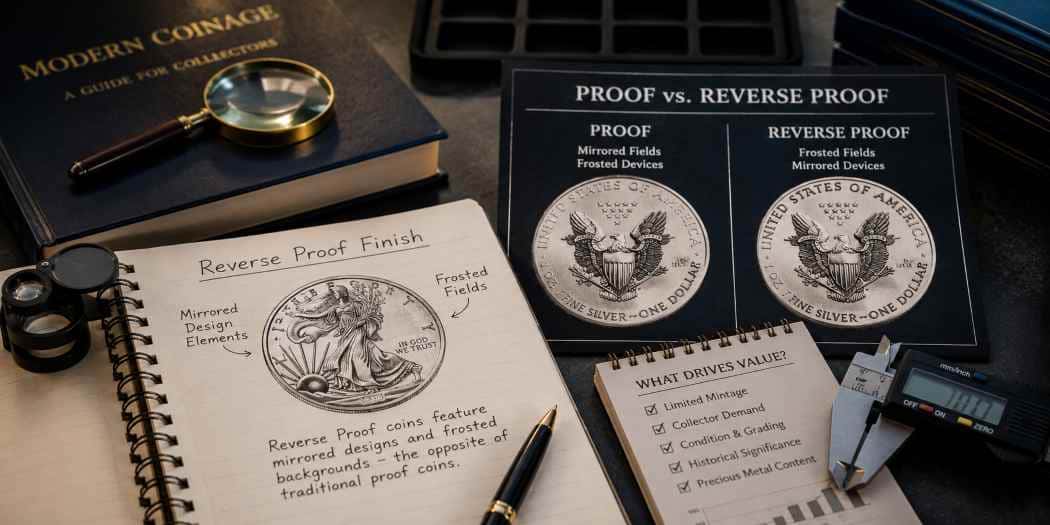
Why Collectors Are Paying More Attention to Specialty Coin Finishes
As gold and silver prices continue attracting investor attention and modern numismatics evolves beyond traditional collecting, specialty coin finishes have become one of the fastest-growing areas of interest in the market. Among them, reverse proof coins stand out for a reason that is immediately visible the moment one is placed under proper lighting. Their striking mirrored design elements and frosted fields create a dramatic appearance that differs from both standard bullion coins and traditional proofs.
This growing popularity is not occurring in isolation. In an environment where precious metals buyers are balancing bullion accumulation with collectible opportunities, many collectors are seeking products that offer more than intrinsic metal value alone. Limited mintages, enhanced visual appeal, and strong aftermarket demand have elevated certain reverse proof releases into highly sought-after modern numismatic pieces. As a result, these coins often attract both collectors pursuing rarity and investors interested in products that can command premiums beyond spot price movements.
The Mirrored Design Effect That Defines Reverse Proof Coins
The defining characteristic of reverse proof coins is found in their finish. Traditional proof coins feature mirrored fields and frosted design elements. Reverse proofs invert this relationship, creating frosted backgrounds while the raised design elements display a reflective, mirror-like appearance.
While this may sound like a subtle difference on paper, the visual effect is dramatic. The mirrored devices draw attention directly to the artwork, making details appear sharper and more pronounced. National symbols, portraits, wildlife designs, and intricate inscriptions often seem to leap from the surface of the coin due to the contrast between reflective and frosted areas.
This presentation is particularly effective on highly detailed designs. The finish creates depth and visual separation that many collectors find more striking than conventional proof finishes. Because lighting interacts differently with mirrored design elements than with mirrored fields, the coin's appearance can change significantly depending on viewing angle and light source.
For collectors who appreciate coin artistry as much as precious metal content, this distinctive finish often becomes a primary reason for purchase.
Where Reverse Proof Coins Fit Between Bullion and Numismatics
One of the most misunderstood aspects of reverse proof coins is how they should be categorized. They contain precious metals, yet they are rarely purchased solely for their gold, silver, platinum, or palladium content.
Traditional bullion coins are generally valued based on metal weight and purity. Their premiums above the precious metals spot price tend to remain relatively modest because investors are primarily purchasing precious metal exposure. Reverse proof releases occupy a different position. Their value is influenced not only by the underlying metal but also by factors such as mintage, collector demand, packaging, grading populations, and historical significance.
This creates a hybrid market dynamic. During periods when precious metals prices rise, the intrinsic value of these coins increases alongside standard bullion products. At the same time, numismatic demand can create additional appreciation independent of metal prices. In some cases, collector premiums become a much larger component of overall value than the underlying bullion content itself.
Understanding this distinction is critical for buyers evaluating whether the additional premium is justified.
Limited Production Runs Create Scarcity That Bullion Often Lacks
Scarcity remains one of the most powerful forces in numismatics, and reverse proof coins frequently benefit from intentionally limited production.
Unlike standard bullion programs that may produce hundreds of thousands or even millions of coins annually, reverse proof releases are often reserved for special occasions. Anniversaries, commemorative programs, exclusive sets, and limited-edition releases commonly feature this finish. Because production is restricted, collector demand can quickly outpace supply.
The United States Mint has demonstrated this phenomenon repeatedly. Several reverse proof American Silver Eagle releases sold out rapidly upon release, creating strong aftermarket demand almost immediately. Similar patterns have emerged with special American Gold Eagle releases and limited-edition commemorative products.
When scarcity combines with attractive design and strong collector interest, premiums can remain resilient even when broader precious metals markets experience periods of volatility. This scarcity factor helps explain why many collectors view reverse proof releases differently from ordinary bullion products.
How Major Government Mints Turned Reverse Proofs Into Modern Collectibles
Although proof coinage has existed for centuries, reverse proof finishes represent a relatively modern innovation. Their rise coincided with growing demand for collector-focused products and increased competition among government mints seeking to offer distinctive releases.
The United States Mint helped popularize the format through anniversary editions of the American Eagle program. The 2006 20th Anniversary Silver Eagle Set remains one of the most influential releases in modern numismatics and introduced many collectors to the reverse proof concept for the first time.
Other major institutions followed similar paths. The Royal Canadian Mint, Perth Mint, Royal Mint, and additional sovereign issuers have incorporated reverse proof finishes into commemorative and collector-focused programs. These releases frequently showcase national icons, wildlife themes, historical figures, and cultural milestones.
By limiting availability and pairing the finish with significant releases, mints successfully transformed what might have been a niche production technique into one of the most recognizable finishes in modern coin collecting.
Why Grading Can Have an Outsized Impact on Value
Condition plays an important role in virtually every area of numismatics, but its influence can be particularly significant for modern collector coins.
Many reverse proof issues are submitted to third-party grading services such as NGC and PCGS immediately after release. Collectors often seek perfect or near-perfect grades, creating strong demand for coins certified as PF70 or equivalent designations.
Population reports become especially important in these situations. If only a limited percentage of a release achieves top grades, scarcity develops within an already scarce product. Registry-set collectors frequently compete for the finest known examples, which can push premiums substantially higher than raw or lower-graded versions.
This grading dynamic creates another layer of differentiation from traditional bullion ownership. While bullion investors primarily focus on metal content, advanced collectors often pay significant premiums for certified condition rarity.
How Market Conditions Influence Demand for Specialty Coins
Collector demand does not exist independently of broader market conditions. In many cases, rising precious metals prices encourage new participants to enter the market, increasing visibility for collectible products.
When gold reaches new highs or silver experiences strong rallies, investor interest often expands beyond standard bullion purchases. Buyers begin exploring premium products that offer additional upside potential through collectibility. Reverse proof coins frequently benefit from this migration because they combine precious metal ownership with aesthetic appeal and scarcity.
Economic uncertainty can further reinforce demand. Inflation concerns, currency depreciation, central bank gold accumulation, and financial market volatility often increase public awareness of precious metals. As investors become more comfortable owning bullion, some naturally progress toward collector-oriented products that offer a different risk-and-reward profile.
This relationship helps explain why specialty coin programs often perform well during periods of heightened interest in precious metals more broadly.
When Paying the Premium Makes Sense—and When It Doesn't
The question most buyers eventually ask is straightforward: are reverse proof coins actually worth the premium? The answer depends largely on why the coin is being purchased.
For investors focused exclusively on acquiring the maximum amount of precious metal for the lowest possible cost, standard bullion products typically remain the more efficient choice. A bullion-focused strategy prioritizes ounces accumulated rather than collector appeal. From that perspective, paying a substantial premium for a specialized finish may not align with long-term objectives.
Collectors, however, often evaluate value differently. A limited mintage, visually distinctive finish, historical significance, and strong collector demand can justify paying more upfront. In many cases, buyers are purchasing not only metal content but also scarcity and collectibility. The strongest-performing modern issues often share several traits: limited availability, broad market recognition, government-mint backing, and enduring collector interest.
The key is understanding that a reverse proof coin is not simply a prettier bullion coin. It occupies a different segment of the market altogether. Buyers should evaluate it as both a precious metals product and a collectible asset.
Characteristics That Separate Strong Releases From Ordinary Ones
Not every reverse proof release becomes a standout collectible. Some achieve remarkable aftermarket performance, while others experience more modest appreciation. Understanding the factors that tend to drive long-term demand can help collectors make more informed decisions.
Low mintages remain one of the most important considerations. The fewer examples available, the greater the potential scarcity if demand remains strong. Historical significance also matters. Anniversary releases, first-year issues, and milestone commemoratives often attract more sustained interest than routine releases.
Design quality can be equally important. Some coin designs are particularly suited to the reverse proof finish because the mirrored devices dramatically enhance intricate artwork. Coins featuring iconic national symbols, wildlife motifs, or popular series tend to attract broader audiences.
Finally, market recognition plays a critical role. A reverse proof issue from a globally recognized government mint generally enjoys stronger liquidity and collector confidence than comparable products from lesser-known issuers.
Why Collector Demand May Continue Growing
The modern numismatic market looks very different than it did a generation ago. Online marketplaces, registry-set competition, social media communities, and global access to new releases have expanded the collector base dramatically. As a result, demand for visually distinctive products continues to grow.
At the same time, younger collectors often gravitate toward modern issues rather than classic rare coins. Many appreciate products that combine advanced minting technology, recognizable designs, and transparent mintage information. Reverse proof releases fit naturally into this trend.
Government mints have also recognized this shift. Rather than relying solely on traditional proof and bullion programs, they continue introducing specialty finishes designed to create excitement among collectors. This strategy suggests that reverse proof coins will likely remain a prominent feature of modern numismatics for years to come.
As precious metals ownership continues gaining attention amid inflation concerns, economic uncertainty, and global central bank accumulation of gold, specialty collector products may benefit from increased visibility as well.
Looking Ahead: A Lasting Place in Modern Numismatics
Reverse proof coins have evolved from a niche minting innovation into one of the most recognizable categories in modern coin collecting. Their distinctive mirrored design elements, limited production runs, and strong collector appeal create a combination that few other products can replicate.
While they may not be the ideal choice for every precious metals investor, they offer a unique proposition for collectors seeking something beyond simple bullion ownership. The ability to combine intrinsic metal value with scarcity, artistry, and potential numismatic appreciation has helped establish these coins as a permanent fixture in today's market.
For buyers who appreciate exceptional craftsmanship and understand the importance of collector demand, reverse proof coins represent far more than an alternative finish. They demonstrate how modern mints continue to blend precious metals, innovation, and artistry into products that resonate with collectors around the world.
Related reading you may find interesting:
10 Key Dates Modern Bullion Coin Collectors Should Know