View Charts
Is Gold a Good Investment in 2026? A Complete Market Analysis
 0
0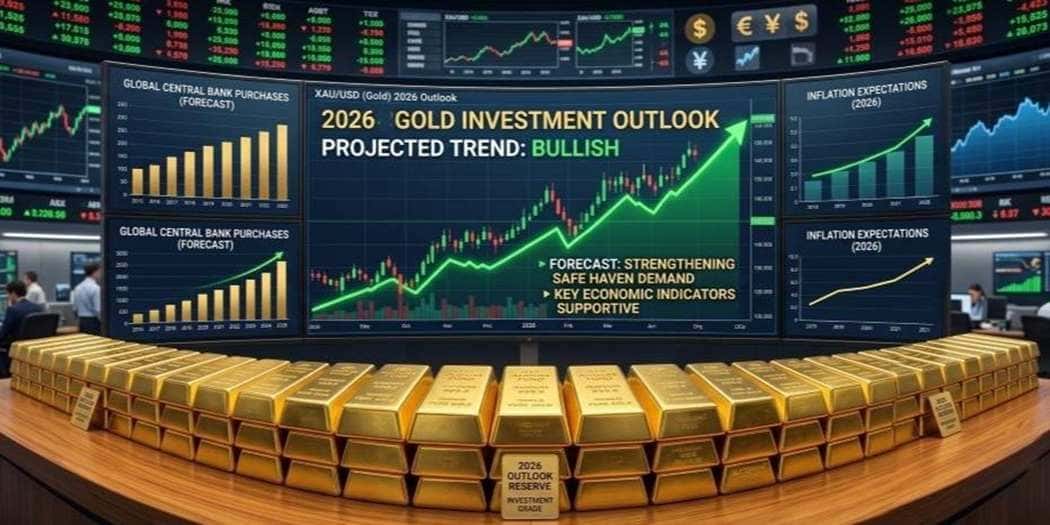
Gold Investment in 2026: Key Market Drivers and What You Need to Know
Gold has been in the news more in the last 24 months than in the previous decade combined. Central banks are buying at record pace, investors are questioning fiat currencies, and gold itself has pushed to repeated all-time highs. That naturally raises the question: is gold still a good investment going into 2026, or has the easy money already been made? Here's an honest, non-promotional analysis.
What you'll learn
-
Gold's long-term track record
-
The macro setup going into 2026
-
Gold vs stocks, bonds, and Bitcoin in 2026
-
Risks to the gold thesis
-
How much gold should you actually own?
-
The honest verdict
-
Start or add to your gold position
Gold's long-term track record
Looking at gold strictly as a dollar asset over multi-decade periods tells a consistent story. From 1971 (the end of dollar-gold convertibility) through today, gold has compounded at roughly 8% per year in USD terms — roughly in line with the S&P 500's nominal total return, with very different characteristics:
-
Gold is negatively correlated with real interest rates.
-
Gold has near-zero long-run correlation with stocks.
-
Gold has positive correlation with CPI inflation surprises.
-
Gold has almost no default or counterparty risk.
You can verify these long-run statistics against the World Gold Council research database — they publish underlying return and correlation data free of charge.
The macro setup going into 2026
Three structural forces are supporting gold demand right now:
1. Sustained central bank buying
Central banks have been net buyers of gold every year since 2010. In the last two years combined, they've added more gold to reserves than in any similar period since 1971. The most aggressive buyers — China, Turkey, Poland, Singapore, and India — are not price-sensitive retail investors; they are building reserves as a matter of sovereign strategy. That structural bid does not turn off because the price rose.
2. U.S. fiscal dynamics
U.S. federal debt service is now the single largest line item in the budget after Social Security. Even under optimistic growth assumptions, the long-run math pushes toward higher deficits and larger Treasury issuance. Gold historically benefits when markets question sovereign debt sustainability.
3. De-dollarization at the margin
The dollar will remain the dominant reserve currency for the foreseeable future, but its share of global reserves has drifted down from roughly 70% in the early 2000s to under 60% today. The bulk of that shift has gone into gold and smaller non-dollar currencies — a marginal but persistent tailwind.
Gold vs stocks, bonds, and Bitcoin in 2026
Gold vs stocks
Stocks and gold are not substitutes. Stocks are ownership claims on productive enterprises; gold is a monetary asset. In a period of stable real growth and falling inflation, stocks will beat gold. In a period of fiscal stress, inflation surprises, or financial instability, gold will beat stocks. Most investors should own both.
Gold vs bonds
For decades, long-duration U.S. Treasuries were the canonical portfolio hedge. After the 2022 bond drawdown — the worst in 40 years — the case for long bonds as a hedge has weakened meaningfully. Gold has partially assumed that portfolio role, especially when real yields are stable or falling.
Gold vs Bitcoin
Bitcoin shares gold's scarcity narrative but is a fundamentally different asset — higher volatility, shorter track record, digital rather than physical, and still sensitive to sentiment swings in risk assets. Many long-term investors now own both, treating gold as the lower-volatility monetary asset and Bitcoin as the higher-volatility growth option.
Risks to the gold thesis
A complete analysis acknowledges what would hurt gold:
-
A sustained rise in real interest rates without an offsetting inflation surprise.
-
A strong, extended dollar rally.
-
Central banks becoming net sellers (no visible signs, but possible).
-
A major mine supply discovery (unlikely — global mine output has been roughly flat for a decade).
-
Regulatory changes around private ownership (unlikely in the U.S. but worth noting).
How much gold should you actually own?
The most commonly cited allocation ranges come from:
-
Harry Browne's Permanent Portfolio — 25% gold.
-
Bridgewater's All Weather — roughly 7.5% gold + 7.5% commodities.
-
World Gold Council research — optimal historical allocations of 6–19% depending on risk profile.
For most investors, a 5–15% allocation is reasonable: enough to matter in a stress scenario, not so much that it dominates your returns during normal equity bull markets. Build the position gradually — dollar-cost averaging eliminates the psychological pressure of trying to pick a top or bottom.
The honest verdict
Is gold a good investment in 2026? As a portfolio allocation held for the next 10–20 years — yes. The structural drivers (central bank buying, fiscal dynamics, de-dollarization) support the thesis. As a short-term trade after a multi-year rally — probably not; gold will have drawdowns along the way. The answer for most investors is to build the position methodically over the next 12–24 months rather than trying to time a single entry.
Start or add to your gold position
Build your position methodically
BullionExchanges makes it easy to dollar-cost average into physical gold with live spot pricing and a published buyback policy. Start with one coin and scale from there.
Related reading you may find interesting:
British Sovereign Gold Coin Buyer’s Guide
GLD vs IAU: Which Gold ETF Is Better in 2026?