View Charts
Inflationary Pressures and the Need for Real Assets in Portfolio Diversification
 0
0
Source: Canva
By: Michael Figueroa
The American economic climate has been experiencing noticeable fluctuations, with consumer prices showing a faster-than-expected upswing in recent times. Specifically, September witnessed a 0.4% rise in the prices of diverse goods and services, outpacing analysts' expectations.
This recent surge has once again brought the intricate issue of inflation into the limelight for both economists and policymakers.
Decoding the Consumer Price Index
The Consumer Price Index (CPI), the nation's bellwether for tracking inflation, has been consistently escalating. Fresh statistics unveil a 0.4% inflationary bump in September, accumulating a 3.7% year-on-year increase.
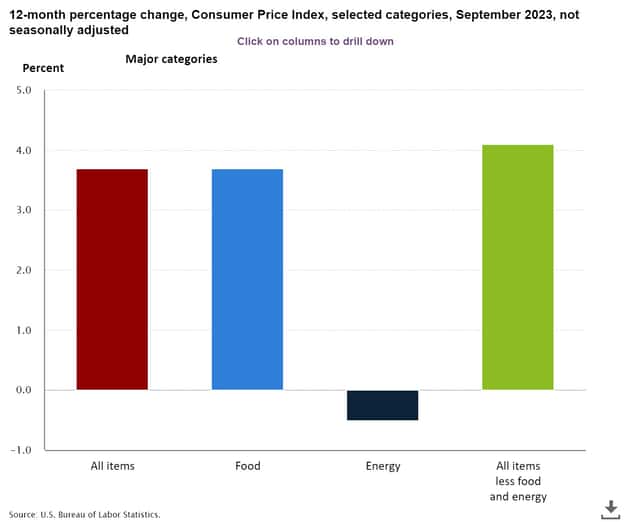
Surpassing previous forecasts, these numbers also underline the fact that we're in the midst of a third consecutive monthly spike in inflationary trends.
Dissecting the Factors Behind the CPI Surge
Several contributing elements underpin the CPI's progressive rise. Shelter costs, bearing substantial weight in the CPI, underwent a 0.6% escalation. Energy expenses, notably gasoline, traced a similar trajectory.
There were also significant hikes in other sectors, including motor vehicle insurance, recreation, and new vehicles. Contrastingly, the used car segment, once a prominent driver of inflation, presented a downturn.
The Repercussions on Established Investment Avenues
The Federal Reserve, the linchpin of the nation's financial apparatus, is meticulously monitoring these statistics, especially when pondering imminent fiscal policies. With inflation continuously posing a formidable challenge, it's evident that a renovation of traditional investment strategies is on the cards.

Source: Canva
The time-tested 60/40 portfolio, composed of 60% equities and 40% bonds, seems to be in troubled waters amidst the prevailing inflationary vortex.
Historically, bonds have been the safe haven, cushioning the volatile equities market and acting as a sentinel against economic recessions. However, in the current milieu characterized by erratic and soaring inflation, bonds' longstanding defensive stature appears to be under siege.
Spotlight on Real Assets: A Shield Against Inflation?
In this unfolding scenario, real assets emerge as prospective contenders for shielding portfolios against inflation. Gold, TIPS (Treasury Inflation-Protected Securities), and similar commodities are anchored to tangible assets. This means they possess the innate potential to reflect inflationary trends in their prices, thereby serving as a robust hedging mechanism.

Source: Canva
A dive into historical patterns reinforces the credibility of both TIPS and gold bullion during economic downturns. Commodities, too, have showcased their mettle, particularly in commodity-induced recessions.
While the initial reaction has been to offload commodities during growth scares preceding a recession, they have often rebounded during the actual downturn, proving their resilience.
Potential Pitfalls and Roadblocks
However, the path to diversifying with real assets is full of pitfalls. The liquidity and scale of markets for these commodities are inherently restricted compared to the vast expanses of nominal Treasuries.
Further complicating the scenario is the allure of alternative real assets like infrastructure and real estate. While they present themselves as lucrative opportunities on the surface, they often carry the baggage of challenges ranging from liquidity crunches to barriers in accessibility and management.
While real assets have conventionally occupied only a minuscule fragment of 60/40-like portfolios, the current inflationary climate compels a re-evaluation of this stance.
Considering the prevailing economic indices and the inherent vulnerabilities in the mainstream bond arena, diversification encompassing real assets is the order of the day.
Beyond Inflation: Steering Through the Economic Tempest
The evolving economic panorama, marked by surging inflation and unpredictable market trajectories, mandates a strategic overhaul of investment blueprints. A judicious blend of gold, equities, bonds, and real assets might just be the panacea for these tumultuous times, offering a ray of hope for sustainable growth amidst the prevailing challenges.
Investors must remain agile, informed, and open to recalibrating their strategies in this dynamic economic landscape.