View Charts
How to Spot Fake Gold and Silver Coins: 10 Tests That Actually Work
 0
0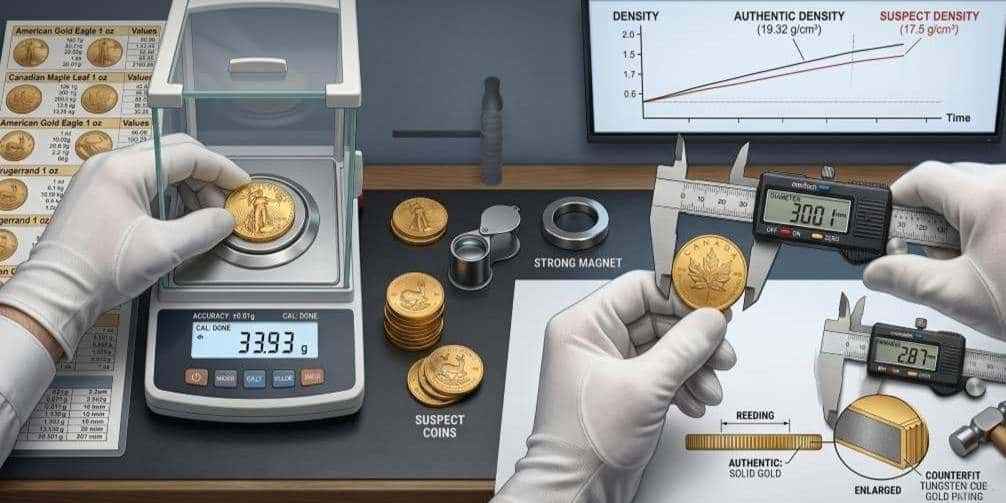
10 Essential Tests to Safeguard Against Fake Gold and Silver Coins
Counterfeit precious metals are a real — if often overstated — problem. The good news is that with a handful of low-cost tools and a few minutes of inspection, you can reliably authenticate almost every piece of bullion you'll ever buy. This guide covers the ten tests used by dealers, arranged from simplest to most definitive, plus the upstream strategy that prevents almost every counterfeit problem in the first place.
What you'll learn
-
Why counterfeits exist (and why bullion is harder to fake than you think)
-
Test 1: the magnet test
-
Test 2: dimensions — diameter and thickness
-
Test 3: weight on a precision scale
-
Test 4: the ping test (silver)
-
Test 5: the Sigma verifier (precious metals)
-
Test 6: density (Archimedes test)
-
Test 7: visual and security feature inspection
-
Test 8: acid test (destructive — use only on unknowns)
-
Test 9: XRF analyzer
-
Test 10: the dealer test (the most important one)
-
How to avoid fake bullion in the first place
-
Authenticity you don't have to test
Why counterfeits exist (and why bullion is harder to fake than you think)
Counterfeiters target two kinds of bullion: products with high collectible premiums (older U.S. coins, proof sets), and products where tiny weight differences are hard to notice (small bars, fractional coins). Modern sovereign bullion coins like the American Gold Eagle, Canadian Gold Maple Leaf, and Austrian Philharmonic are remarkably hard to fake because they have tight tolerances, anti-counterfeit security features, and universally known dimensions.
Test 1: the magnet test
Gold and silver are non-magnetic. A strong neodymium magnet should have no attraction to a real gold or silver coin. If it sticks, the coin has a ferrous core and is a fake. This test catches most low-quality counterfeits in seconds but cannot catch a fake made with non-magnetic base metals like tungsten or brass.
Test 2: dimensions — diameter and thickness
Every sovereign bullion coin has extremely precise dimensions. A 1 oz American Gold Eagle measures 32.7 mm in diameter and 2.87 mm thick. A 1 oz Canadian Gold Maple Leaf is 30.0 mm × 2.87 mm. Use digital calipers to verify. Fakes that nail the weight almost always miss the diameter or thickness because copper, tungsten, and gold all have different densities.
Test 3: weight on a precision scale
A jeweler's scale reading to 0.01 grams is all you need. A 1 oz Gold Eagle weighs 33.931 g total (it's 22k so the coin weighs more than 31.10 g of pure gold). A 1 oz Gold Maple Leaf weighs exactly 31.10 g. A 1 oz American Silver Eagle weighs 31.10 g. Weight alone won't catch a tungsten-cored fake, but dimension + weight together is very hard to defeat.
Test 4: the ping test (silver)
Silver has a unique, long, high-pitched ring when struck against another piece of silver or metal. There are smartphone apps (CoinTrust, BullionTest) that listen for the specific frequency. Tungsten, copper, and lead all produce a dull thud. The ping test is remarkably effective on silver coins.
Test 5: the Sigma verifier (precious metals)
The Sigma Metalytics Precious Metal Verifier is a device that measures electrical resistivity through a coin or bar. Because gold, silver, platinum, and common counterfeit metals all have different resistivity signatures, the Sigma can detect gold-plated tungsten (a tough counterfeit) that defeats magnet and weight tests. It costs roughly $700–$1,000 and is the gold standard for private testing.
Test 6: density (Archimedes test)
Pure gold has a density of 19.32 g/cm³. Tungsten is 19.25 g/cm³ — nearly identical, which is why it's the counterfeiter's favorite base metal. Most other common metals are far off (copper 8.96, lead 11.34, silver 10.49). The Archimedes test uses a scale and a beaker of water to measure displacement. It will catch any fake that isn't tungsten-cored.
Test 7: visual and security feature inspection
-
Modern Canadian Maple Leafs have a micro-engraved mini maple leaf showing the last two digits of the year — verify under magnification.
-
2021+ American Gold Eagles have added micro-printing and a redesigned eagle.
-
British Britannias have radial 'sunburst' lines and a year-micro-text.
-
Real coins have crisp, deeply-struck details; fakes are often slightly soft, especially in lettering and portrait details.
Test 8: acid test (destructive — use only on unknowns)
A drop of nitric acid on an unknown item will turn base metals green or dissolve plating. This test will damage the surface of the coin, so reserve it for scrap or unknowns, not bullion coins you plan to keep.
Test 9: XRF analyzer
X-ray fluorescence analyzers are the tool refiners and dealers use. They non-destructively identify the elemental composition of the surface. XRF handhelds cost $15,000+ — impractical for most individuals but the definitive test at any reputable dealer.
Test 10: the dealer test (the most important one)
The single best counterfeit protection is buying from an established dealer with decades in business, transparent buyback policies, and participation in industry groups like ICTA, PNG, or ANA. Dealers stake their entire reputation on not shipping fake metal — this incentive alignment is more reliable than any test you can run at home.
How to avoid fake bullion in the first place
-
Buy from established dealers with published buyback guarantees.
-
Avoid 'too good to be true' deals on eBay, Facebook Marketplace, or Craigslist.
-
Stick to widely-recognized sovereign coins (Eagle, Maple, Philharmonic, Krugerrand).
-
Keep original mint assay cards that ship with bars.
-
Learn the dimensions and weight of your most-owned products by heart.
Authenticity you don't have to test
Buy from a dealer that stands behind every piece
Every coin and bar sold by BullionExchanges comes from direct mint and LBMA-approved refiner channels and is backed by our published buyback policy.
Related reading you may find interesting:
Gold Jewelry Investment: Pros, Cons, and Value Guide