View Charts
How Gold Performed During Every Major U.S. Recession
 0
0
Gold's Recession Record Depends on More Than Economic Slowdowns
Gold is often viewed as one of the safest assets to own during a recession, but history tells a more nuanced story. While the metal has frequently outperformed during economic downturns, its strongest gains have typically occurred when recessions coincided with rising inflation, financial instability, aggressive monetary easing, or declining confidence in traditional assets.
That distinction matters because recessions alone do not determine gold prices. Instead, investors should evaluate the broader economic backdrop—including inflation, interest rates, Federal Reserve policy, and market sentiment—to understand why gold sometimes thrives during downturns and, in other cases, struggles to gain traction.
Looking back at every major modern U.S. recession reveals a consistent lesson: gold has generally performed best when economic weakness is accompanied by uncertainty about the financial system or the purchasing power of paper currencies.
The 1970s Established Gold as a Defensive Asset
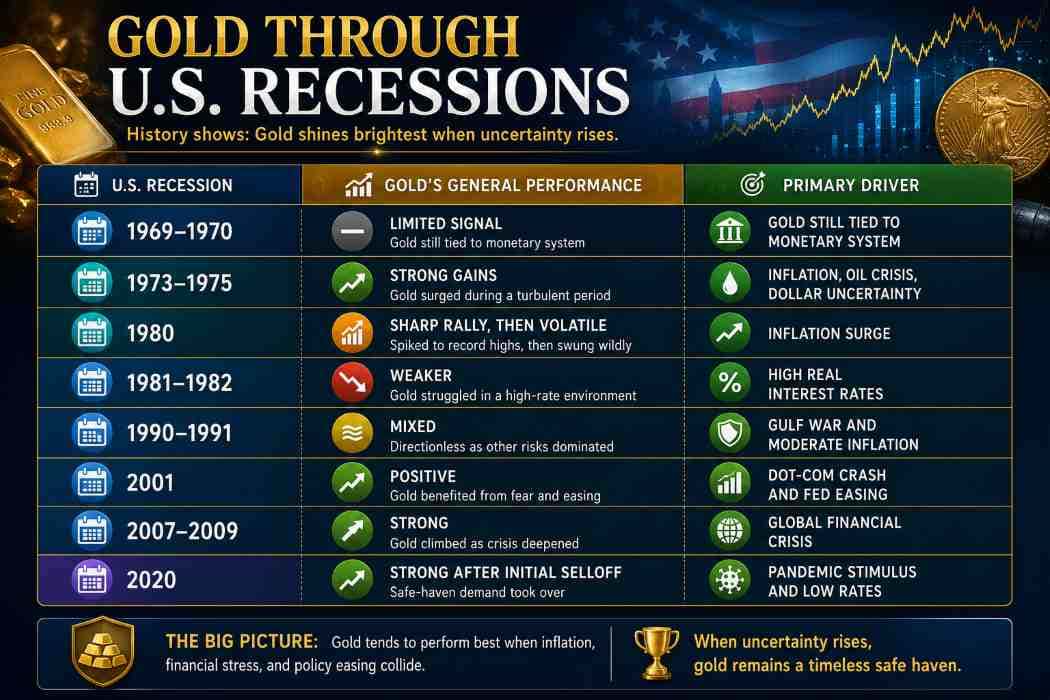
The 1969–1970 recession provides little guidance for modern investors because gold was still heavily influenced by the Bretton Woods monetary system. Its price had not yet become fully market-driven, limiting its usefulness as a recession hedge.
Everything changed after the United States abandoned the gold standard in the early 1970s.
The 1973–1975 recession combined surging inflation, the Arab oil embargo, weak economic growth, and one of the worst bear markets in modern history. For investors, the recession represented far more than slowing economic activity—it raised fundamental questions about inflation, the dollar, and the stability of the global monetary system.
Gold responded accordingly.
Rather than acting as a simple recession hedge, it became a refuge from inflation and monetary uncertainty. Investors sought an asset that could preserve purchasing power while stocks and bonds struggled, helping establish gold's reputation as a defensive holding during periods of economic stress.
The pattern continued into the brief 1980 recession as inflation reached multi-decade highs. Gold prices surged amid fears that inflation was becoming uncontrollable, although volatility increased dramatically once Federal Reserve Chairman Paul Volcker responded with sharply higher interest rates.
The Early 1980s Proved Gold Doesn't Rise in Every Recession
The 1981–1982 recession demonstrated that economic contraction alone is not enough to guarantee higher gold prices.
Although the recession was severe, the Federal Reserve's aggressive campaign against inflation restored confidence in monetary policy while pushing real interest rates sharply higher. Those higher yields increased the opportunity cost of owning gold, reducing investor demand despite worsening economic conditions.
The 1990–1991 recession produced a similar lesson. The Gulf War briefly increased safe-haven buying, but once geopolitical tensions eased, gold struggled to sustain significant gains. Inflation remained relatively contained, and investors viewed the broader financial system as stable despite the economic slowdown.
Together, these recessions reinforced an important principle: gold performs best when investors fear both economic weakness and financial instability. When recession risk is accompanied by confidence in the dollar and restrictive monetary policy, gold's defensive appeal tends to be more limited.
Gold Reasserted Itself During the Financial Crises of the 21st Century
The 2001 recession marked a turning point for gold after nearly two decades of subdued performance. Triggered by the collapse of the dot-com bubble and compounded by the September 11 terrorist attacks, the downturn led the Federal Reserve to cut interest rates aggressively. As confidence in technology stocks faded and monetary policy became increasingly accommodative, investors began returning to gold as a portfolio diversifier.
While gold's gains during the recession itself were measured, the period marked the beginning of a powerful multi-year bull market. Lower interest rates, a weakening U.S. dollar, and growing concerns about expanding government debt created conditions that remained favorable for gold well beyond the official end of the recession.
The 2007–2009 Global Financial Crisis provided perhaps the clearest example of gold's role during systemic financial stress.
When major financial institutions began failing and credit markets froze, investors initially sold nearly every asset—including gold—to raise cash. That brief decline was short-lived. As central banks slashed interest rates, governments introduced massive rescue programs, and concerns about the global banking system intensified, gold rebounded sharply.
Unlike previous recessions, the defining feature of the financial crisis was a collapse in confidence. Investors were not simply worried about slower economic growth—they questioned the stability of banks, financial markets, and the broader economy. Gold benefited because it was viewed as an asset outside the traditional financial system, helping preserve wealth during a period of extraordinary uncertainty.
The recession officially ended in mid-2009, but gold continued climbing for several more years as exceptionally low interest rates and quantitative easing remained in place. Once again, it was the policy response—not merely the recession itself—that helped sustain the rally.
The Pandemic Recession Reinforced Gold's Defensive Reputation
The COVID-19 recession was unlike any other in modern history. Officially lasting only two months, it became the shortest U.S. recession on record, yet it triggered one of the fastest market selloffs ever experienced.
Gold initially fell alongside equities as investors rushed to raise cash during the market panic. Similar to 2008, that weakness proved temporary.
The Federal Reserve quickly reduced interest rates to near zero, launched large-scale asset purchases, and policymakers approved unprecedented fiscal stimulus to support households and businesses. Those actions flooded financial markets with liquidity while raising concerns about future inflation and currency debasement.
As uncertainty surrounding the pandemic continued, investors increasingly turned to gold as a defensive asset. Prices climbed to new record highs during 2020, demonstrating once again that gold responds not only to recession risk but also to the extraordinary monetary and fiscal measures often used to combat economic crises.
What History Suggests About the Next Recession
If history offers one clear lesson, it is that investors should avoid assuming gold will react the same way in every recession.
The metal has generally delivered its strongest performance when several conditions occur simultaneously: falling real interest rates, accommodative Federal Reserve policy, elevated inflation, financial market stress, or declining confidence in paper assets. Recessions that include those characteristics have historically created the most favorable environment for gold.
Conversely, recessions accompanied by high real interest rates, a strong U.S. dollar, or confidence that inflation is under control have often produced more muted results. Economic contraction alone has rarely been enough to guarantee sustained gains.
Today's economic environment illustrates why context matters. Inflation, government debt, central bank policy, geopolitical uncertainty, and global demand for safe-haven assets all influence gold alongside traditional recession risks. Investors considering gold should therefore focus on the broader macroeconomic picture rather than relying solely on recession headlines.
Gold has earned its reputation as a long-term store of value, but history shows it is not simply a recession hedge. It is an asset that has tended to perform best when investors lose confidence in conventional financial assets or expect monetary policy to weaken the purchasing power of cash. Understanding that distinction can help investors build more resilient portfolios regardless of where the economy stands in the business cycle.
Related reading you may find interesting:
How Bullion Dealers Actually Price Gold and Silver