View Charts
CRB Index & Gold vs. Commodities
 0
0We have seen weakness in the gold price over the past two weeks. If gold fails to break higher from its ongoing consolidation over the next 3-6 months, a significant culprit will sell amongst broad-based commodity funds. Below we zoom in on a detail of the CRB Index (Commodities). Gold measures an average price level of 19 commodities including gold, silver, platinum, palladium. Additionally, it includes industrial metals, energy complex, and agricultural products. Note that the CRB index has recently broken below its 15-month support zone between 176 – 179. It held that support zone since April 2016. 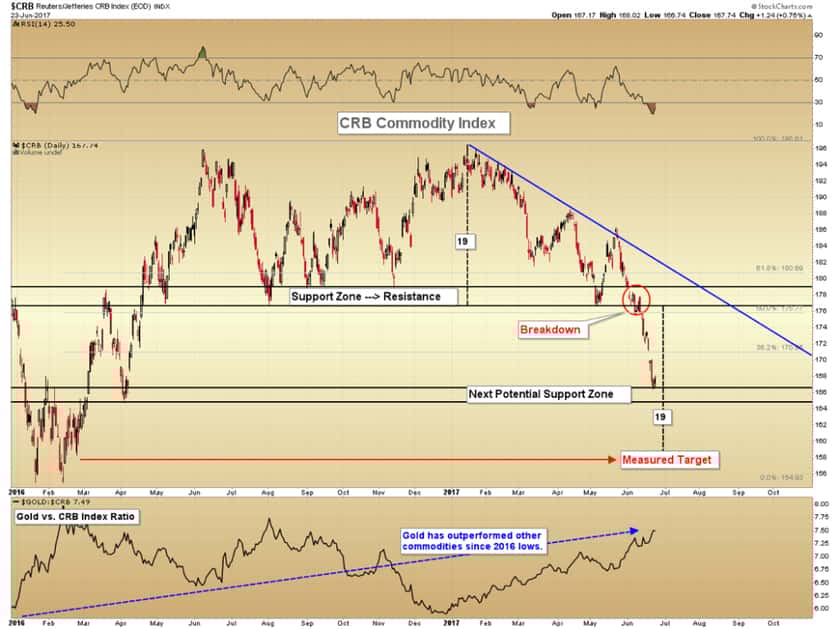 Our technical target for the CRB over the short run is 158 on the index. In other words, a retest of the 2016 lows. This target is calculated by subtracting the amplitude of the failed advance above the support zone (19) from the breakdown point (177). Fundamentally, it represents an equal number of long contract holders who are likely to liquidate below the breakdown point.
Gold Sometimes Grouped with Other Commodities
Gold is certainly not merely another commodity like the rest of the CRB index. During times in which investor psychology preoccupies with “hot” markets such as technology stocks. (Amazon, Facebook, etc.). As well as real estate, and crypto-currencies. Sentiment tends to fade against all commodities. We might disagree with the market fundamentally, i.e., we know currency debasement and unsustainable debt continue to increase every day. Yet, a key point of our philosophy is to put our fundamental opinion second and to respect the market first.
At present, the market is seeing less of a need for safety.
This is due to a focus on hot risky asset classes. So that component of gold demand is absent. We are thus witnessing gold and silver have a high correlation with the rest of the commodity complex. In such an environment gold is dumped in tandem with the group. When institutional funds place sells orders for their diversified commodity holdings this happens. Yes, gold has been outpacing the rest of the commodity complex since the late 2015 lows. However, such relative strength is not always sufficient to stop precious metals from falling in a general commodity liquidation over the short run. If we see a gold break down below $1,230, a continued decline in the CRB index will be a major contributing factor.
Commodity Index Long-Term
Below we back out the chart for the CRB index from 1974 – 2017: 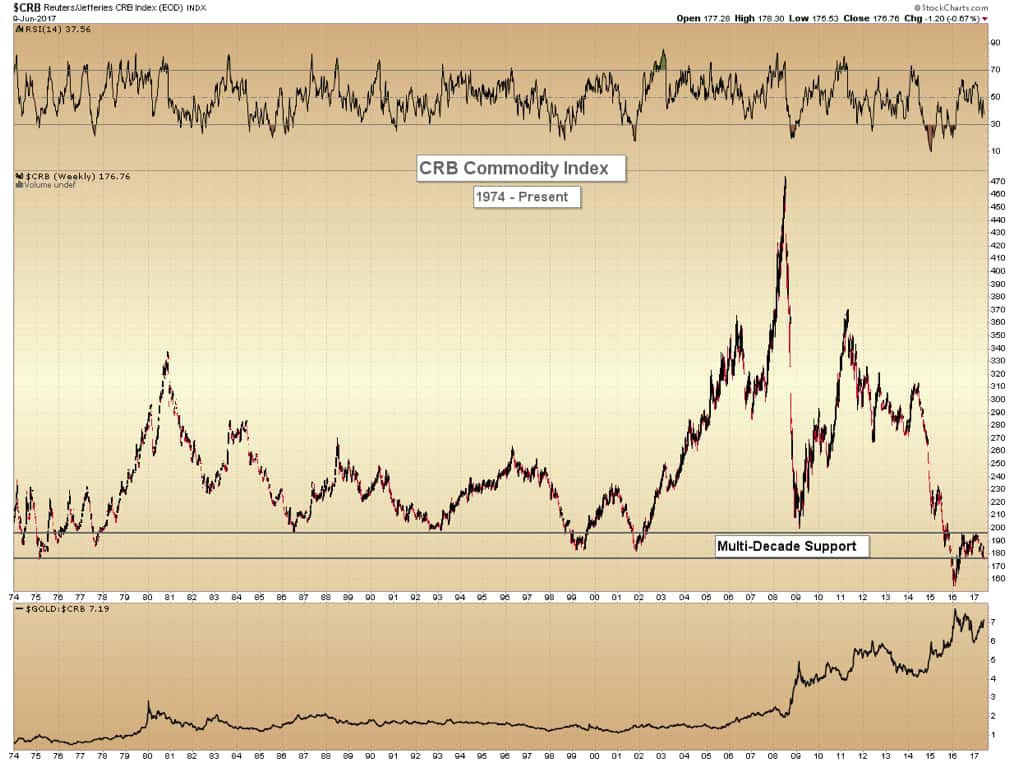
We should note that broad commodities are now the cheapest they have been in 43 years. Nominally, and by far the most economical in real terms (adjusted for inflation).
The low of 2016 is in the process of being retested. This is what may lead to near-term weakness in gold. In viewing the chart above we must seriously ask the question: how much lower can commodities fall from 43-year lows? These are tangible materials of finite supply in the earth’s crust. The ever-growing world population consumes every day. This is a reality that will not change in our lifetimes unless technology to harvest minerals from asteroids arrives soon. Which is a scenario still in the realm of science fiction works. The CRB Index (Commodity) cannot go to zero as a currency or individual stock can. Yet, this is the lowest that commodities have been in four decades. When things that cannot go to zero are priced at their lowest in over a generation, we must view the relative risk/reward proposition as favorable from a long-term perspective. We assess that even if moderate weakness continues for several months to 1-2 years, broad commodities are much closer to a long-term bottom than a top.
Commodity Cycles
Commodities are cyclical. The chart at right shows the three primary cycles that the commodity complex has seen since the 1970s. These are divided into two sub-phases each of boom and bust cycles. (Green and red shading, respectively). Booms and busts are an inherent feature of the typical 10-20 year delay that it takes for the mining lifecycle to move from:
- (a) mineral discovery through
- (b) mine permitting to
- (c) construction to
- (d) successful production which then
- (e) increases supply in the market.
Commodities are “low prices are the solution for low prices.” Marginal mine supply eliminates when prices fall. Then, forcing prices higher again. We see this phenomenon already in many junior oil and precious metals companies. Deposits which were once economic are no longer at today’s low commodity prices. Thus the mines are placed on care and maintenance, reducing supply until higher prices emerge.
Takeaway on CRB Index (Commodities) in Relation to Gold
Let's say weakness continues in the commodity complex through the remainder of this year. We assess that most commodities are much closer to long-term bottoms than long-term tops. Of course, each commodity will move at different times. Each has a different set of fundamentals. The macro analysis shows a world preoccupied. At the moment with the bull markets in digital technology. However, as day must follow night, higher commodity prices must follow a period of lower rates. Gold selling due to broad commodity weakness is thus limited in the big picture. Weakness in the short term runs out.
More articles:
US/China Tariffs Weigh On Commodities
Top 5 Numismatic Coins for Serious Collectors
Gold Holds Primary Rising Trend
Christopher Aaron, Bullion Exchanges Market Analyst
Christopher Aaron has been trading in the commodity and financial markets since the early 2000s. He began his career as an intelligence analyst for the Central Intelligence Agency. The CIA where he specialized in the creation and interpretation of the pattern of- life mapping in Afghanistan and Iraq. Technical analysis shares many similarities with mapping. They both base on the observations of repeating and embedded patterns in human nature. His strategy of blending behavioral and technical analysis has helped him and his clients. It has helped to identify both long-term market cycles and short-term opportunities for profit. This article is a third-party analysis. It does not necessarily match views of Bullion Exchanges. Readers should not consider it as financial advice in any way.