View Charts
Gold Tariff Confusion: Why the Missing EO Still Matters
 0
0
Lingering Uncertainty Over U.S. Gold Imports
In early August 2025, U.S. Customs and Border Protection (CBP) shocked the bullion industry by reclassifying 1 kg and 100 oz gold bars under a tariff-bearing code. This triggered fears of a 39% tariff on one of the most widely traded bullion formats. Almost immediately, major Swiss refiners — the largest suppliers of gold to the United States — paused shipments. Prices spiked to record levels before President Trump took to social media to declare, “Gold will not be tariffed!”
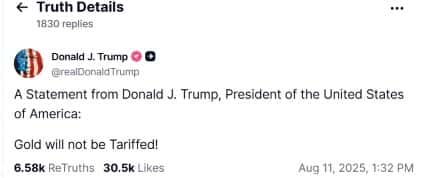
While the reassurance calmed markets temporarily, the underlying issue remains: nearly three weeks later, the promised Executive Order clarifying the matter has yet to appear. Without that formal directive, uncertainty continues to cloud the bullion market.
Why the Delay?
The White House has repeatedly said that an Executive Order (EO) would be issued to “clarify misinformation” and confirm gold bars are not subject to reciprocal tariffs. But as of late August, no such EO is on the Federal Register or the White House’s own Presidential Actions page.
This delay raises pressing questions:
-
Is the holdup due to legal or bureaucratic complexity in revising CBP’s tariff classifications?
-
Could internal disagreements over tariff scope be creating political friction?
-
Or is the administration deliberately buying time to keep trade policy flexible in broader negotiations?
For traders, refiners, and investors, the reasons behind the delay matter less than the consequences of continued ambiguity.
Supply Chain Strain
Gold flows into the United States depend heavily on refiners in Switzerland. With shipments paused until the policy is formally clarified, the U.S. faces the risk of reduced near-term supply. COMEX warehouse inventories remain high — cushioning the shock for now — but this buffer is not infinite. If uncertainty lingers, import slowdowns could tighten physical availability and create dislocations in the U.S. bullion market.
Investor Sentiment on Edge
The mere suggestion of tariffs caused gold futures to surge to new highs. While prices eased after Trump’s social media reassurance, the lack of a binding EO leaves investor sentiment fragile. Traders remain quick to react to every headline, fueling volatility in both spot and futures markets. For long-term investors, the episode underscores the importance of regulatory clarity in sustaining market confidence.
Pricing Implications
-
Short-Term: Prices remain elevated, reflecting both the safe-haven bid amid Fed uncertainty and the tariff confusion premium.
-
Medium-Term: If the EO is issued soon, gold may retrace some gains as supply resumes smoothly.
-
Long-Term: The episode highlights how vulnerable bullion markets are to policy missteps, suggesting volatility could remain a recurring feature if trade classifications are not carefully managed.
The Urgency for Clarity
Gold is a foundational asset in the global financial system. The idea that its free flow could be jeopardized by misapplied tariffs rattles confidence not just in bullion markets, but in U.S. trade policy itself. Until the EO is formally issued, every importer, dealer, and investor must operate under a cloud of uncertainty.
For the bullion industry, the lesson is clear: regulatory precision is as critical as market demand in shaping prices and confidence.
What Comes Next?
Nearly three weeks after the tariff scare, the absence of a clarifying Executive Order remains a glaring gap in U.S. trade and monetary policy. The delay invites speculation, heightens volatility, and constrains supply chains. Investors are left to ask: Why has such a straightforward clarification not yet been made official?
Until the EO is published, the U.S. gold market will continue to operate in a state of suspended animation — buffered by inventories, rattled by rumors, and watching closely for the moment when words finally become law.
Other articles that may interest you:
Executive Order Sets Stage for Gold Bar Tariff Relief
Fort Knox Gold Audit 2025: Can Transparency Finally Win?
U.S. De Minimis Rule Ends: What It Means for Metals & Coins