View Charts
Gold Seasonal Trends and Bullion Timing in 2026
 0
0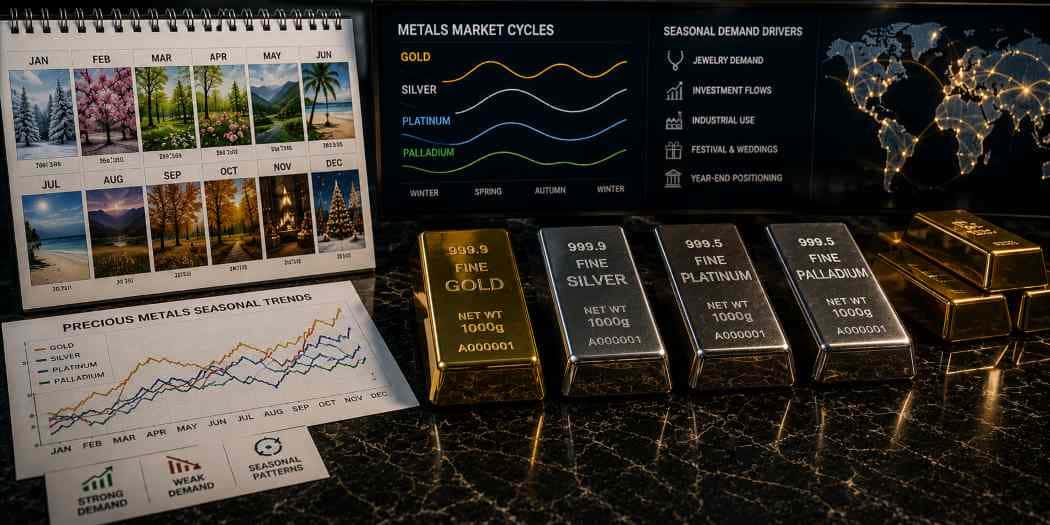
Why Seasonality Remains Relevant Even in a Headline-Driven Market
Gold investors rarely suffer from a shortage of information. On any given day, markets are digesting inflation reports, Federal Reserve commentary, employment data, geopolitical developments, central bank purchases, currency movements, and institutional investment flows. Against that backdrop, seasonal analysis can seem almost outdated. Why study historical calendar patterns when a single economic report or policy decision can move markets in a matter of hours?
Yet seasonality continues to attract attention because it offers something different from daily market commentary. Rather than focusing on short-term catalysts, it examines recurring patterns that have appeared across multiple market cycles. These tendencies are not forecasts and they certainly are not guarantees, but they can provide useful context about when demand has historically strengthened, when investor activity tends to increase, and how certain buying behaviors repeat throughout the year.
The key is understanding what seasonality can and cannot do. It is most valuable as a framework for perspective, not prediction. Investors who treat seasonal patterns as one piece of a broader analytical process often find them useful. Those who expect the calendar alone to determine future price movements are usually disappointed.
The Market Has Changed, but Seasonal Behavior Has Not Disappeared
One reason seasonality remains relevant is that many of the forces behind it are tied to real-world activity rather than market folklore. Jewelry demand, cultural buying traditions, annual portfolio adjustments, tax considerations, and recurring investment cycles all influence precious metals markets in ways that have persisted for decades.
At the beginning of many calendar years, investors reassess allocations, review economic expectations, and adjust portfolio exposure. In major gold-consuming regions, seasonal demand linked to weddings, festivals, and gifting traditions can influence physical buying activity. These recurring behaviors help explain why certain periods have historically produced stronger demand than others.
At the same time, today's gold market is very different from the one that existed twenty or thirty years ago. Central bank accumulation has become a dominant force, reserve diversification has increased, and institutional investment products have expanded access to the market. These developments have introduced new demand drivers that can reinforce, weaken, or completely override traditional seasonal tendencies.
This evolution does not invalidate seasonality. It simply means that seasonal patterns now operate within a far more complex market environment than they once did.
Strong Seasonal Periods Often Reflect Real Demand Rather Than Speculation
One of the reasons some seasonal tendencies have persisted is that they are rooted in actual buying activity. Historically stronger periods for gold have often coincided with times when physical demand increases, either through consumer purchases or investment allocation decisions.
This distinction matters because it separates meaningful seasonal influences from purely technical observations. A recurring pattern supported by tangible demand has a stronger foundation than one based solely on historical price behavior. Investors sometimes overlook this difference and assume seasonality is simply a chart-based phenomenon when, in reality, many seasonal trends originate from identifiable economic and cultural activity.
However, demand alone does not determine outcomes. Even historically favorable periods can produce disappointing performance if rising real yields, a stronger dollar, or changing monetary policy expectations create headwinds. Likewise, traditionally weaker periods can outperform if macroeconomic conditions shift in gold's favor.
Seasonality may influence the backdrop, but larger market forces still determine the final outcome.
Silver's Seasonal Profile Tells a Different Story
Investors sometimes assume that silver follows the same seasonal calendar as gold, but the two metals are responding to different influences. Gold's demand profile is dominated by investment activity, central bank purchases, and safe-haven flows. Silver must balance those same factors with substantial industrial demand.
That industrial exposure introduces another layer of complexity. Manufacturing activity, solar deployment, electronics production, electrical infrastructure investment, and broader economic growth all influence silver consumption. As a result, silver's seasonal tendencies are often less stable than gold's because they are competing with a wider range of economic variables.
This is one reason silver frequently experiences larger swings than gold. When industrial demand and investment demand move in the same direction, seasonal trends can appear amplified. When those forces diverge, historical patterns become much less reliable. Investors evaluating seasonal opportunities in silver must therefore pay closer attention to broader economic conditions than they might when evaluating gold alone.
The comparison serves as a useful reminder that seasonality is never independent of market fundamentals. The same calendar period can produce very different outcomes depending on what is happening elsewhere in the economy.
Platinum and Palladium Follow Their Own Cycles
The differences become even more pronounced when looking at platinum and palladium. While these metals are grouped within the precious metals sector, their demand profiles are tied far more closely to industrial activity than to traditional bullion investing.
Automotive production, emissions-control systems, chemical processing, recycling activity, and supply conditions within major producing regions often exert a greater influence on platinum and palladium prices than seasonal investment demand. Platinum's potential role in hydrogen technologies adds another variable, while palladium remains heavily linked to developments in vehicle manufacturing.
This distinction is important because it highlights a common mistake among investors. Seasonal tendencies observed in gold should not automatically be applied across the entire precious metals complex. Each market responds to a different combination of economic forces, supply constraints, and investor behavior.
The calendar may influence all four metals, but it rarely influences them in the same way.
Why Premiums Often Matter More Than Seasonal Price Fluctuations
Many bullion buyers devote substantial energy to identifying the ideal moment to purchase based on anticipated price movement. In practice, that effort can sometimes have less impact than expected because spot prices represent only part of the total acquisition cost.
Premiums fluctuate for reasons that extend well beyond metal prices. Mint production schedules, inventory availability, transportation costs, fabrication expenses, retail demand, and supply-chain conditions all influence what investors ultimately pay for physical products. These variables can sometimes overshadow relatively modest changes in spot prices.
A seasonal pullback in gold may appear attractive on a chart, but if premiums expand simultaneously, the actual savings may be minimal. Conversely, stable metal prices accompanied by declining premiums can create opportunities that are not immediately obvious from spot-price analysis alone.
For long-term bullion buyers, understanding premium behavior often provides a practical advantage that seasonal forecasting alone cannot deliver.
New Bullion Releases Create Seasonal Demand of Their Own
The physical precious metals market develops its own recurring patterns that exist separately from broader metal-price trends. One of the most visible examples is the annual release cycle for government-issued bullion coins.
New-year issues from major sovereign mints frequently generate enthusiasm among investors, collectors, and dealers. Demand can increase as buyers seek newly released products, complete annual sets, or acquire the latest version of a familiar series. These recurring buying waves contribute to seasonal activity within the physical market even when broader metal prices remain relatively stable.
The investment implications are mixed. Some buyers are willing to pay higher introductory premiums to secure new releases, while others prefer established products carrying lower premiums and stronger liquidity. The key distinction is recognizing that product demand and metal demand are not always the same thing.
Understanding this difference helps investors avoid confusing short-term product enthusiasm with long-term value creation.
Major Events Can Render Seasonal Expectations Irrelevant
Perhaps the most important limitation of seasonality is that markets do not respect historical tendencies when significant events alter the investment landscape.
Federal Reserve decisions, inflation surprises, employment data, geopolitical conflicts, banking concerns, currency volatility, central bank purchases, and large institutional flows can all overwhelm seasonal influences. A historically strong period can quickly become weak if macroeconomic conditions deteriorate. Likewise, a traditionally quiet period can become highly active when investors rush toward safe-haven assets.
This reality is not an argument against seasonal analysis. It is an argument for using it appropriately. Seasonality should support decision-making, not dominate it. The strongest investors tend to view historical tendencies as context rather than conviction.
The market's most important drivers are rarely found on a calendar.
Why Consistent Accumulation Often Outperforms Perfect Timing
Because seasonal patterns are imperfect, many experienced bullion investors focus less on timing and more on consistency. Rather than attempting to identify the ideal entry point, they build positions gradually across multiple market environments.
Dollar-cost averaging remains popular for a simple reason: it acknowledges uncertainty. Investors cannot reliably predict the next geopolitical event, central bank decision, inflation surprise, or market correction. By spreading purchases across time, they reduce the risk of making large allocation decisions based on a single market view.
This approach becomes particularly valuable in precious metals markets, where sentiment can shift rapidly and price volatility often exceeds expectations. Gold, silver, platinum, and palladium all experience periods when short-term forecasting becomes exceptionally difficult.
Consistency may not be as exciting as perfect timing, but it often proves more practical.
Using Seasonality as a Tool Rather Than a Strategy
Seasonality remains a useful part of precious metals analysis because it highlights recurring behaviors that continue to influence the market. Historical demand cycles, portfolio adjustments, cultural buying traditions, and physical-market activity all contribute to patterns that investors should understand.
At the same time, seasonality is most effective when combined with broader analysis. Spot prices, premiums, central bank activity, interest rates, inflation expectations, currency trends, and physical supply conditions often have a greater influence on long-term outcomes than any particular month on the calendar.
For bullion investors in 2026, the most productive approach may be to treat seasonality as a source of perspective rather than a source of predictions. Understanding recurring market rhythms can improve decision-making, but long-term success still depends on discipline, patience, and a clear understanding of the forces driving precious metals demand.
Timing can occasionally help at the margins. Ownership, allocation discipline, and a well-developed investment process remain far more important.