View Charts
Gold Double Bottom? A More Complex Path Than Expected
 1
1Let us be very clear: we are bullish on precious metals over the long term. Yet over the intermediate timeframe, the market is giving us signals that a long-term gold double bottom we are expecting to form may take a more complex path than was initially anticipated. We should stay nimble and be prepared for some twists and turns going forward.
For the last week, gold spot price fell by $30 to close at $1,183. This was as of the NY COMEX final print, a 2.4% loss for the week. Notably, the low for the week came late Thursday night EST / early Friday morning in Asia. It was at near $1,171, before bouncing. It went to touch the 61.8% Fibonacci retracement line of the entire December through July advance. The final "Must Hold" support zone we have been monitoring for some months.
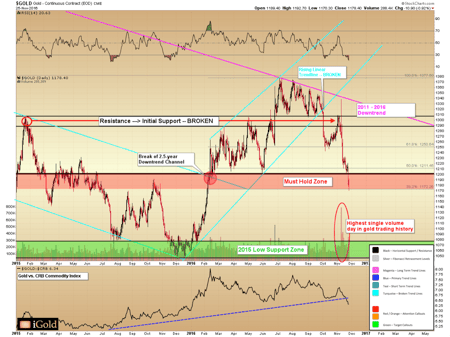
Gold is going to put in a low in this region. It must immediately rise this week above the $1,200 level. It must maintain a weekly close there.
This would turn the break below the $1,200 level into a "false breakdown." This would require us to re-examine the possibility that the next advance is indeed underway. Such fake-outs do occur in all markets periodically. The only way to identify them is to maintain a close watch of the critical support/resistance levels.
This is the only scenario in which we could consider the initial advance from 2015 to be continuing. However, the bulk of the evidence now in front of us leads to a conclusion. A conclusion is gold will need to at least retest the region of its 2015 lows. Or, break below them, as part of a more complex multi-year bottoming formation.
The support below $1,173 is negligible for gold, down to the 2015 lows.
Strong support levels are by prior periods of consolidative action. In the case of gold, consolidation took place between $1,200 and $1,305 from February to June. Gold saw little to no buying interest at $1,200 last week. This indicates those buyers who bought the dips toward $1,200 the previous spring are no longer participating in the market.
Why are they no longer present? We cannot know. Those buyers were a diverse group of institutions, individuals, and funds from around the world. So, we cannot possibly identify a single cause for their sum lack of participation. All we can know is what they (the market) are doing. Then, align ourselves for the highest probability of success.
Below $1,173, we will next look for a bottom in gold. This shows in the new green shading on the chart above. It corresponds to the consolidation seen from November 2015 through early January 2016. This zone of $1,045 - $1,085 is where we would look for the possibility of gold to form a double bottom. The term double bottom is because the price reached this level once before. Then it comes back to retest (if successful) this level for a second time.
Technical Clues for the Next Gold Double Bottom
No matter what the exact low price forms for gold. We will be looking for a specific set of bottoming patterns to come into play. One of the most critical bottom indicators will be to watch for a period of outperformance of the mining sector. (versus the metal itself). As an example, let's say gold was to fall to $1,045 again.
We should expect to see the mining complex bottom several points above its related 2015 lows. This will measure either by either the HUI or GDX index. We will also be looking for a downtrend break in gold. As well as any other number of confirming bottoming patterns.
These patterns include bottoming wedge, inverse head and shoulders, gold outperformance versus CRB commodity index, etc. These are the bottoming indicators that worked in 2008 as well as 2015. At least several of them will allow us to target the next bottom as it approaches.
Of course, we will not catch the exact bottom to the day. The truth is no one will. We will, however, be able to observe the shift in the market. We might see a move equal to, if not higher than, the 2016 initial advance.
1999 - 2001 Gold Example
As an example, here is how the last long-term bottom in gold formed from 1999 - 2001. The pattern features a support zone between $250 and $265. This is with an initial advance to $337, a 34% surge that gave back almost all of its gains into the double bottom of 2001. Downtrend breaks were noted in a continuous fashion in November 2000 and then again in May 2001.
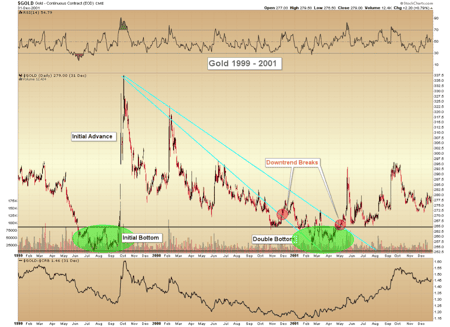
For long-term investors, let's take any purchases within the 1999 - 2001 period, even at the $337 peak. They were eventually seen to be excellent value once the price of gold. They exceeded the initial advance in 2002. It then never looked back. Of course, no two periods in history will match exactly. The point is that a set of potential patterns exist which tend to define most bottoms. We fully expect to identify the next one to come.
Gold: Looking Forward
As a working hypothesis, we propose the following trajectory for gold over the subsequent two years: (with the expectation of a double bottom to form in gold, )
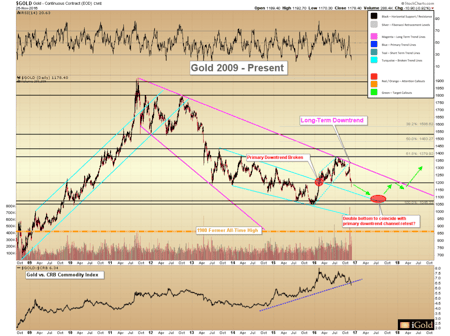
The primary 2013 - 2015 downtrend channel for gold will be set up to act as a second support level for gold near the $1,045 double bottom. This broke in February and shows in light blue.
A successful gold double bottom would then set up gold to challenge its long-term (magenta color) downtrend again in late 2017. The expectation of a successful breakout is either then or in early 2018. By this time, the downtrend would come in much lower. Approximately $1,200. Yet its significance would be no less. For comparison, we continue to monitor the incredible action taking place in the copper market over the last month. In just four weeks, copper has surged 28% to $2.67 per pound.
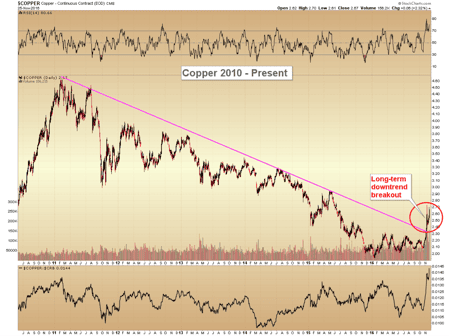
A similar 28% percentage gain, should gold break its long-term downtrend next year at $1,200. It would result in a surge to $1,536 within four weeks. Such is the type of move we want to prepare for ahead of time.
Christopher Aaron, Bullion Exchanges Market Analyst
Christopher Aaron has been trading in the commodity and financial markets since the early 2000s. He began his career as an intelligence analyst for the Central Intelligence Agency. This is where he specialized in the creation and interpretation of pattern-of-life mapping in Afghanistan and Iraq. Technical analysis shares many similarities with mapping. They both base on the observations of repeating and embedded patterns in human nature. His strategy of blending behavioral and technical analysis has helped him and his clients. It helps to identify both long-term market cycles and short-term opportunities for profit. This article is a third-party analysis. It does not necessarily match the views of Bullion Exchanges. Readers should not consider it as financial advice in any way.
Articles you may also like:
Bitcoin Breaks Yet Another Record,
Market Updates - Gold Breakout is Approaching,
CRB Index & Gold vs. Commodities.
Millennials Lead Gold Investing Trend But Prefer ETFs Over Physical Gold
1 Comments