View Charts
Financial Crisis of 2008 VS 2020 Coronavirus
 0
0Times are increasingly volatile with the 2020 Coronavirus Crisis. People are drawing comparisons from the 2008 Financial Crisis to the Bubonic Plague. With all these comparisons it is becoming increasingly stressful and confusing to understand what is currently occurring, particularly with precious metals and the dollar. Bullion Exchanges takes a look into the similarities, differences, and possibilities for the future regarding the economy during what is hopefully the peak of the coronavirus crisis.
What Happened to Precious Metals During the 2008 Financial Crisis?
In 2008, markets crashed for multiple reasons, but the main factor tended to be centered around debtors defaulting on mortgages. Subprime lending is the provision of loans to people who may have difficulty making regular payments. At this time, there was a high rate of people defaulting on their mortgages. This high rate of foreclosures led to Real Estate Investment Trusts (REIT) declaring bankruptcy. Thus, investors sold their stocks and got out of the market, dropping the Dow Jones to as low as around 6,000 points in 2009. At this time with the 2020 Coronavirus, the gold price also peaked and dipped. Normally when the stock market falls, gold and other precious metals rise in price. This is known as an inverse relationship. During this crisis, however, gold dropped as low as about $800 an ounce in October 2008. 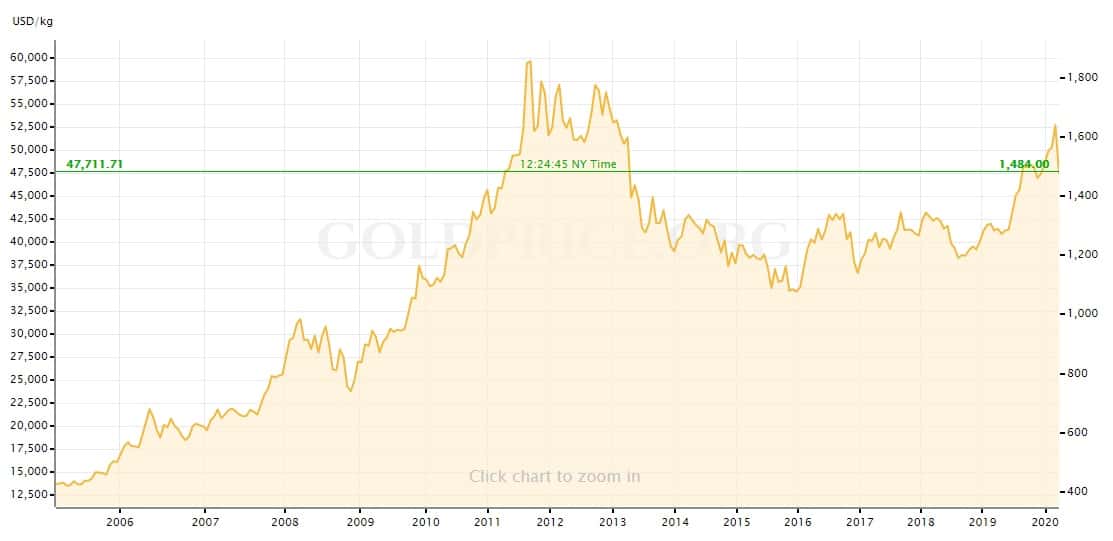
Source: GoldPrice.org
A few months later, February 2009 saw gold climbing again to over $1000 an ounce. This drop in price resulted from large institutions, hedge funds, and basically large money selling all their stock and hedge funds in gold to cash. So, gold suffered along with stocks, but then saw all-time highs from October to August 2011 of $1900 an ounce.
How is the 2008 Financial Crisis Different From the 2020 Coronavirus?
Right now is a unique time because we have not seen a health crisis like this since possibly the bubonic plague. This crisis is still very different from the bubonic plague, but the widespread nature of it shares similarities. This health crisis infects the market as well. Precious metals are going down, just like they did in 2008-2009, because large money, hedge funds, and institutions are selling everything they can to put into the dollar. As of this writing, the US dollar is around 102 according to the US Dollar Index. This index has been as high as 164.72 in February 1985 and as low as 70.698 in March 2008. Currently, everyone is again getting out of the stock market because of uncertainty about what will happen to the economy as soon as a few months. Gold will also see massive fluctuations, and already has, because this is also being sold off. Gold might be 5-10% of big investors’ hedge portfolios. People are thinking why keep hedge when you are getting out of the market? So, they are flocking to cash to hold onto before they lose it in the plummeting stock market.
What is Different with the 2020 Coronavirus Crisis?
People might be selling everything they have for cash, but this does not necessarily mean what happened in 2008 will happen again. The Federal Reserve is reinstating the Commercial Paper Funding Facility to print more money to try and curb the economic meltdown. Although this facility began in 2008 to combat the crisis, the production of paper cash is far more now. In 2008 the US printed about $1 Trillion dollars. But, the US is not the only country printing more money during this crisis. There is a planned ten-fold increase in paper currency globally, which analysts are saying will lead to inflation and maybe even ‘currency wars.’ Simply put, if there is more paper money, then that paper money’s value depreciates. But, different countries and unions (EU) also compete with their currency value in comparison to others. Due to worries over impending inflation, investors in the future might turn back to precious metals for their intrinsic value. What we could see happen again is the gold price breaking out to all-time highs. Perhaps in the future months, it could even surpass the high from 2011. The silver lining to look at is this economic crisis is not stemming from the financial world. Technically because the influence is not from the financial sector, it could be less destabilizing and could have more of an opportunity to bounce back quicker. However, this is only if the world works together.
ABOUT BULLION EXCHANGES
Bullion Exchanges is your trusted precious metals retailer located in the heart of Midtown Manhattan’s Diamond District. Unfortunately, we temporarily closed our storefront and office until further notice from the impact of the coronavirus. This is effective at the end of the day on March 20th. Online orders might take between 15-30 days for shipping and handling. We are eager to return to work in April when we will continue to handle products with the highest level of care. Our inventory includes bars, coins, and rounds in a variety of gold, silver, platinum, and palladium products. Bullion Exchanges thanks you for your patience as we work through our high volume of orders and customers. We will resume in limited operation in April. Until then, we wish our customers good health for you, your families, and your communities. Disclaimer: This article is not meant to serve as professional economic advice. Any action you take upon the information from this article and website is strictly at your own risk.
Articles you may also like: Financial Crisis of 2008 VS 2020 Coronavirus, The Rollercoaster of the Rhodium Price, Gold to Silver Ratio (and Silver Fundamentals), Austrian Philharmonic Coin 2018.