View Charts
Fed Cuts Rates Again: Gold, Silver & Crypto React as 2025 Ends
 0
0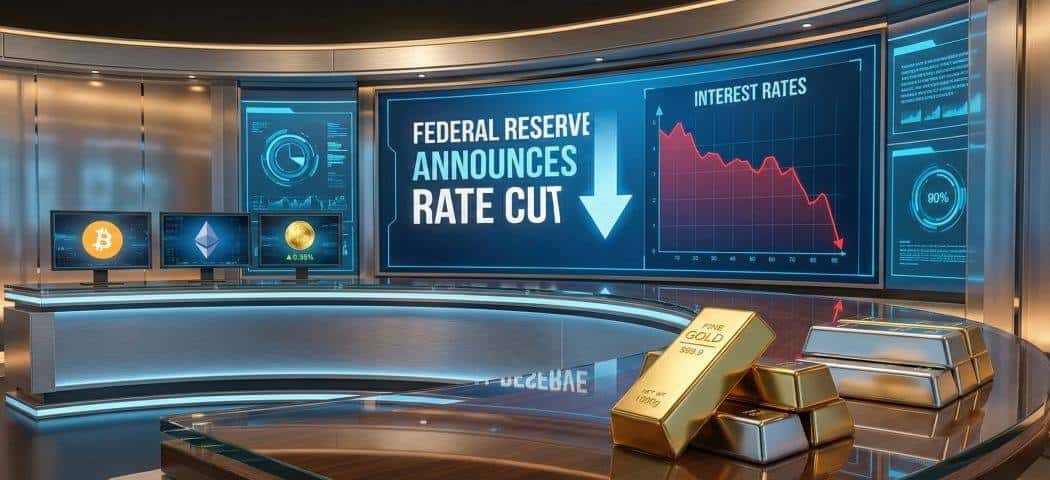
A Significant Final Rate Cut of 2025
On December 10, 2025, the Federal Reserve issued its long-anticipated final rate cut of the year, lowering the federal funds target range by another 25 basis points to 3.50%–3.75%. This marks the third rate reduction of 2025, following September and October’s easing moves, and reflects the central bank’s clearest signal yet that restrictive monetary policy is giving way to sustained accommodation.
This final act of the year caps a dramatic policy pivot: after holding rates high through most of 2025 to ensure inflation’s retreat, the Fed is now prioritizing support for slowing economic conditions. With inflation drifting closer to the 2% goal and labor markets showing signs of deceleration, policymakers gained the confidence to implement one more cut before year-end.
The move sets the stage for a very different economic landscape in 2026 — one that could reshape the trajectory of gold, silver, and cryptocurrencies as markets reprice risk, liquidity, and opportunity under a more dovish policy regime.
Why Economic Conditions Supported a Third 2025 Rate Cut
The Federal Reserve spent most of 2025 in a defensive posture. Even as headline inflation cooled, core inflation in housing, medical services, and transportation remained stubborn, preventing an earlier easing cycle. Policymakers feared that cutting prematurely could reignite price pressures.
Several factors contributed to delaying additional cuts:
-
Persistent labor-market strength through early fall
-
Sticky services inflation tied to wage growth
-
Global energy volatility affecting short-term inflation readings
-
The 43-day federal government shutdown, which created temporary distortions in economic data, disrupted hiring, and weakened consumer and business confidence
The shutdown, in particular, from October 1 - November 12, 2025, complicated the Fed’s decision-making: it depressed government spending and employment figures while simultaneously inflating some categories of inflation data tied to disrupted services and supply chains. The Fed needed clear evidence that these effects were temporary before adjusting policy again.
As winter approached, however, the data shifted decisively. Job creation slowed, wage pressures moderated, and multiple inflation readings showed sustained cooling once shutdown-related distortions washed out of the numbers — enough to justify a final 2025 rate cut widely expected by the market.
This December adjustment now marks a formal transition into a 2026 easing cycle, with deep implications for commodities, currencies, and digital assets.
Market Response: How Investors Are Expected to React
Precious Metals: Mixed at First, Bullish Over Time
Immediately following the announcement, anticipate gold and silver volatility as markets recalibrate expectations. Historically, rate cuts weaken real yields and the U.S. dollar, both of which tend to support gold and silver prices.
Key dynamics now in play:
-
Lower yields reduce the opportunity cost of holding gold
-
A softer dollar makes metals more attractive globally
-
Anticipation of additional 2026 cuts fuels defensive hedging
-
Inflation expectations stabilizing near 2% reinforce gold’s appeal
Silver — already breaking records late in 2025 — may benefit disproportionately, as industrial demand merges with monetary-driven buying.
Cryptocurrencies: Liquidity Tailwind with Volatility
Bitcoin and Ethereum typically outperform during easing cycles, as greater liquidity stimulates speculative flows. However, with regulatory uncertainty still clouding crypto markets, short-term moves may be choppy even as long-term conditions improve.
Historical Perspective: How Rate Cuts Influence Metals and Crypto
Rate-cut cycles have historically driven major rallies in precious metals:
-
In the 2008–2011 easing cycle, gold surged more than 150%.
-
During 2020–2021, gold climbed over 25% while silver outperformed dramatically.
-
Crypto markets also historically react strongly to expanded liquidity, though with higher volatility.
The core mechanism remains consistent:
➡ Lower real rates = higher demand for hard assets like gold and silver.
➡ More liquidity = stronger upside for speculative and emerging digital assets.
If the market interprets this December cut as the beginning of multiple 2026 reductions, metals may enter a renewed multi-month bull phase.
2026 Outlook: A Transformational Year for the Fed — and for Markets
With the final rate cut of 2025 now complete, investor focus has shifted squarely to next year’s path.
Several major developments will shape 2026:
1. Expected Additional Rate Cuts
Economists are forecasting two to four cuts in 2026, depending on how inflation behaves during the first two quarters. A more aggressive path is possible if unemployment rises faster than expected.
2. The Final Year of Jerome Powell’s Chairmanship
Jerome Powell’s term ends in May 2026, adding uncertainty. Markets expect:
-
A Trump-aligned nominee who supports lower interest rates
-
A potential shift toward more accommodative monetary policy
-
Altered dynamics in inflation tolerance and growth prioritization
A dovish successor could usher in a multi-year easing cycle.
3. Precious Metals Could Benefit Most
A sustained 2026 loosening cycle would likely lead to:
-
Higher gold prices as real yields fall
-
Continued strength in silver, already demonstrating explosive momentum
-
Improving platinum and palladium demand in industrial sectors
-
A weaker U.S. dollar, boosting commodities broadly
Silver, in particular, may outperform given tightening supply and relentless industrial expansion.
4. Cryptocurrencies May Re-Accelerate
Crypto markets often respond positively to easing conditions, though regulatory policy remains a wildcard. If liquidity expands, Bitcoin and Ethereum could experience fresh inflows.
Investor Strategy for 2026: Navigating a Loosening Cycle
As monetary conditions relax, long-term investors may consider the following strategies:
Diversify Across Asset Classes
Blend physical gold and silver with moderate crypto exposure to balance security with growth potential.
Track Real Yields Closely
Real yields — not nominal rate cuts — determine gold and silver direction. Declining real yields typically mean rising metals.
Use Pullbacks to Accumulate
Volatility following Fed decisions can create buying opportunities for bullion investors.
Monitor Fed Communication and Nomination Events
Markets will react sharply to announcements about Powell’s replacement and forward guidance on 2026-rate-cut trajectories.
A Fed Pivot That Redefines the Precious Metals Outlook
The Federal Reserve’s final rate cut of 2025 signals the end of a restrictive era and the beginning of a pivotal transition into 2026. With inflation moderating, economic momentum slowing, and leadership changes approaching, monetary policy is set to play a defining role in next year’s market environment.
For gold and silver investors, the shift marks one of the most favorable setups in years.
Lower rates, softer yields, and a potential 2026 dovish Fed leadership could accelerate demand across physical bullion and digital assets alike.
As 2025 draws to a close, one thing is clear:
This final cut may be remembered as the moment the next major cycle in precious metals began.