View Charts
Can Gold Erase the $38 Trillion U.S. Debt?
 0
0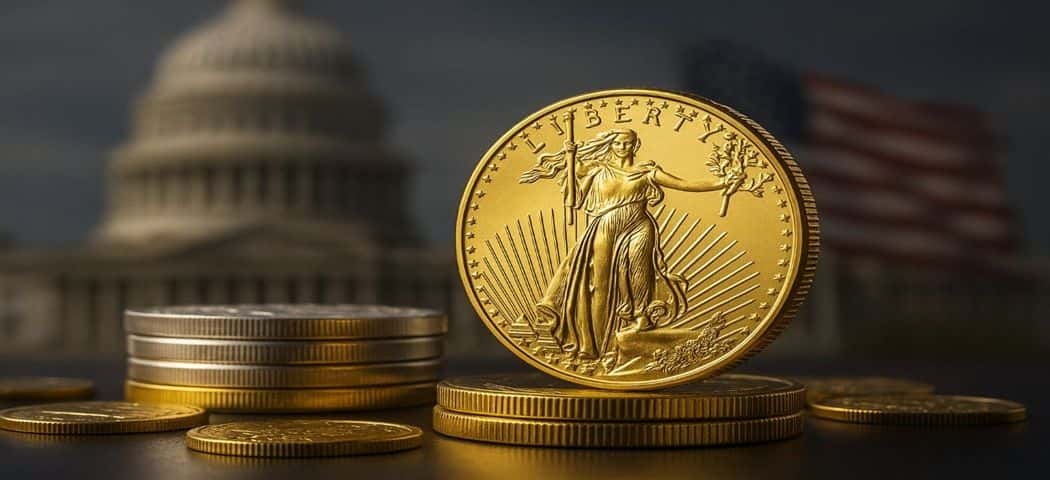
The Golden Thought Experiment
What if the price of gold climbed high enough to erase the U.S. national debt?
It’s a question that blends economic curiosity with the allure of one of humanity’s oldest assets. With the federal debt now surpassing $38 trillion, analysts and investors alike are re-evaluating the current gold price per ounce and what it would take for the metal to reclaim a central monetary role.
While the idea may sound theoretical, this exercise offers valuable insight into gold’s role in global finance, its relationship to debt and inflation, and its enduring status as a safe-haven asset. Gold remains both a barometer of trust and a reflection of fiscal stability — and the math behind this thought experiment reveals just how massive today’s debt truly is.
Calculating the “Debt-Erasing” Gold Price
To estimate how high the gold price would need to rise, consider that the world’s total above-ground gold supply is approximately 6.7 billion troy ounces. Dividing the $38 trillion national debt by that figure yields roughly $5,700 per ounce — assuming every ounce of gold in existence were mobilized to cover the liability.
Of course, not all of this metal is available. Much of it is held in jewelry, technology, or central bank reserves. In practical terms, even doubling global accessibility would barely move the needle. The calculation is more symbolic than actionable — a vivid illustration of the scale of U.S. debt relative to tangible value.
The Fort Knox Factor: U.S. Gold Reserves and Confidence
The United States officially holds 261 million troy ounces of gold, most of it stored at the Fort Knox Bullion Depository in Kentucky. At today’s gold spot price (around $4,000 per ounce), that reserve represents just over $1 trillion in value — a fraction of total federal liabilities.
To fully offset $38 trillion in debt using only U.S. gold holdings, the metal would need to be revalued at roughly $145,000 per ounce. While that figure is hypothetical, it underscores why gold remains such a powerful psychological anchor in the global monetary system.
Calls for a Fort Knox audit occasionally resurface, particularly during times of fiscal strain or political uncertainty. Though such an audit wouldn’t directly influence the gold market forecast, it could boost transparency and reaffirm the legitimacy of U.S. holdings — strengthening market confidence in the long run.
Lessons from History: Gold Revaluation and Debt Relief
This isn’t the first time gold has been linked to U.S. fiscal policy. In the Gold Reserve Act of 1934, President Franklin D. Roosevelt raised the official gold price from $20.67 to $35 per ounce, effectively devaluing the dollar and expanding the nominal value of government gold reserves. This move helped stimulate liquidity during the Great Depression and reasserted federal control over the monetary system.
While a similar gold revaluation today would be unprecedented in scope, the historical precedent demonstrates how governments can—and sometimes do—use the metal to recalibrate public balance sheets.
Could It Really Happen? The Feasibility Challenge
For gold to reach even a fraction of the theoretical $145,000 valuation, several seismic shifts would need to occur:
-
Massive currency debasement or inflation that erodes trust in fiat money and drives institutional capital toward gold.
-
Global central-bank accumulation, with nations dramatically expanding their bullion reserves to reduce reliance on the U.S. dollar.
-
Severe mining supply constraints, such as production halts or geopolitical disruptions, tightening available stocks.
-
Systemic financial crises, prompting both retail and institutional investors to seek tangible, inflation-resistant assets.
While each of these factors individually supports higher prices, all four aligning simultaneously would represent a profound restructuring of global finance. In short, it’s theoretically possible—but practically improbable in the near term.
How Long Could It Take?
Assuming steady macroeconomic pressure—moderate inflation, rising central-bank demand, and limited mine expansion—the gold market forecast could point toward gradual gains in the $4,500 – $5,000 per ounce range over the coming years.
However, reaching debt-erasing levels would likely take decades, if ever, barring a total reset of the international financial system.
Market Ripple Effects: Silver, Platinum, and Investor Behavior
Even a partial surge toward $5,000 gold would spark sweeping consequences:
-
The gold-to-silver ratio could tighten from 80:1 to around 40:1, historically common during precious-metal bull markets.
-
Mining equities and gold-backed ETFs would likely surge as investment capital chased momentum.
-
Industrial metals such as silver and platinum could benefit from renewed attention to tangible assets amid global currency uncertainty.
In essence, gold’s upward march wouldn’t occur in isolation — it would lift the entire precious metals market and reshape investor sentiment worldwide.
Gold’s Real Role in an Era of Debt
The idea of gold “erasing” the national debt is more metaphor than monetary solution — but it powerfully highlights why investors continue to buy gold bullion as both a hedge against inflation and a symbol of long-term financial stability.
Rather than waiting for a revaluation miracle, prudent investors focus on macro indicators, real interest rates, and central bank gold policy to navigate shifting market cycles with confidence.
Gold doesn’t need to reach $145,000 per ounce to prove its importance — it remains the one asset that has preserved purchasing power through centuries of debt, devaluation, and political change.
Related reading you may find interesting:
Fed Cuts Rates 0.25%: Gold, Silver & Crypto React as Policy Shifts Again
Silver’s Moment: Why the Silver Price Is Outshining Gold