View Charts
Bretton Woods Gold and the Dollar System, 1944-1971
 0
0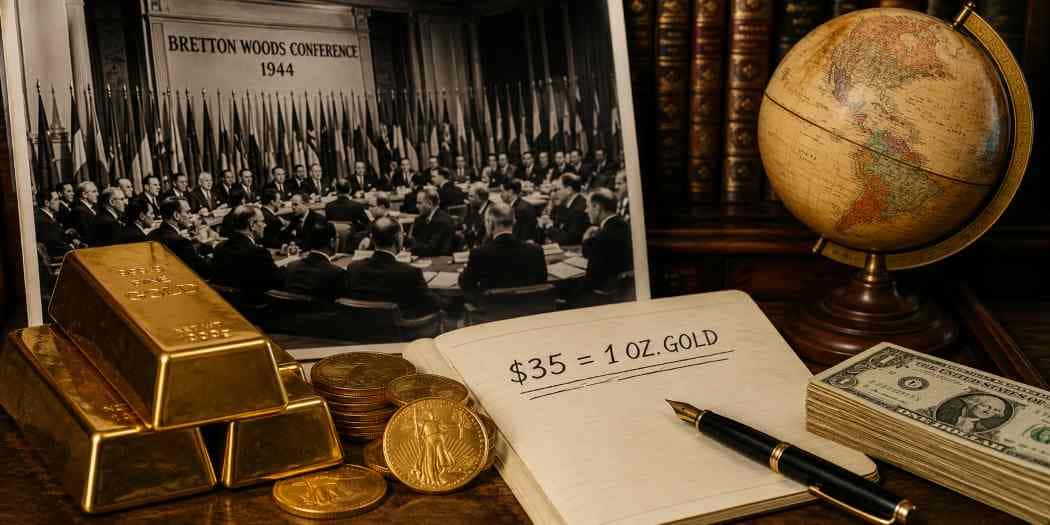
A Gold-Linked Dollar Built the Postwar Monetary Order
The Bretton Woods gold system reshaped global finance by making the U.S. dollar the central anchor of the postwar economy. Created in 1944 and fully tested through the decades that followed, the system tied foreign official dollar holdings to gold at $35 per ounce while other major currencies were fixed to the dollar. It was not a classic gold standard where every citizen could freely exchange paper money for gold. Instead, it was a government-to-government convertibility framework built around U.S. gold reserves, dollar credibility, and international cooperation.
The system matters today because many of the same questions that defined Bretton Woods still shape investor behavior: how much trust should markets place in fiat currency, how do central banks defend credibility, and why does gold remain relevant when currencies are no longer formally backed by metal? From the rise of dollar reserves to the 1971 suspension of gold convertibility, Bretton Woods explains why gold still carries monetary importance even in a floating-rate world.
The 1944 Framework Made the Dollar the Gold Link
The Bretton Woods Agreement was negotiated in July 1944, before World War II had fully ended, as Allied nations planned a more stable financial order for the postwar world. The goal was to avoid the competitive devaluations, trade restrictions, and monetary instability that had intensified economic hardship during the 1930s. Instead of returning to the rigid prewar gold standard, policymakers designed a hybrid system that combined fixed exchange rates with limited flexibility.
Under this structure, participating countries pegged their currencies to the U.S. dollar, and the United States promised foreign governments and central banks that dollars could be converted into gold at $35 per ounce. This made the dollar the main reserve currency and placed the United States at the center of international trade, finance, and monetary settlement. The International Monetary Fund and World Bank were also created as part of the broader Bretton Woods framework, giving the system institutional support beyond gold convertibility alone.
The arrangement worked because the United States emerged from World War II with enormous economic power, deep industrial capacity, and the world’s largest official gold reserves. In the early years, foreign confidence in the dollar was strong because the U.S. appeared capable of meeting gold conversion obligations.
Gold Backing Was Official, But Not Universal
One of the most important distinctions in understanding Bretton Woods gold is that the dollar was not backed by gold for everyday domestic use. American citizens had already been restricted from owning most monetary gold after the early 1930s, and ordinary dollar holders could not walk into a bank and redeem currency for bullion under Bretton Woods.
Convertibility was reserved mainly for foreign central banks and official institutions. If another country accumulated dollars through trade or reserve management, it could request gold from the U.S. Treasury at the official price. This official convertibility gave the dollar credibility abroad, but it also created a major vulnerability. The more dollars circulated globally, the larger the potential claim on America’s gold reserves became.
That tension eventually became central to the system’s breakdown. The world needed dollars for trade, reserves, and reconstruction, but too many outstanding dollars made investors and foreign governments question whether the United States could redeem them all for gold.
Fixed Exchange Rates Supported Trade and Stability
Bretton Woods was designed to create exchange-rate stability without completely eliminating national monetary policy. Countries maintained fixed but adjustable exchange rates against the dollar, allowing international businesses and governments to plan trade and investment with less currency risk. This stability helped support postwar reconstruction, global commerce, and the expansion of U.S.-led financial markets.
For much of the 1950s and early 1960s, the system appeared successful. Western Europe and Japan rebuilt rapidly, global trade expanded, and the dollar became the preferred reserve asset for many central banks. Gold remained the ultimate confidence anchor, but the dollar became the practical working currency of the international system.
This structure also reinforced U.S. financial influence. Countries needed dollar reserves to manage exchange rates, settle trade, and participate in global finance. As a result, U.S. deficits could be financed more easily because the rest of the world wanted dollars. That privilege brought major benefits, but it also created pressure once foreign dollar holdings began growing faster than U.S. gold reserves.
The Triffin Dilemma Exposed the System’s Weakness
The central flaw of Bretton Woods is often described through the Triffin dilemma, named after economist Robert Triffin. The problem was simple but powerful: the world needed the United States to supply dollars for global liquidity, yet supplying too many dollars would eventually undermine confidence in the dollar’s convertibility into gold.
If the United States ran persistent balance-of-payments deficits, more dollars flowed overseas and supported global trade. But those same dollars became claims on U.S. gold. If the United States ran surpluses to protect gold reserves, the world could face a shortage of dollar liquidity. Bretton Woods depended on solving both problems at once, and over time that became impossible.
By the 1960s, foreign governments held increasing dollar balances while U.S. gold reserves became less adequate relative to those claims. The official $35 gold price looked increasingly unrealistic as inflation pressures, overseas military spending, and domestic fiscal demands grew. Confidence in the system began to weaken because the promise of convertibility looked more difficult to maintain.
Inflation, Deficits, and Gold Outflows Pressured the Dollar
The 1960s placed intense stress on the Bretton Woods system. U.S. spending rose as the government financed the Vietnam War and expanded domestic programs. At the same time, inflation pressures began building, and foreign central banks became more concerned about holding dollars that might lose purchasing power.
Gold outflows became a visible sign of declining confidence. If foreign governments suspected the dollar was overvalued or that the United States might eventually suspend convertibility, the rational move was to exchange dollars for gold while the official window remained open. This increased pressure on U.S. reserves and forced policymakers to defend a fixed gold spot price that no longer reflected market reality.
Efforts were made to stabilize the system, including international cooperation and attempts to manage gold-market pressure. Yet the underlying imbalance continued. The United States wanted the benefits of reserve-currency leadership, but maintaining gold convertibility required monetary discipline that became politically and economically difficult.
The Nixon Shock Ended Dollar-Gold Convertibility
On August 15, 1971, President Richard Nixon announced that the United States would suspend the dollar’s convertibility into gold for foreign official holders. This decision, often called the Nixon Shock, effectively ended the core gold link within Bretton Woods.
The move was framed as temporary, but the system never returned to its original form. Without gold convertibility, the dollar could no longer serve as a fixed gold-backed anchor for other currencies. Attempts to preserve fixed exchange rates continued briefly, but by 1973 major currencies had moved toward floating exchange rates.
The 1971 suspension marked a turning point in monetary history. It ended the formal role of gold in backing the dollar and ushered in the modern fiat-currency era. Gold was no longer officially priced at $35 per ounce within the international monetary system, allowing market forces to play a much larger role in determining its value.
Gold’s Price Repricing Changed Investor Psychology
After Bretton Woods collapsed, gold entered a new era. Freed from the official $35 peg, the metal began reflecting inflation, currency confidence, interest rates, geopolitical risk, and investor demand more directly. The 1970s became a defining decade for gold because inflation surged and confidence in paper currencies weakened.
This shift changed how investors viewed bullion. Under Bretton Woods, gold functioned as an official monetary anchor behind the dollar. After 1971, it became a market-priced hedge against fiat-currency risk, inflation, and financial instability. That transformation still shapes modern precious metals investing.
Today, gold prices are no longer fixed by government agreement, but the metal’s historical monetary role continues influencing demand. Central banks still hold gold reserves, investors still use bullion as a store of value, and markets still treat gold as a confidence gauge when currencies or debt systems come under pressure.
Central Banks Still Treat Gold as Strategic Insurance
Even though no major currency is formally backed by gold today, central banks continue holding substantial gold reserves. This reflects gold’s enduring role as a neutral reserve asset that is not issued by any single government and does not depend on another country’s creditworthiness.
The legacy of Bretton Woods helps explain this behavior. The system proved that gold can support monetary confidence, but it also showed the difficulty of maintaining a fixed convertibility promise when debt, deficits, and global liquidity needs expand. Modern central banks do not usually seek a return to Bretton Woods, but many still value gold as protection against currency risk, sanctions risk, inflation, and geopolitical fragmentation.
For investors, this official-sector behavior reinforces gold’s status beyond jewelry or commodity demand. Gold remains tied to monetary trust, reserve diversification, and long-term purchasing power protection.
The Bretton Woods Legacy Still Shapes Bullion Demand
The 1944-1971 gold-dollar system remains relevant because it reveals both the strengths and limits of monetary discipline. A gold-linked dollar helped stabilize postwar exchange rates and supported decades of global growth, but the system eventually failed when international dollar claims grew larger than the credibility of U.S. gold convertibility.
That history continues influencing modern bullion demand. Investors buy gold not because the dollar is still formally redeemable for metal, but because gold represents an asset outside the credit structure of fiat currencies. It carries no central bank promise, no corporate earnings risk, and no government liability.
Understanding Bretton Woods helps explain why gold remains central to debates about inflation, currency debasement, central bank reserves, and monetary reform. The system ended more than five decades ago, but its lessons still shape how investors think about trust, liquidity, and the long-term value of money.