View Charts
Best of the Mint Revives the Legendary 1804 Silver Dollar
 0
0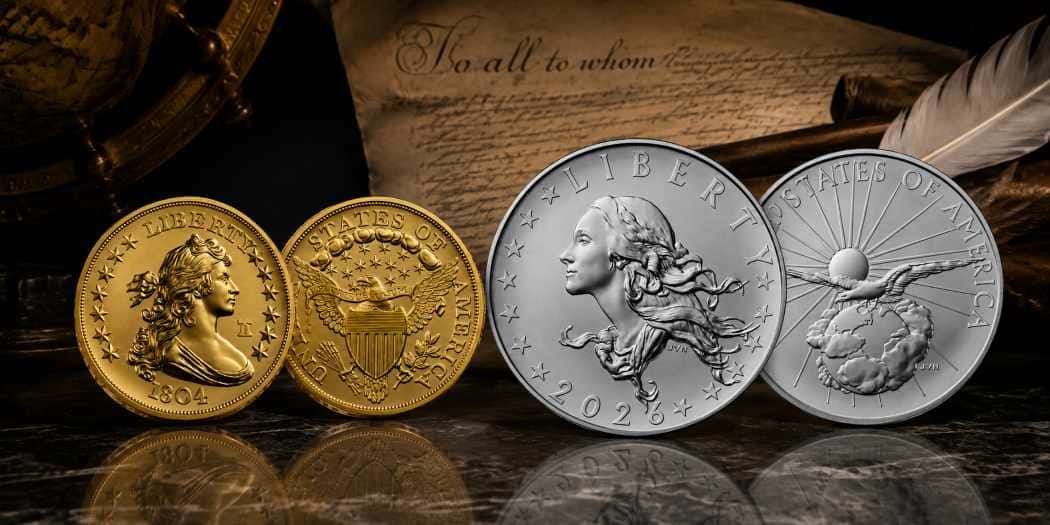
The 'King of American Coins' Returns for America's 250th Anniversary
Few American coins carry the mystique of the 1804 Silver Dollar. Known for generations as the 'King of American Coins,' the famous rarity combines an extraordinarily small surviving population with an origin story that sounds almost contradictory: despite the date on its face, the first known 1804 Dollars were not struck in 1804. They were produced decades later for diplomatic purposes, beginning a story that would eventually involve restrikes, royal presentation sets, celebrated collections, multimillion-dollar auctions, and more than a century of numismatic fascination.
That history makes the coin a natural choice for the fourth installment of the U.S. Mint's 2026 Best of the Mint series. Created for America's 250th anniversary, the five-release program brings historically important U.S. coin designs into the present as faithful 24-karat gold recreations accompanied by newly designed one-ounce silver medals. After revisiting the Mercury Dime, Standing Liberty Quarter, and Walking Liberty Half Dollar, the series now moves to one of the greatest rarities in American coinage.
The Strange Story Behind the 1804 Dollar
The 1804 Silver Dollar owes much of its fame to the unusual circumstances surrounding its creation. The Draped Bust Dollar design had been used on circulating silver dollars through coins dated 1803, but when the federal government assembled special proof coin sets for diplomatic missions in the 1830s, officials wanted the sets to include examples of U.S. denominations then in use or historically significant. New silver dollars were consequently produced bearing the date 1804.
The first examples were struck in 1834 and 1835 for presentation sets intended for foreign dignitaries. Eight examples from this original production, now classified as Class I dollars, are known. Additional 1804 Dollars were produced decades later at the Philadelphia Mint. One surviving Class II example and seven known Class III examples account for the later restrikes, giving the 1804 Dollar a history divided into distinct groups that specialists have studied for generations.
The result is one of American numismatics' great paradoxes. A coin famous for the year displayed prominently beneath Liberty was actually created long after that year had passed. Rather than diminishing its importance, the discrepancy became central to its identity, helping transform what began as a diplomatic presentation piece into one of the most closely studied coins ever produced by the United States Mint.
The Draped Bust Design Returns in Gold
The 2026 Best of the Mint gold coin preserves the visual identity that made the original famous. Its obverse features Liberty facing right with flowing hair tied by a ribbon, surrounded by 13 stars representing the original states. The portrait comes from the Draped Bust design associated with early U.S. silver coinage, connecting the modern issue to an era when the young nation was still developing the symbols and artistic conventions that would define its money.
The reverse is considerably more elaborate. A heraldic eagle with raised wings carries a United States shield across its breast, with arrows in its right talon and an olive branch in its left. Above the eagle appear clouds and 13 stars, while a scroll carries the national motto 'E PLURIBUS UNUM.' 'UNITED STATES OF AMERICA' surrounds the composition. Together, the two sides preserve the appearance associated with the legendary rarity while presenting it in an entirely different precious metal.
For the 2026 edition, the historic dollar design is struck as a high-relief coin containing one troy ounce of .9999 fine, 24-karat gold. The Semiquincentennial Liberty Bell privy mark bearing the numeral '250' identifies it as part of America's anniversary celebration without replacing the historic imagery that gives the issue its significance.
A Silver Medal Tells the Diplomatic Story
The companion medal provides the set's contemporary counterpoint. Rather than simply enlarging or duplicating the Draped Bust Dollar, the Mint's artists used the one-ounce silver medal to explore an important part of the original coin's history: its connection to American diplomacy and its journey beyond the United States.
Its design draws recognizable elements from the 1804 Dollar and transforms them into a new composition. Flowing, ribbon-like hair recalls Liberty's hairstyle on the original coin, while the arched clouds above the historic eagle are reworked into a braided motif. That braid encircles Liberty's head and a globe, visually linking the original design with the international purpose for which the famous dollars were created.
The approach gives the medal a reason to exist alongside the gold coin rather than functioning as a second copy of it. One piece recreates an artifact of early American numismatic history; the other interprets the story behind that artifact. Together they connect the 1804 Dollar's familiar imagery with the diplomatic mission that ultimately helped make the coin legendary.
A New 1804 Dollar Appeared Just Before the Anniversary
The timing of the Best of the Mint release is especially interesting because the population of known 1804 Dollars changed only recently. For years, the accepted total stood at 15 examples. Then, in 2025, a previously unrecorded Class III specimen from the collection of James A. Stack, Sr. emerged publicly, increasing the known population to 16 coins.
The newly revealed dollar was graded PR65 by Professional Coin Grading Service and became the seventh known Class III example. When Stack's Bowers Galleries offered it in December 2025, the coin realized $6 million, establishing a new auction record for an 1804 Dollar. The discovery was remarkable not simply because another example had surfaced, but because specialists had long treated the population of one of America's most researched rarities as essentially settled.
That event gives the 2026 tribute an unusually current connection to the original. Collectors are not revisiting a rarity whose story ended generations ago; the census of surviving 1804 Dollars changed less than a year before the Mint brought the design back for the Semiquincentennial.
Why the 15,000-Set Mintage Stands Out
The 1804 Silver Dollar set also carries a 15,000-unit product limit, giving it a substantially smaller potential population than several earlier entries in the program. A limited mintage never guarantees future appreciation, and secondary-market performance will depend on collector demand, precious-metal values, certified populations, and the long-term reception of the entire Best of the Mint series.
Still, the subject gives this installment an unusually broad collecting audience. Early U.S. dollar specialists, classic-coin collectors, gold buyers, modern U.S. Mint collectors, and those assembling all five Best of the Mint sets can each approach the release from a different direction. The original coin's near-mythical status also distinguishes it from designs remembered primarily for their beauty or former role in circulation. Very few collectors will ever have an opportunity to own an authentic 1804 Dollar, making an official Mint tribute a fundamentally different proposition.
More Than a Recreation of a Famous Rarity
The Best of the Mint series was created to revisit designs Americans selected as some of the most important in the nation's coinage history. With the 1804 Dollar, however, the Mint is commemorating more than celebrated artwork. The original coin became famous because of the extraordinary circumstances surrounding its creation, the tiny number that survive, and the remarkable collecting history that followed.
That makes its appearance during America's 250th anniversary particularly fitting. The first 1804 Dollars were created as objects representing the United States abroad at a time when the country was still establishing its international identity. Nearly two centuries later, the design returns in gold as part of a national celebration looking back across 250 years of American history.
With only the 1907 Saint-Gaudens High Relief Double Eagle remaining after this installment, the Best of the Mint series is also approaching its conclusion. The 1804 Dollar occupies a distinctive place within that progression: not merely an admired design from the past, but a coin whose mystery, rarity, and unlikely history helped define American numismatics itself.
Image source: U.S. Mint
Related reading you may find interesting:
Why the 1804 Silver Dollar Is Called the King of American Coins
Why the 2026 American Palladium Eagle Stands Apart
2025 American Liberty Wins Best Gold Coin at COTY Awards