View Charts
Are Platinum and Palladium the Next Precious Metals Opportunity?
 0
0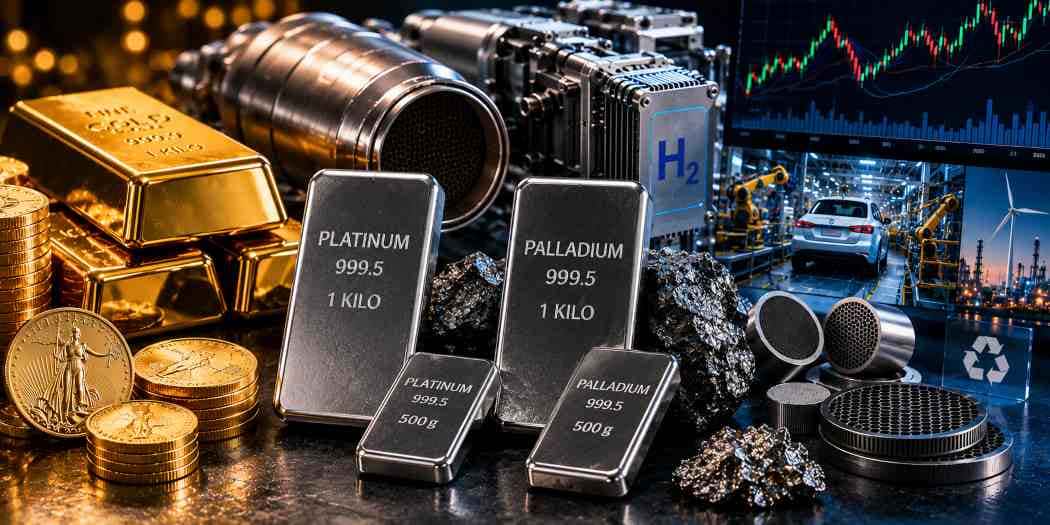
Gold’s Big Run Is Sending Investors Toward Overlooked Metals
Gold and silver movement have dominated the precious metals conversation, but the next trade may be developing in a quieter corner of the market. Platinum and palladium have spent years outside the spotlight, weighed down by automotive uncertainty, electric vehicle adoption concerns, and investor preference for gold and silver. That neglect is exactly what makes the setup worth watching.
When gold becomes expensive on a relative basis, capital does not always leave precious metals altogether. It often rotates. Some investors look for lower entry points, stronger industrial leverage, or assets that have not yet priced in the same level of bullish sentiment. That is where platinum investing and the palladium outlook begin to attract renewed attention.
The case is not simple. Platinum and palladium are more cyclical than gold, more exposed to manufacturing, and more dependent on the automotive sector. Yet those same risks can create contrarian opportunities when supply remains tight, sentiment is depressed, and prices do not fully reflect future demand.
The Rotation Trade Emerging After Gold’s Rally
Gold has become the anchor of the precious metals market, supported by central bank buying, inflation concerns, geopolitical risk, and long-term reserve diversification. Its strength has reinforced confidence in hard assets, but it has also created a valuation problem for investors searching for upside beyond the obvious trade.
Platinum and palladium offer a different proposition. They are not primarily monetary metals in the same way gold is, and they do not carry silver’s broad retail identity. Their appeal rests on scarcity, industrial necessity, and the possibility that sentiment has become too pessimistic after several difficult years.
That rotation dynamic matters because markets rarely move in a perfectly straight line. When a leading asset becomes crowded, investors often begin looking for laggards with credible catalysts. Platinum has already benefited from renewed attention as supply deficits persist, while palladium remains more controversial because of long-term electric vehicle pressure. Together, they form one of the more interesting alternative precious metals trades in today’s market.
Platinum’s Supply Story Is Hard to Ignore
Platinum’s investment case begins with supply. The metal is heavily dependent on South Africa, which accounts for the majority of global mine production. That geographic concentration creates recurring vulnerability to power constraints, labor disruptions, aging infrastructure, and capital discipline from mining companies.
Recent market research from the World Platinum Investment Council has continued to emphasize deficit conditions, with 2026 expected to mark another year in which demand exceeds supply. Above-ground stocks have been drawn down, while mining growth remains limited and recycling has not been strong enough to fully rebuild availability.
This matters because platinum does not need explosive demand growth to tighten. A market can become price-sensitive simply because supply has little flexibility. When mine output is constrained and inventories are already reduced, even modest improvement in investment demand, jewelry demand, or industrial usage can shift pricing expectations quickly.
Unlike gold, which trades heavily on macroeconomic psychology, platinum has a more physical constraint built into its market structure. Investors looking at platinum are not only assessing inflation or Federal Reserve policy. They are also evaluating whether enough metal will be available to satisfy automotive, industrial, jewelry, and investment demand at current platinum prices.
Palladium Is Riskier, but the Bearish Case May Be Too Obvious
Palladium’s reputation has changed dramatically. Once the star performer of the precious metals complex, it became closely associated with catalytic converters for gasoline-powered vehicles. As electric vehicle adoption accelerated, the market began pricing palladium as a metal facing structural decline.
That concern is valid, but it may also be too neatly packaged. Global vehicle fleets do not transition overnight. Gasoline and hybrid vehicles continue to require emissions-control systems, and hybrid adoption can extend demand for palladium even as full battery electric vehicle penetration grows. In several markets, consumers and automakers have shown that the shift to EVs is uneven, policy-sensitive, and influenced by affordability, charging infrastructure, and regional preferences.
Palladium’s challenge is that its long-term story remains cloudy. Its opportunity is that much of that concern may already be reflected in sentiment. A metal does not need a perfect outlook to rally. It only needs conditions to be less negative than the market assumed.
That is why the palladium outlook is more contrarian than bullish in a straightforward way. Investors considering palladium must weigh declining long-term automotive intensity against supply concentration, substitution trends, short-covering potential, and the possibility that hybrid demand remains stronger than expected.
Automotive Demand Still Holds the Key
Platinum and palladium both sit at the center of the global emissions-control market. Platinum is used in diesel catalytic converters and increasingly competes for substitution in gasoline applications, while palladium remains tied to gasoline and hybrid vehicle catalysts. This automotive link makes both metals more economically sensitive than gold.
The market often frames electric vehicles as an immediate death sentence for platinum group metals. Reality is more gradual. Internal combustion engine vehicles, hybrids, heavy-duty transportation, and regional auto markets continue to support demand. At the same time, automakers face cost pressures that can influence substitution between platinum and palladium.
When palladium prices were far above platinum, manufacturers had an incentive to use more platinum where technically feasible. That substitution trend helped revive interest in platinum and created another layer of uncertainty for palladium. Now, with price relationships shifting, investors are watching whether substitution slows, stabilizes, or reverses in specific applications.
The automotive sector does not provide a clean narrative. It provides a moving target. That is precisely why platinum and palladium can reprice sharply when assumptions change.
Industrial Uses Create a Broader Platinum Case
Platinum’s appeal extends beyond catalytic converters. It plays a role in chemical processing, glass manufacturing, petroleum refining, medical devices, electronics, and hydrogen-related technologies. That industrial diversity gives platinum a broader foundation than many casual investors realize.
Hydrogen remains one of the more speculative but potentially important long-term demand areas. Platinum is used in proton exchange membrane fuel cells and electrolyzers, both of which are linked to clean-energy infrastructure. The timeline for mass adoption remains uncertain, but the strategic relevance is difficult to dismiss.
More immediately, industrial demand has shown resilience in areas tied to manufacturing and advanced technology. WPIC’s 2026 analysis points to industrial demand growth helping offset weakness in some other categories. That type of demand is not as emotionally visible as gold buying, but it can be more persistent.
This gives platinum a dual identity: part precious metal, part strategic industrial input. That combination can be attractive in an environment where investors are looking for assets connected to both scarcity and real-world use.
Why Palladium Should Not Be Written Off Completely
Palladium’s long-term headwinds are real, but markets often overshoot in both directions. The same metal that once became too expensive because buyers feared scarcity may now risk being dismissed too quickly because investors fear obsolescence.
Supply remains concentrated, particularly through Russia and South Africa. Any disruption involving mining output, sanctions, refining, or transport can alter sentiment quickly. Palladium also has a history of sharp moves when available inventory becomes tight or when industrial users move to secure supply.
The lesson from past palladium cycles is that this market can move faster than broader investors expect. It is smaller, less liquid than gold, and heavily influenced by industrial users. When positioning becomes one-sided, palladium spot price reactions can be sharp.
That does not make palladium an easy long-term investment. It does make it a market worth monitoring, particularly for investors who understand that deeply unpopular assets sometimes offer the most asymmetric setups.
Bullion, Bars, and Coins in a PGM Allocation
Physical platinum and palladium ownership differs from buying gold or silver. Product availability is often narrower, premiums can be more variable, and resale markets tend to be less broad. That makes product selection especially important.
Popular options include platinum bars, palladium bars, and select government-minted coins such as Platinum American Eagles, Platinum Maple Leafs, Palladium Maple Leafs, and American Palladium Eagles. These products can appeal to investors who want tangible exposure rather than ETFs, mining equities, or futures contracts.
The trade-off is liquidity. Gold and silver enjoy deeper retail markets, while platinum and palladium require more careful buying and selling strategies. Investors who choose physical PGMs often do so because they want exposure to metals that are scarcer, less widely held, and more tied to industrial repricing.
That scarcity can be a strength, but it also requires patience. Platinum and palladium are not always as easy to accumulate or liquidate as the more familiar bullion categories.
The Opportunity Lies in Being Early, Not Certain
The strongest argument for platinum and palladium is not that either metal is guaranteed to outperform. It is that both occupy a part of the precious metals market where uncertainty remains high, investor attention remains limited, and supply-demand surprises can matter.
Gold’s strength has made the case for hard assets obvious. Platinum and palladium require a more selective mindset. Platinum offers a cleaner deficit story, industrial diversity, and potential support from jewelry and investment demand. Palladium offers a more difficult but potentially more contrarian setup, especially if automotive demand proves more durable than expected or supply risks return to focus.
Investors do not need to choose between gold and platinum group metals as an all-or-nothing decision. A diversified precious metals strategy can treat gold as the monetary anchor, silver as the high-beta hybrid metal, and platinum or palladium as smaller tactical allocations tied to industrial scarcity.
The market has spent years talking about gold. The next opportunity may belong to metals that investors stopped talking about too soon.
Related reading you may find interesting:
Why Are Precious Metals Falling Today? Market Selloff Factors