View Charts
AI Impact on Precious Metals Demand in 2026
 0
0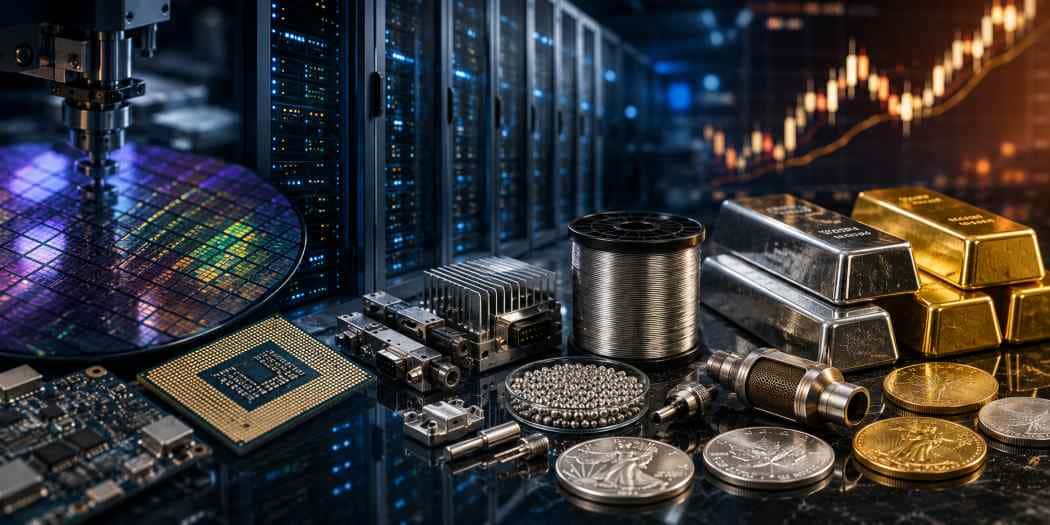
Why the Artificial Intelligence Boom Is Becoming a Metals Story
Artificial intelligence is usually discussed in terms of software breakthroughs, semiconductor leaders, and the race among technology giants to build ever-more-powerful computing systems. Yet beneath the headlines about algorithms and AI models lies a less obvious reality: the entire ecosystem depends on an enormous amount of physical infrastructure. Data centers, power networks, semiconductor fabs, cooling systems, and industrial equipment all require vast quantities of raw materials, turning what appears to be a digital revolution into a very tangible industrial expansion.
That distinction matters for precious metals investors because it broadens the conversation beyond traditional drivers such as inflation, interest rates, and safe-haven demand. For decades, precious metals markets were largely analyzed through monetary and macroeconomic lenses. Today, a growing portion of future demand is increasingly linked to technological investment, industrial buildouts, and energy infrastructure. As capital continues flowing into AI development, the metals required to support that growth are becoming part of the investment narrative.
The result is not a replacement of traditional precious metals demand but an expansion of it. Monetary demand still matters. Central bank buying still matters. Geopolitical uncertainty still matters. What has changed is that technology spending is creating an additional source of structural demand that investors can no longer afford to ignore.
The Real AI Buildout Is Happening in Concrete, Steel, and Electricity
One of the more interesting misconceptions surrounding artificial intelligence is the belief that it exists primarily in the digital world. Investors hear about cloud computing, machine learning, and large language models, but every AI application ultimately runs on physical systems that consume energy, occupy real estate, and require extensive industrial support.
The scale of investment underway is extraordinary. Technology firms are committing hundreds of billions of dollars toward data-center construction, semiconductor manufacturing, networking infrastructure, and power generation. Governments are simultaneously investing in domestic chip production and strategic technology capabilities, creating a second layer of demand that extends well beyond the private sector.
Viewed through this lens, the AI boom begins to resemble previous industrial expansions. Just as railroads, telecommunications networks, and the internet required enormous physical investment before generating widespread economic benefits, artificial intelligence is creating demand for infrastructure that must be designed, built, powered, and maintained. That infrastructure is where precious metals increasingly enter the picture.
Silver Is Emerging as the Most Direct AI Beneficiary
Among all precious metals, silver has the clearest and most immediate connection to AI-related growth. The reason is not particularly complicated. Modern technology depends heavily on efficient electrical conductivity, and silver remains the most conductive metal available for many applications.
The significance of this advantage becomes more apparent when examining how AI infrastructure is being deployed. Data centers require extensive electrical distribution systems, networking hardware, connectors, circuit boards, and power-management equipment. Semiconductor manufacturing facilities depend on highly specialized electronics and precision components. Expanding electrical grids, backup power systems, and renewable-energy projects all consume silver in varying quantities.
What makes this trend important is not necessarily the amount of silver contained within a single device. The story is one of scale. A single facility may require thousands of interconnected components. A regional network becomes a national network. Individual projects evolve into global infrastructure programs. Small amounts of silver used repeatedly across massive deployments can produce meaningful demand growth over time.
This dynamic has added a new layer to silver's investment case. Historically, investors often viewed silver through either a monetary lens or an industrial lens. Increasingly, both narratives are operating simultaneously. The same metal attracting investors concerned about inflation is also benefiting from one of the largest technology infrastructure expansions in decades.
Semiconductor Expansion Is Quietly Supporting Multiple Precious Metals
Much of the AI discussion eventually leads back to semiconductors. Advanced chips serve as the computational foundation of modern artificial intelligence, and demand for those chips has triggered one of the largest manufacturing expansion cycles the industry has ever seen.
Silver benefits from this trend through its use in conductive applications, but the story does not stop there. Gold continues to play a critical role in specialized electronics where reliability, corrosion resistance, and performance remain essential. Even in an increasingly digital world, certain high-performance applications continue to rely on gold's unique properties.
Platinum group metals also participate in this ecosystem, though often in less visible ways. Specialized manufacturing equipment, process-control systems, sensors, and industrial technologies can all incorporate platinum or palladium. Investors focusing exclusively on end products often overlook the extensive network of supporting technologies required to manufacture advanced semiconductors at scale.
What emerges is a broader observation: AI demand does not stop at the chip itself. Every expansion in semiconductor capacity creates secondary demand throughout the industrial supply chain, extending the metals footprint far beyond what most investors initially assume.
Data Centers Are Creating an Unexpected Metals Demand Cycle
Perhaps the most significant development associated with artificial intelligence is the explosive growth in data-center construction. These facilities have become the physical backbone of AI, and their energy requirements continue to reshape conversations across multiple industries.
The challenge is straightforward. Training and operating advanced AI systems requires enormous computational resources, and those resources require enormous amounts of electricity. Utilities, power providers, grid operators, and infrastructure developers are all being forced to adapt to demand forecasts that would have seemed aggressive only a few years ago.
This surge in electricity demand creates ripple effects throughout the economy. New generation capacity must be built. Transmission infrastructure requires expansion. Substations, transformers, backup systems, and energy-management technologies all become increasingly important. The metals embedded within those systems effectively become part of the AI supply chain, even if they never appear inside a server rack.
Silver remains the most visible beneficiary because of its broad electrical applications. Yet platinum and palladium also participate through specialized industrial equipment, sensors, and advanced technologies supporting large-scale infrastructure development. The connection may be indirect, but it is becoming increasingly difficult to separate the future of AI from the materials required to power it.
Platinum May Benefit From the Energy Demands of the Digital Economy
While silver's role in the AI story is relatively easy to identify, platinum's potential opportunity is more nuanced. Rather than benefiting directly from computing infrastructure, platinum may increasingly find itself connected to the energy systems needed to support long-term digital growth.
Artificial intelligence is intensifying conversations about power generation, grid stability, and future energy sources. Meeting rising electricity demand will likely require a combination of traditional generation, renewable energy, storage technologies, and potentially hydrogen-related solutions. Platinum already plays a role in several of these areas, particularly within fuel-cell and hydrogen technologies.
The timeline remains uncertain, and investors should be careful not to assume immediate demand acceleration. Nevertheless, the broader trend is difficult to ignore. If AI expansion continues driving investment in next-generation energy systems, platinum may benefit from infrastructure decisions that originate far outside the precious metals market itself.
This possibility highlights how interconnected modern markets have become. A technology trend that begins in Silicon Valley can ultimately influence industrial demand thousands of miles away through changes in energy policy and infrastructure investment.
Palladium's Opportunity Is Real but More Limited
Palladium's relationship with artificial intelligence is more complicated. Unlike silver, it lacks a broad-based connection to electrical infrastructure. Unlike platinum, it has fewer potential links to emerging energy systems. Its demand profile remains heavily influenced by the automotive sector, where emissions-control technologies continue to dominate consumption.
That does not mean AI-related growth is irrelevant. Palladium still appears in various electronic applications, specialized components, and advanced manufacturing processes. As semiconductor production and electronics manufacturing expand, incremental demand could emerge from those areas.
The challenge is one of scale. Automotive demand remains so significant that broader industry developments continue to exert greater influence over palladium prices than technology infrastructure alone. Vehicle production trends, substitution dynamics between platinum and palladium, and evolving emissions regulations are likely to remain the dominant variables.
Investors evaluating palladium should therefore view AI as a supporting factor rather than a transformational one. It adds another source of demand, but it does not fundamentally redefine the metal's market structure.
Gold's Investment Case Remains Largely Separate
One of the more interesting aspects of the AI-driven metals story is how little it changes gold's core investment thesis. While silver, platinum, and palladium are increasingly benefiting from industrial demand linked to technological expansion, gold continues to derive most of its value from monetary and financial considerations.
Central bank purchases, inflation expectations, currency trends, sovereign debt concerns, and geopolitical developments remain the dominant drivers of gold demand. Artificial intelligence may contribute indirectly through broader economic growth or investment flows, but it does not fundamentally alter gold's role within the global financial system.
This distinction is useful because it illustrates how different precious metals respond to different forces. Silver may benefit from both industrial growth and monetary demand. Platinum and palladium remain closely tied to industrial activity. Gold continues to occupy its own category as the market's primary monetary metal.
For diversified precious metals investors, that separation can be advantageous. Different demand drivers can create different opportunities, reducing reliance on a single economic outcome.
Supply Constraints Could Amplify Technology-Driven Demand
Demand stories tend to attract headlines, but supply ultimately determines how markets respond. This is particularly relevant for precious metals, where expanding production is rarely a quick or simple process.
New mining projects require years of exploration, permitting, financing, and construction before meaningful output reaches the market. Even when higher prices encourage investment, supply growth often lags demand growth by a considerable margin. Environmental regulations, labor challenges, infrastructure limitations, and geopolitical risks can create additional obstacles.
Silver has attracted particular attention because industrial demand is increasingly competing with investment demand, jewelry fabrication, and physical bullion purchases. If AI infrastructure continues expanding alongside renewable-energy deployment and broader electronics manufacturing, pressure on available supply could become more pronounced.
Platinum and palladium face their own challenges due to concentrated production profiles. Supply disruptions in key mining regions can quickly alter market sentiment when industrial demand begins strengthening.
The AI Revolution Is Expanding the Precious Metals Narrative
The most significant takeaway from artificial intelligence may not be its impact on any single metal. Instead, it is changing how investors think about precious metals as a group. For years, discussions focused primarily on inflation, interest rates, Fed monetary policy, and safe-haven demand. Those factors remain important, but they no longer tell the entire story.
Today, a growing portion of precious metals demand originates from economic expansion rather than financial uncertainty. Data centers require electricity. Semiconductor fabs require advanced manufacturing. Grid modernization requires materials. Energy infrastructure requires specialized components. The digital economy is increasingly dependent on the physical economy.
That shift does not diminish the role of gold as a store of value, nor does it guarantee higher spot prices across the sector. What it does suggest is that precious metals are becoming more deeply integrated into the technologies shaping the next phase of global economic growth.
For long-term investors, understanding that evolution may prove just as important as tracking inflation reports or central bank policy decisions. Artificial intelligence is often portrayed as a software revolution, but its impact on precious metals demonstrates that even the most advanced technologies ultimately depend on tangible resources. In that respect, the future of AI may be more closely connected to the metals market than many investors realize.
Related reading you may find interesting:
Silver Recycling and Its Impact on Market Supply