View Charts
2026 American Innovation Reverse Proof Set: What to Know
 0
0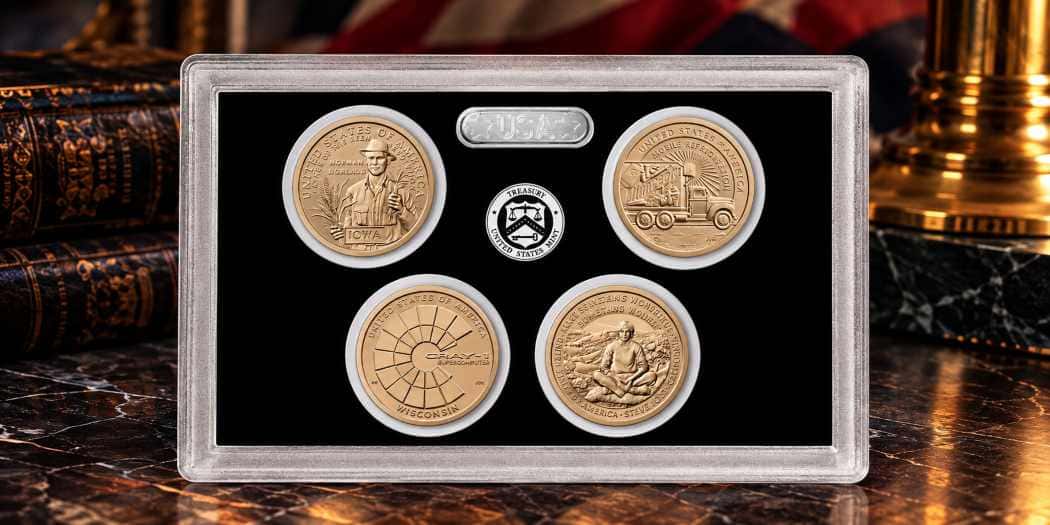
Four American Innovations Come Together in Reverse Proof
The U.S. Mint will bring all four 2026 American Innovation $1 Coin designs together on October 13 with the release of the 2026 American Innovation $1 Coin Reverse Proof Set. The four-coin set features this year's Iowa, Wisconsin, California, and Minnesota designs, but presents each one in a reverse proof finish that distinguishes the set from the regular versions issued throughout the year.
That combination gives collectors a different way to view a particularly varied year in the long-running American Innovation program. The 2026 subjects range from agricultural science and supercomputing to consumer technology and refrigerated transportation, creating a snapshot of American innovation across very different fields. The coins also share a special Liberty Bell “250” privy mark recognizing the United States Semiquincentennial, adding a common anniversary element across the four designs.
Rather than revisiting each individual release in isolation, the reverse proof set brings the year's complete group together in one San Francisco Mint product—and according to the U.S. Mint, it is the only way to obtain the 2026 American Innovation Dollars in the reverse proof finish.
What Makes the 2026 Reverse Proof Set Different?
Reverse proof coinage essentially reverses the visual contrast collectors associate with a conventional proof coin. Instead of frosted design elements against deeply mirrored fields, these coins feature reflective foreground elements against frosted backgrounds. The effect can emphasize fine details differently, particularly on designs combining portraits, machinery, landscapes, and lettering.
Bullion Exchanges previously examined the distinction in our guide to reverse proof coins and how the finish differs from traditional proofs. For the American Innovation program, that difference is particularly relevant because the 2026 designs were originally created around four very different visual subjects. Placing all four into the same reverse proof format gives the annual set a more unified appearance.
Each coin carries a $1 denomination and weighs 8.1 grams, with a diameter of 26.49 millimeters. Their composition is primarily copper with zinc, manganese, and nickel. All four reverse proof coins are produced at the San Francisco Mint and carry the “S” mint mark as part of their edge-incused inscriptions alongside “2026” and “E PLURIBUS UNUM.”
The set packages the four coins together in a clear plastic lens, creating a dedicated annual collectible rather than simply grouping standard versions of the year's releases.
Four Very Different Stories Define the 2026 Set
Iowa's coin honors Dr. Norman Borlaug, the Nobel laureate associated with the Green Revolution and advances in crop development that increased agricultural productivity around the world. Its reverse depicts Borlaug holding a sheaf of wheat alongside wheat stalks, with inscriptions identifying him as the “FATHER OF THE GREEN REVOLUTION.”
Wisconsin takes the program in an entirely different direction by celebrating the Cray-1, widely recognized as the first commercially successful supercomputer. Its circular architecture was not merely stylistic: shortening internal wiring helped reduce signal delays and contributed to the machine's extraordinary computing performance for its era. Bullion Exchanges previously explored the technology and coin design in our coverage of the 2026 Wisconsin Innovation Dollar and the Cray-1.
California honors Steve Jobs through a more reflective design. Rather than depicting one of the devices associated with Apple, the coin shows a young Jobs seated in a northern California landscape. The composition connects technological innovation with the creativity and design philosophy that shaped his approach to consumer technology. The additional inscription, “MAKE SOMETHING WONDERFUL,” reinforces that theme.
Minnesota closes the group with mobile refrigeration. Its reverse depicts a 1940s-era truck equipped with an early front-mounted refrigeration unit, representing the technology that allowed perishable goods to travel safely over much greater distances. The innovation helped reshape food distribution while later supporting the movement of medicines and other temperature-sensitive products. Bullion Exchanges examined that broader impact when the 2026 Minnesota Innovation Dollar was introduced earlier this year.
Together, the four designs make the reverse proof set broader than any single technological theme. Agriculture, computing, product design, and transportation all become parts of the same larger story about how innovation changes everyday life.
The Liberty Bell “250” Privy Connects the Set to 2026
Although the reverse designs differ, every coin shares the American Innovation program's common obverse. Justin Kunz's design presents the Statue of Liberty in profile alongside “IN GOD WE TRUST” and the denomination “$1,” while a stylized gear serves as the program's recurring symbol of industry and innovation.
For 2026, that gear incorporates an additional element: a Liberty Bell accompanied by the numeral “250.” The special privy recognizes the 250th anniversary of the United States and appears across the year's American Innovation issues.
The feature also connects these four coins to the Mint's much broader Semiquincentennial coinage program. The U.S. Mint's 250th-anniversary program uses anniversary elements across multiple established series and special releases, making 2026 an unusually design-intensive year for modern U.S. coinage.
Bullion Exchanges recently examined that wider transformation in Is 2026 the Start of a New Era for U.S. Mint Coin Collecting?, including how special finishes, privy marks, historic designs, and one-year anniversary concepts are changing the way collectors approach current Mint issues.
For American Innovation collectors specifically, the Liberty Bell “250” privy creates an easy visual distinction between the 2026 coins and earlier entries in a program that will ultimately extend through 2032.
Where the Set Fits Into the American Innovation Program
The American Innovation $1 Coin Program began in 2018 and is designed to recognize innovations or innovators connected with every state, the District of Columbia, and the five U.S. territories. Four new state designs are generally introduced each year according to the order in which states ratified the Constitution or entered the Union.
That structure makes annual sets particularly useful for collectors attempting to follow the complete program. A single year can move between scientific discoveries, inventions, individuals, industries, and cultural achievements with little thematic similarity beyond the broader concept of American innovation.
The Mint's American Innovation program overview confirms that the series is scheduled to continue through 2032. That long timeline means the 2026 group represents one chapter within a much larger collection rather than a standalone commemorative program.
The reverse proof format adds another layer for collectors who organize the series by finish as well as by state. Because the Mint identifies this set as the only source for the four 2026 coins in reverse proof, collectors pursuing that particular format will encounter the Iowa, Wisconsin, California, and Minnesota designs together rather than as separate reverse proof releases.
Why the 2026 Set Has a Distinct Identity
Modern Mint sets often derive their appeal from completeness, but the 2026 American Innovation Reverse Proof Set has several characteristics that give it a particularly recognizable identity within the series. All four coins share the same finish, San Francisco origin, anniversary privy, and common obverse while telling four very different stories on their reverses.
The year itself also matters. America's 250th anniversary has produced an unusually broad range of changes across U.S. coinage, and the Liberty Bell “250” privy gives these Innovation Dollars an unmistakable connection to that moment. Unlike an anniversary theme added only to packaging, the commemorative element appears directly on the coins.
For collectors already assembling American Innovation Dollars, the set therefore offers a clearly differentiated version of the year's four designs. For collectors approaching the program through the Semiquincentennial, it provides four examples of how the Mint has connected the anniversary to an existing multi-year series without replacing its underlying theme.
As the American Innovation program moves toward its later years, 2026 may ultimately stand apart as the point where the series' celebration of invention intersected directly with a major national anniversary. The Reverse Proof Set captures that intersection in one four-coin collection.
Image source: U.S. Mint