View Charts
1965 Quarter Value: The Coin That Ended the Silver Era
 13
13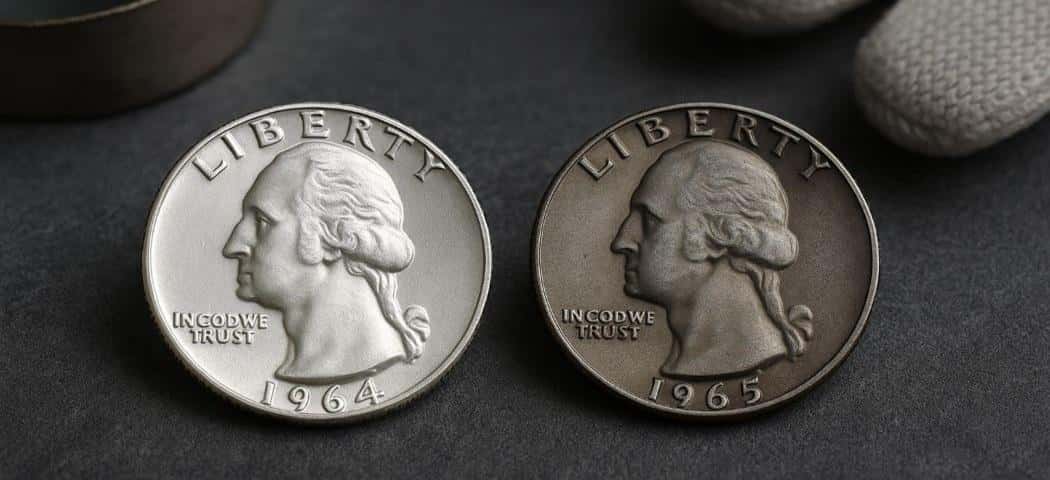
A Transitional Quarter That Redefined U.S. Coinage
The 1965 Washington Quarter stands as one of the most transformative coins in modern U.S. history. It marked the official end of the nation’s reliance on 90% silver coinage and the introduction of the copper-nickel clad composition still used today. This shift not only changed the look and feel of American currency but also reshaped how collectors view modern-era coins.
Although billions of 1965 quarters were produced, the issue holds special numismatic importance because of what it represents — the turning point from silver to clad coinage. A small number of rare 1965 silver quarters exist due to transitional minting errors, making them among the rarest quarters worth money in circulation. This article explores how one coin bridged America’s precious metal past with its modern monetary future.
The End of Silver: When Quarters Changed Forever
By the early 1960s, the rising silver price created a coin shortage. Americans began hoarding dimes, quarters, and half dollars, knowing that the melt value of 90% silver coins was quickly catching up to their face value. The result was an economic and logistical crisis for the U.S. Mint.
Congress responded with the Coinage Act of 1965, which eliminated silver from dimes and quarters and reduced it in half dollars. The Act also temporarily suspended mintmarks to discourage speculation and allowed for overlapping production years to meet demand.
This made 1965 a unique year — a transitional bridge between two eras of coinage. Some leftover silver planchets from 1964 were accidentally struck with the 1965 date, producing a few ultra-rare silver 1965 quarters that today can sell for thousands of dollars.
For collectors asking “when were quarters silver?” — 1964 was the last official year. Beginning in 1965, all U.S. quarters were made without silver, ushering in the clad era that continues to this day.
Design and Symbolism of the 1965 Washington Quarter
Although its composition changed, the 1965 quarter retained the classic design that Americans had known since 1932. Sculptor John Flanagan’s artistry honored the nation’s first president, and the design became one of the longest-running in U.S. coinage.
-
Obverse: Features a left-facing bust of George Washington, based on the famous Houdon sculpture. The inscriptions “LIBERTY,” “IN GOD WE TRUST,” and the date “1965” surround the portrait.
-
Reverse: Shows a bald eagle clutching arrows above olive branches, symbolizing both strength and peace. Surrounding inscriptions read “UNITED STATES OF AMERICA,” “E PLURIBUS UNUM,” and “QUARTER DOLLAR.”
-
Designer: John Flanagan (obverse and reverse).
-
Artistic Legacy: The Washington design remained unchanged until the launch of the 50 State Quarters Program in 1999, making the 1965 issue a symbolic close to the traditional design era.
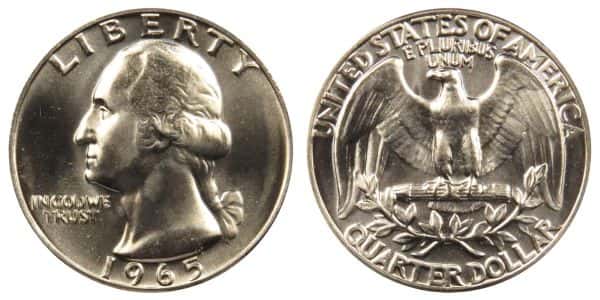
1965 Washington Quarter
Specifications and Composition
The 1965 quarter was the first to introduce the modern clad composition that continues to define circulating U.S. coins.
-
Composition: Outer layers of 75% copper and 25% nickel bonded to a pure copper core (no silver).
-
Weight: 5.67 grams (lighter than the 6.25 grams of silver quarters).
-
Diameter: 24.3 mm.
-
Edge: Reeded.
-
Mintmarks: None (mintmarks were suspended from 1965–1967).
-
Mintage: Over 1.82 billion struck — one of the largest runs in U.S. history.
Although mintmarks were omitted, production occurred primarily at the Philadelphia Mint, with supplemental output from Denver and San Francisco.
Key Varieties and Rare 1965 Quarter Errors
While the vast majority of 1965 quarters are common, several important varieties and transitional errors keep collectors searching:
-
1965 Silver Quarter Error: Struck on leftover silver planchets from 1964, these weigh 6.25 grams instead of 5.67. Genuine examples are among the rarest quarters ever found, with values ranging from $5,000 to $10,000+ depending on grade.
-
Wrong Planchet Strikes: A few quarters were struck on dime or foreign coin planchets, creating unique and collectible errors.
-
Doubled Die Varieties: Some coins show minor doubling on the obverse or reverse, modestly increasing their value.
-
Prooflike Examples: While the Mint did not strike proofs in 1965, a few coins from highly polished dies display semi-prooflike surfaces and are prized for their appearance.
These scarce varieties make the 1965 quarter one of the most fascinating modern-era coins to examine for hidden errors and anomalies.
Collector and Investor Appeal
For both collectors and investors, the 1965 quarter holds enduring appeal because it captures a key moment in U.S. coinage evolution.
-
Historical Significance: Represents the first year of non-silver quarters — the pivotal change in U.S. currency composition.
-
Affordability: Regular strikes remain accessible to all collectors, while error coins offer aspirational rarity.
-
Investment Angle: The clad version holds nominal intrinsic value, but its silver error variety ranks among the quarters worth money that can appreciate significantly over time.
-
Grading Trends: Uncirculated examples in MS66 or higher can fetch premiums of $100–$200, especially those with bright luster and minimal contact marks.
The 1965 issue bridges the affordability of modern coin collecting with the depth of historical significance, making it a core type coin in every U.S. quarter collection.
Auction Highlights and Market Performance
Over the years, the few confirmed silver-planchet 1965 quarters have commanded strong auction results:
-
January 2023: A PCGS MS62 silver error quarter sold for $9,600 at Heritage Auctions.
-
July 2021: A PCGS MS63 silver 1965 quarter brought $7,200 at Stack’s Bowers.
-
Even circulated examples have exceeded $3,000, demonstrating the strong demand for transitional rarities.
These results confirm that while most 1965 quarters are common, the rare few struck on silver planchets represent exceptional finds — blending historical intrigue with significant numismatic value.
Unique Historical Footnotes
The 1965 quarter is distinctive for more than just its metal composition. It was struck continuously through 1966 using only the 1965 date, part of the Mint’s effort to restabilize public confidence during the coin shortage. As a result, millions of “1965” quarters were technically minted after 1965 ended — an unusual footnote in American coin production.
The removal of silver also sparked public controversy. Many Americans believed that silver-backed currency symbolized financial trust and stability. The 1965 quarter became a flashpoint in that debate, later remembered as the coin that ushered in the modern era of fiduciary money.
Modern Relevance and Collecting Tips
Today, collectors still hunt for 1965 quarters in change, estate lots, and rolls — hoping to discover one of the few surviving silver examples. To check whether your 1965 quarter might be special:
-
Weigh It: Silver errors weigh 6.25 grams (clad quarters weigh 5.67g).
-
Inspect the Edge: Silver coins have a solid white edge; clad coins show visible copper.
-
Use a Magnet: Neither version should stick, but other metallic contamination could indicate counterfeit.
-
Consider Certification: Having a coin authenticated by PCGS or NGC can confirm composition and authenticity.
Even in an era dominated by digital investments, coins like the 1965 quarter remind collectors why tangible history — and real metal — still matter.
The Lasting Legacy of the 1965 Quarter
The 1965 Washington Quarter represents the dividing line between two chapters in U.S. numismatic history — the silver standard of the past and the modern monetary system of today. Though common in circulation, it remains a symbol of transition, adaptation, and innovation in American coinage.
Whether you’re a casual hobbyist curious about when quarters were silver or a serious collector hunting for one of the rarest silver quarters ever struck, the 1965 issue offers a window into a moment of profound economic change.
Discover more collectible quarters and historic U.S. coins today at Bullion Exchanges, your trusted destination for numismatic expertise and precious metals investing.
Images sourced from: USA Coin Book
13 Comments