View Charts
Standing Liberty Quarter (1916-1930)
A 25-cent coin struck by the United States Mint from 1916 to 1930, the Standing Liberty quarter succeeded the Barber quarter, which had been minted since 1892. American sculptor Hermon Atkins MacNeil's design featured the image of Liberty on one side and a flying eagle on the other. Although these coins were only produced for less than 15 years, they have cemented their place in history as one of the most beautiful quarter designs ever conceived.
Standing Liberty Quarter History
In 1915, Mint Director Robert Woolley began the process of replacing the Barber dime, quarter, and half dollar, A sculptor named Hermon Atkins MacNeil submitted a militaristic design that featured an image of Liberty standing guard, prepared for any attacks that would come her way. The identity of the model for the obverse of the quarter is uncertain. Some claim the muse was reported to be Doris Doscher (later known as silent film star Doris Doree), and some claim it was Broadway actress Irene MacDowell.
In late 1916, without consulting MacNeil, Mint officials made major changes to MacNeil's design. The sculptor understandably complained about the changes in January 1917. Consequently, the Mint quickly obtained special legislation to allow MacNeil to redesign the coin as he desired. One notable change MacNeil made was adding a chain mail vest to cover Liberty's formerly bare breast.
American citizens immediately fell in love with the Standing Liberty Quarter when it was first introduced, as the design was admired for its fierce imagery and distinct elements. However, the new design provided some challenges - in circulation, the coin's date wore away quickly. Once noticed by the Mint, the engravers edited the design in 1925 to address the issue. The Standing Liberty quarter was discontinued in 1931; that year, no quarters were struck.
Standing Liberty Quarter Design and Varieties
What design is on the Standing Liberty Quarter?
There are two main designs/composition variations of the Standing Liberty Quarter: Type 1, struck from 1916-1917, and Type 2, struck from 1917-1930.
Both design variations contain 90% Silver - 10% Copper. They also feature Liberty standing guard while holding a shield on the obverse and an eagle in mid-flight on the reverse. However, the Type 2 design showcases small modifications made by the artist after he was dissatisfied with the Mint’s original alterations in 1916.
Standing Liberty Quarter Type 1: 1916-1917
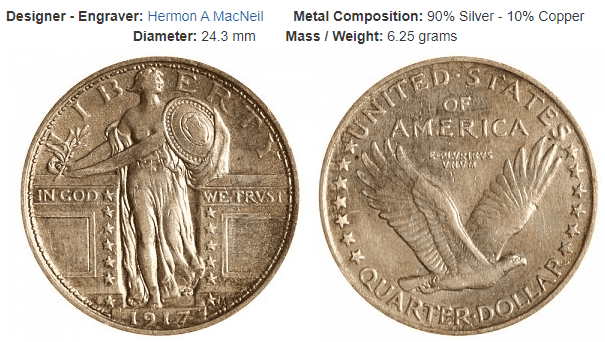
Image source: https://www.usacoinbook.com
Standing Liberty Quarter Type 2: 1917-1930
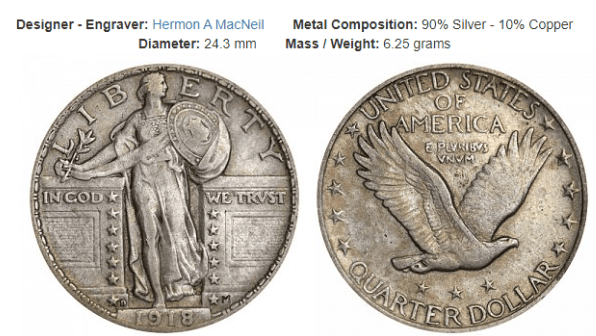
Image source: https://www.usacoinbook.com
What Is The Value of a Standing Liberty Quarter?
Standing Liberty Quarters are among some of the desirable quarter dollars to collect due to their design. The value of a Standing Liberty Quarter will vary depending on the year of mintage, the coin’s condition, and the mintmark. For example, the “S” mintmark (denoting the coin was minted in San Francisco) is one of the rarest and highly sought-after mint marks for this particular coin. While the price of these historic silver coins usually ranges from around $6 up to $300 in substandard conditions. a few rarer varieties in great condition can be worth between $1,000 and $40,000. During this coin’s production, about 3 varieties of this coin have been valued at $7,000 or higher (in certain conditions). These varieties are listed below:
1916 P Standing Liberty Quarter
Value: Between $2,500 and $20,000, depending on condition
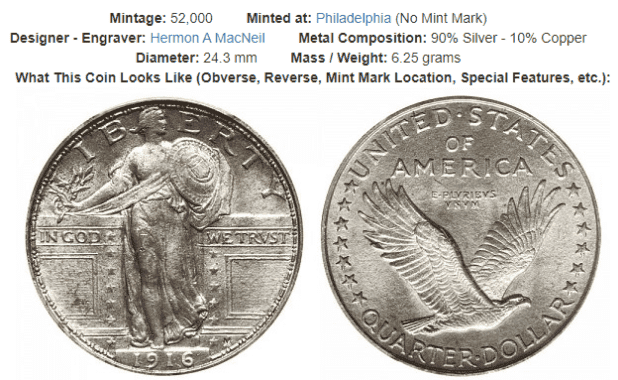
Image source: https://www.usacoinbook.com
1918 S Standing Liberty Quarter: 8 Over 7
Value: Between $1,800 and $36,000, depending on condition
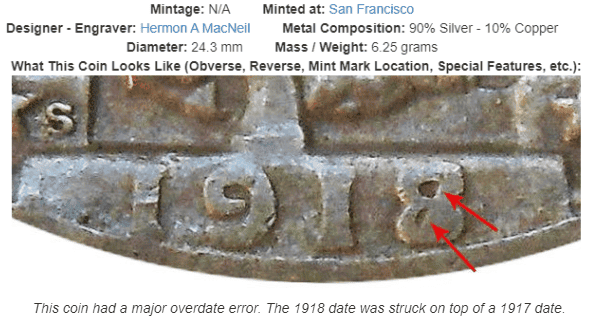
Image source: https://www.usacoinbook.com
1927 S Standing Liberty Quarter
Value: Between $45 and $7,850, depending on condition
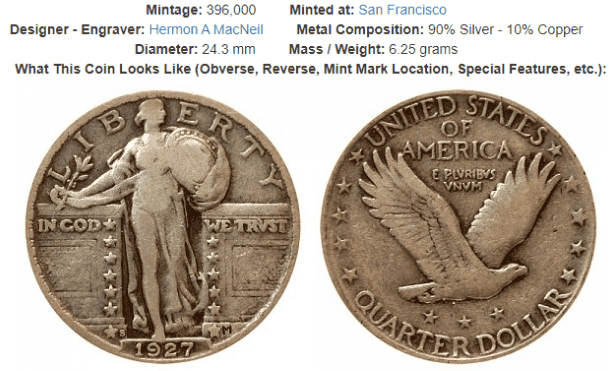
Image source: https://www.usacoinbook.com
Why Should I Collect Standing Liberty Quarters?
In comparison to other American silver coinage, Standing Liberty Quarters are not as easy to find, as they were only minted for about 15 years total. This makes adding them to your collection all the more satisfying! Values for the common dates/ mintmarks usually range from $6-$100 in “Good” condition and up to $200-$2,000 or more in MS 63 condition. Due to their low mintage, these Liberty coins hold an undeniable historical and collector appeal. As always, we encourage you to seek the help of a numismatic professional when determining the value of your coin.