View Charts
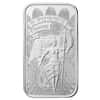
1908-1933 Saint Gaudens 20 Dollar Gold Coin
A Masterpiece of American Coinage
The Saint Gaudens $20 Gold Double Eagle (1907–1933) is often hailed as the most beautiful U.S. coin ever produced. Designed by renowned sculptor Augustus Saint Gaudens at the request of President Theodore Roosevelt, the coin represented a bold artistic renaissance in American numismatics.
Struck in .900 fine gold, the Double Eagle features a commanding depiction of Lady Liberty striding forward with a torch of enlightenment in her right hand and an olive branch of peace in her left. Behind her, the rising sun and the U.S. Capitol radiate light, symbolizing national strength and renewal. The reverse portrays a soaring bald eagle against the sun’s rays — an image of power and freedom that remains iconic today.
Historical Background: Roosevelt’s Vision and Saint Gaudens’ Legacy
Before the Saint Gaudens Double Eagle, all U.S. coin designs came from within the Mint. That changed when President Theodore Roosevelt sought to elevate American coinage to the level of classical art. In 1905, he commissioned Saint Gaudens, already one of the nation’s most respected sculptors, to redesign U.S. gold coins.
Unfortunately, Saint Gaudens passed away in 1907 before his ambitious high-relief vision could be fully realized. The Mint later modified the design for mass production, resulting in lower-relief versions suitable for circulation. Despite these adjustments, the Saint Gaudens $20 Gold Coin remains one of the most celebrated numismatic achievements in U.S. history.
Design Evolution and Types
The series underwent several notable changes during its brief but illustrious production run:
-
Ultra High Relief (1907): Struck in extremely limited quantities, this edition represented Saint Gaudens’ original concept. Only a few dozen exist, making them among the most coveted U.S. coins ever produced.
-
High Relief (1907): Modified slightly for practicality, this version retained most of the original depth and artistry and is highly prized by collectors.
-
Type 2 – No Motto (1907–1908): Early production omitted the national motto “In God We Trust,” sparking public and congressional backlash.
-
Type 3 – With Motto (1908–1933): Following an act of Congress, the motto was restored, and this became the standard issue for the remainder of the series.
Each type preserves the unmatched craftsmanship and national symbolism envisioned by Saint Gaudens.
Ultra High Relief (1907)
Mintage: 25 (with variations)
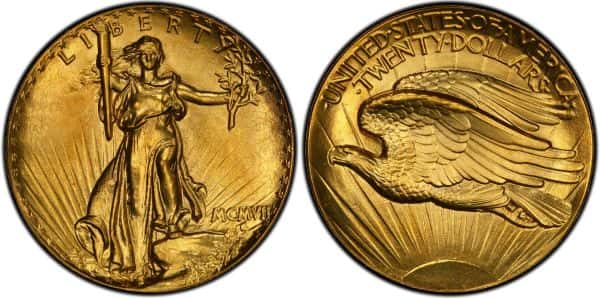
Type 1, High Relief (1907)
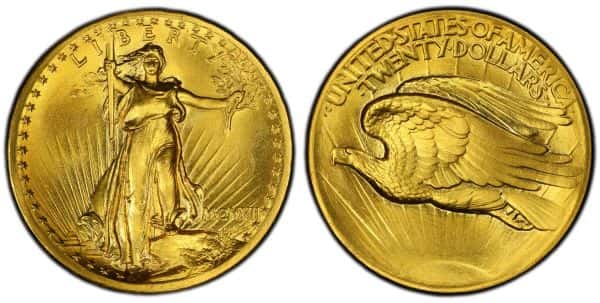
Type 2 - No Motto (1907-1908)
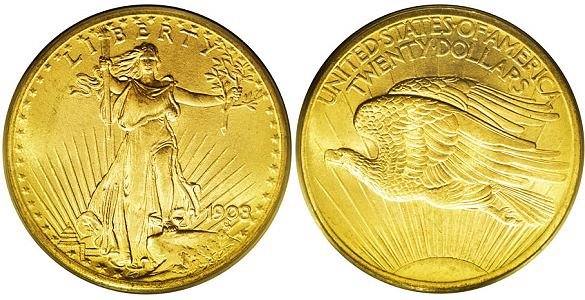
Type 3 - With Motto “In God We Trust” (1908-1933)
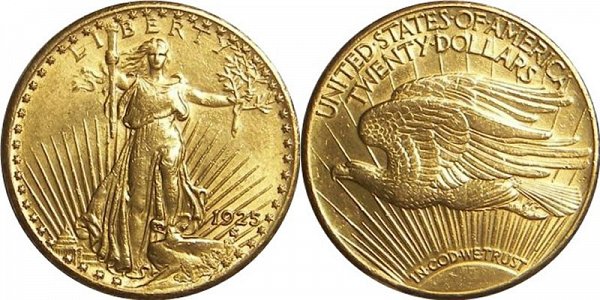
Mintmarks and Production
The Saint Gaudens $20 Gold Coins were struck at three U.S. Mint facilities:
-
Philadelphia (no mintmark)
-
Denver (D)
-
San Francisco (S)
Mintmarks can be found above the year on the obverse. These marks play an important role in determining rarity, as some low-mintage issues — particularly those from San Francisco and Denver — are among the most desirable in the series.
Specifications:
-
Denomination: $20 (Double Eagle)
-
Composition: .900 fine gold (90% gold, 10% copper)
-
Total Weight: 33.436 grams
-
Actual Gold Weight (AGW): 0.9675 troy ounces
-
Diameter: 34 mm
-
Edge: Lettered (“E PLURIBUS UNUM”)
-
Designer: Augustus Saint Gaudens
-
Years of Mintage: 1907–1933
Each Saint Gaudens Double Eagle was meticulously crafted to balance durability and beauty, combining its substantial gold content with the rich copper alloy that enhanced its luster and strike quality.
Market Values and Record Sales
While the gold spot price establishes the baseline intrinsic value of each Double Eagle, most examples command significantly higher numismatic premiums due to rarity, condition, and historical significance. Coins graded by PCGS or NGC often achieve premium prices, especially those in higher mint state grades or from scarce mint years.
The value of a Saint Gaudens $20 Gold Double Eagle depends on its date, mintmark, and condition. Even circulated examples trade well above their intrinsic gold value because of their historical and artistic significance.
Typical Uncertified Circulated Values (approximate, as of 2025):
-
Common-date circulated coins (1908 – 1928): $4,200 – $4,800 USD
-
Lightly circulated or higher-grade examples: $5,000 – $6,000 USD
-
Scarcer mintmarks such as 1908-S, 1921, and 1930-S often range between $25,000 – $90,000, depending on grade and originality.
Certified high-grade pieces and key rarities have achieved extraordinary results at auction:
-
1933 Saint Gaudens Double Eagle – PCGS MS65: Sold for $18.9 million at Sotheby’s (2021), setting the world record for any coin.
-
1907 Ultra High Relief – NGC PR68: Realized $4.75 million at Stack’s Bowers (2021).
-
1927-D – PCGS MS67: Brought $2.16 million at Heritage Auctions (2022).
These sales underscore how condition rarity, mintmark scarcity, and historic context drive value far beyond bullion content — establishing the Saint Gaudens Double Eagle as one of the most desirable and collectible U.S. gold coins ever struck.
The End of an Era
Production of the Double Eagle came to an abrupt end in 1933 when President Franklin D. Roosevelt issued Executive Order 6102, prohibiting private gold ownership to stabilize the U.S. economy during the Great Depression. Millions of coins were melted down, and only a fraction survived.
The rarity of surviving Saint Gaudens coins contributes to their enduring appeal. Some 1933 examples are among the most valuable coins ever sold, with a few specimens residing in museum or private collections.
The design was so iconic that the U.S. Mint revived it in 1986 for the modern American Gold Eagle bullion series, ensuring Saint Gaudens’ artistic legacy continues into the 21st century.
Ultra High Relief (2009)
Mintage: 114,427
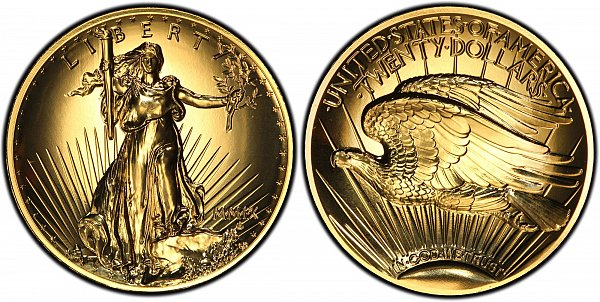
The 2009 Re-Issue: Ultra High Relief Revival
In 2009, the U.S. Mint re-imagined Augustus Saint Gaudens’ masterpiece with the Ultra High Relief $20 Gold Coin, a one-year commemorative struck in one troy ounce of .9999 fine (24-karat) gold. With a limited mintage of 114,427 coins, this modern tribute fulfilled the sculptor’s original vision through cutting-edge digital engraving and high-tonnage minting presses.
Unlike the circulating issues of 1907–1933, the 2009 release was intended solely for collectors. Its smaller diameter (27 mm) and thicker planchet enabled the U.S. Mint to replicate the dramatic depth of the 1907 design in full sculptural relief, complete with edge lettering reading “E PLURIBUS UNUM.” It remains one of the most striking modern gold coins issued by the Mint and a fitting homage to America’s greatest coin design.
A Lasting Symbol of American Artistry
The Saint Gaudens $20 Gold Double Eagle endures as the pinnacle of American coin design — a fusion of beauty, history, and intrinsic value. From its creation in Roosevelt’s “Golden Age of Coinage” to its 21st-century revival, the design continues to inspire modern numismatics and bullion artistry.
Its influence lives on most notably through the American Gold Eagle series, first issued in 1986 and still featuring Saint Gaudens’ iconic Liberty design on its obverse. Together, these coins reflect America’s enduring commitment to artistry, freedom, and the timeless value of gold. For collectors and investors alike, the Double Eagle remains both a masterpiece of design and a cornerstone of U.S. numismatic heritage.
Images sourced from: PCGS CoinFacts & usacoinbook.com