View Charts
1907-1929 5 Dollar Indian Head Gold Coin
The 5-dollar gold coin Indian Head edition did not last very long in US coinage history. Production of the half eagle gold coins ended in 1929, which left these coins at a run that lasted under 20 years. Consequently, few of these pre-1933 gold coins remain on the market today. This is also why the Gold Indian Head coins are highly sought after for their rare and historic design.
Back in the early 1900s, President Theodore Roosevelt trusted the task of redesigning the US coinage to renowned artist and sculptor Augustus Saint Gaudens. This artist was so chosen because Roosevelt trusted he could create beautiful US coinage. Unfortunately, Saint Gaudens was only able to finish two coin designs before his untimely death. The US Mint thought that the designs he made would easily transfer to smaller denomination coins, but this was not the case. The mint struggled to have enough room for the necessary inscriptions on the obverse and reverse in addition to the image. This is why the design of the Indian Head 5-dollar gold coin, and the $2.5 gold coin, are different from the 10-dollar Indian Head gold coins.
Gold half eagle coins are valued as rarities today because many were either not released or recalled and melted in 1933. Despite the fact that Americans could not privately own precious metals from 1933 to 1974, some people secretly stored their half eagle gold coins. This small act of rebellion is partially why few of the 5-dollar Indian head gold coins continue to exist today.
Historic Facts About The $5 Indian Head Gold Coin
Because of production difficulties with striking the Saint Gaudens’ image on the smaller denomination coins, a fellow artist had to create a new design. Hence, the illustration for the $2.5 and 5-dollar gold coin Indian Head releases differs from the 10-dollar gold coin edition. Sculptor Bela Lyon Pratt undertook this task to illustrate the small denomination Indian Head gold coins.
The reverse of the $5 Indian Head gold coin displays an Indigenous American male wearing a feathered war bonnet. He faces the left side of the coin, so we see only his left profile and striking headdress. The other side features the American Eagle perched atop a bundle of arrows with a vine creeping across them.
Regular mintage of the Indian Head 5-dollar gold coin type ceased from 1916 until 1929 because of the economic unrest stemming from WWI. The war effort caused the gold price to rise, increasing the cost of production for coins. This inspired people to hoard these gold coins for their metal content. The US Mint stopped minting the lower denomination gold dollar coins as a result, but they struck the Indian Head 5 dollar gold coin once more in 1929.
About 662,000 of the gold half eagle coins were struck back in 1929, but fewer than 200 may exist today. This is owing to the fact that many were stored in the Treasury Department since gold was disappearing from circulation after WWI. Therefore, the Indian Head 5-dollar gold coin is an elusive item that is a treasured item by numismatic enthusiasts today.
5 Dollar Indian Head Gold Coin Design History
Not many changes were made to the $5 Indian Head gold coin. Aside from mint marks that vary from Denver, San Francisco, New Orleans, and Philadelphia (no mintmark), the design of the gold half eagle coins remained the same. However, there were some proof editions made from 1908-1915. What is particularly impressive about the 5-dollar gold coin Indian Head design is that the illustrations are incuse. This means that the image is actually pressed into the coin, which was very unusual. Having an incuse design makes these coins thinner than others. Mintmarks, however, are not always sunken into the coin.
What is the 5 Dollar Indian Head Gold Coin Value?
The value of an Indian Head gold coin with a face value of $5 will vary according to mintmark, year, finish, mintage, and condition.
Indian Head $5 Gold Coin (1908-1915, 1929)
5 Dollar Indian Head Gold Coin Value: Varies
Designer - Engraver: Bela Lyon Pratt Metal Composition: 90% Gold - 10% Copper
Diameter: 21.6 mm Mass / Weight: 8.36 gram
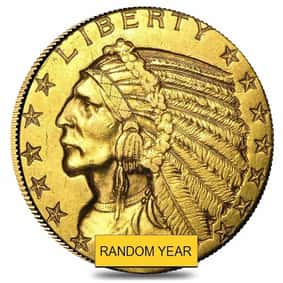
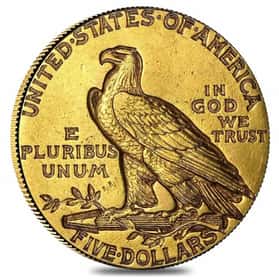
The Indian Head 5 dollar gold coins have a low surviving mintage, which is why they might carry a higher price in the numismatic market than other US gold coins. If certified, these half-eagle gold coins may be worth even more. The main factors that affect the 5-dollar Indian Head gold coin value include whether or not it has a mintmark, what year it was minted, its finish, and its condition.
Before you send your coin for certification, you can get a rough estimate of the value of your $5 gold coin by analyzing its surface for wear and tear. Coins that are certified by professional grading companies, such as PCGS or NGC, can potentially receive a higher premium and value increase. This is especially true if the coin has a decent grade. If you find one of these $5 Indian Head gold coins, you may want to get in touch with a professional numismatist to make sure that you can receive the highest quote possible.