View Charts
1907-1933 10 Dollar Indian Head Gold Coin
Around the time of the release of the $10 Indian Head gold coin, there was a major overhaul of the US coinage system. President Theodore Roosevelt called for a massive redesign of the US Mint coins, and he tasked the famed sculptor Augustus Saint Gaudens to herald the task. This artist worked in his studio in New Hampshire, now a National Historic Site, in his poor health. He was able to only finish designs for two denominations, the $10 and $20 gold coins, before his death. The 10-dollar Indian Head gold coin remains one of the most collected US gold coins of all time, earning a special place in the hearts of numismatic enthusiasts everywhere.
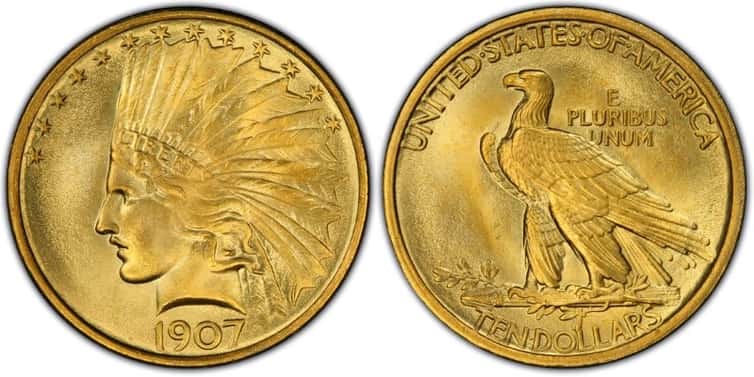
These two designs were first struck in 1907, including this 10 Dollar Indian Head gold coin. This 10-dollar gold coin features a renowned design of a woman wearing an Indigenous American war bonnet on the obverse. The woman who served as the model for this coin is rumored to either be St Gaudens’ mistress, Davida Clark, or else Mary Cunningham. Cunningham was an Irish-born waitress who worked in a restaurant in Windsor, VT across the river from his home. However, neither of these theories has been confirmed, but the features of the woman do appear to be caucasian in nature.
The reverse of the $10 Indian Head gold coin displayed an eagle perched atop a branch. This same design was modified and used for the $2.50 and $5 Indian Head gold coins that began being issued in 1908.
In the final year of production, most of the coins were recalled and melted. Those struck in 1933 were not issued to the public after private ownership of gold was outlawed. However, some were able to keep their gold coins in secret, and many of the $10 gold coins made it overseas, which is why some remain to this day.
Historic Facts About The $10 Indian Head Gold Coin
Before this coin and the Saint Gaudens $20 Gold Eagle coin, no one employed outside of the US Mint designed any US coinage in such a major fashion. However, President Theodore Roosevelt’s mission was to beautify American coinage and handpicked Augustus Saint Gaudens for the job. The President insisted that Gaudens was the only one who could take this task on, even though Gaudens had a complicated history with the US Mint’s Chief Engraver Charles E. Barber.
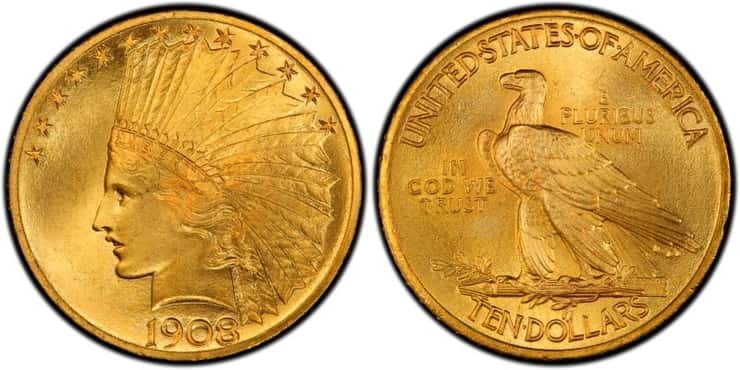
Unfortunately, Gaudens was only ever able to finish the Gold Eagle and Gold Double Eagle coins due to his poor health. He passed away in 1907 before the illustrations could be finalized, which is why his designs were slightly modified posthumously. The two denominations that he was able to finish were edited for ease of production and public approval, such as adding the motto “IN GOD WE TRUST” to the coins.
10 Dollar Indian Head Gold Coin Design History
The original St Gaudens $10 gold coin design was slightly modified after his death because there was a public outrage about how the coins deliberately lacked the motto “IN GOD WE TRUST.” Congress swiftly responded to the public outrage and intervened to include the motto that same year of initial release in 1907.
The ten-dollar Indian Head gold coin did not see significant design changes in its history. However, the edge of the coin was altered several times. The first type, known as the Wire Edge Regular Strike, lacks a strong border. This caused preservation issues with the design since there was no border to protect the interior designs of the coins. Type 1, 1907 Indian Head 10-dollar gold coins are actually very rare and carry a high value despite flaws.
Type 2 - Rolled Edge 1907 Indian Head 10 dollar gold coin was actually melted before being released for circulation. About only 40-45 of them exist today as a result. Then, Type 3 was released with an edge without “In God We Trust.” This omission on the 1907 Indian Head 10-dollar gold coin greatly upset the American public. However, Type 3 remains a fairly common coin type to find, and many were stored by citizens during the first year of issue as keepsakes.
Finally, Type 4 was created with an edge and with the words “In God We Trust” added to it. This type was regularly minted until 1933 after the US prohibited private ownership of precious metals and began to shift towards leaving the gold standard.
Where is the Mintmark on the Ten Dollar Indian Head Gold Coin?
The Indian Head gold coin is a collector’s favorite, and many people endeavor to develop a full collection of these coins. These coins were manufactured in the Philadelphia, Denver, and San Francisco Mints for all their history. Keep in mind that Philadelphia Mint coins almost never display a “P” mintmark, but an “S” or “D” may appear on the obverse to signify the mint that manufactured the coin. You can find the mintmark beside the denomination on the obverse.
What is the Value of an Indian Head Gold Coin?
Please note, that $10 Indian Head gold coins will vary in value depending on mintmark, design type, year, finish, and condition.
Type 1, Wire Edge & No Motto - Regular Strike (1907)
10 Dollar Indian Head Gold Coin Value: $22,500+
Designer - Engraver: Augustus Saint Gaudens Metal Composition: 90% Gold - 10% Copper
Diameter: 26.80 mm Mass / Weight: 16.70 grams Mintage: 500 (with rim variations)
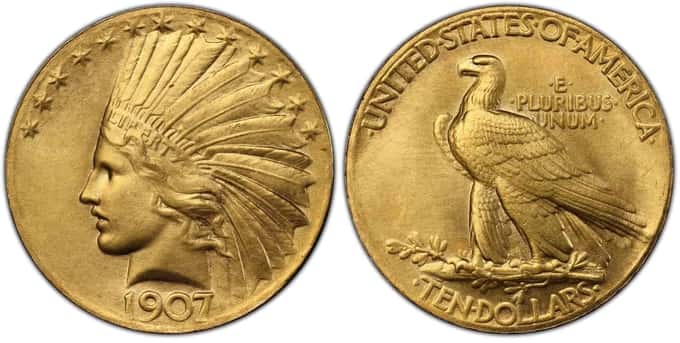
Type 2, Rolled Edge (1907)
10 Dollar Indian Head Gold Coin Value: $45,000+, depends on condition
Designer - Engraver: Augustus Saint Gaudens Metal Composition: 90% Gold - 10% Copper
Diameter: 26.80 mm Mass / Weight: 16.70 grams Mintage: 42
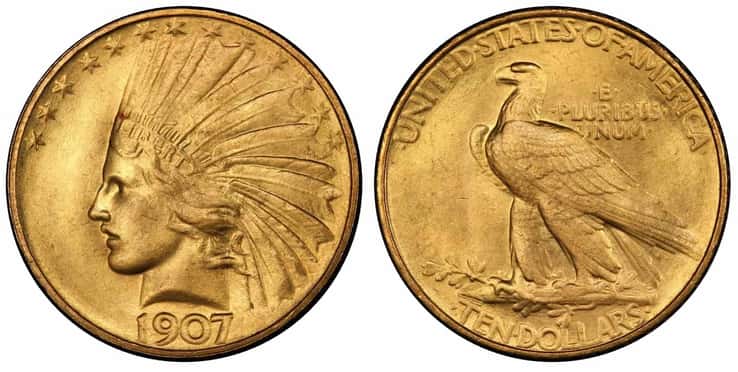
Type 3 - No Motto “In God We Trust” (1907-1908)
10 Dollar Indian Head Gold Coin Value: $1,000+, depends on condition
Designer - Engraver: Augustus Saint Gaudens Metal Composition: 90% Gold - 10% Copper
Diameter: 26.80 mm Mass / Weight: 16.70 grams Mintage: 239,406
Type 4 - With Motto “In God We Trust” (1908-1933)
10 Dollar Indian Head Gold Coin Value: Depends on condition and year
Designer - Engraver: Augustus Saint Gaudens Metal Composition: 90% Gold - 10% Copper
Diameter: 26.80 mm Mass / Weight: 16.70 grams
Locating a 10-dollar Indian Head gold coin may be a difficult undertaking, particularly since many of these coins were melted or confiscated over the years. Although the condition will weigh on the value of an Indian Head gold coin, these are still highly regarded as gold bullion and carry high numismatic value.
If these coins have a higher condition and low surviving mintage, then they are more likely to carry a strong price, especially as certified pieces. Other factors that weigh on the value of an Indian Head gold coin include whether or not it has a mintmark, what year it was minted, its design type, and its condition.
Before you send your coin for certification, you can get a rough estimate of the value of your $10 gold coin by analyzing its surface for wear and tear. Coins that are certified by professional grading companies, such as PCGS or NGC, can potentially receive a higher premium and value increase. This is especially true if the coin has a decent grade. If you find one of these $10 Indian Head gold coins, you may want to get in touch with a professional numismatist to make sure that you can receive the highest quote possible.