View Charts
1965 Quarter Value and History: A Transitional Coin That Changed U.S. Coinage
Why the 1965 Quarter Remains a Key Piece in U.S. Coinage History
The 1965 Washington Quarter is one of the most searched and discussed coins in modern U.S. numismatics, largely because collectors want to know one key question: what is a 1965 quarter worth today—and could it be silver? While most 1965 quarters are common and worth face value, a small number of rare transitional error coins struck on silver planchets have made this issue highly intriguing to collectors.
As the first quarter produced after the U.S. officially removed silver from circulating coinage, the 1965 quarter represents a major turning point in American monetary history. For collectors and investors alike, it offers a unique combination of historical significance, affordability, and the potential for rare, high-value discoveries. Understanding how to identify valuable varieties—and what separates a standard clad coin from a rare silver error—is essential when evaluating any 1965 quarter.
What Is a 1965 Quarter Worth Today?
In most cases, a standard 1965 quarter is worth 25 cents, as it contains no silver and was produced in extremely large quantities. With over 1.8 billion coins minted, the vast majority remain common in circulation and carry little to no premium above face value unless found in exceptional uncirculated condition.
However, rare exceptions exist—and they are what drive collector interest. A small number of 1965 quarters were mistakenly struck on leftover 90% silver planchets from 1964. These transitional error coins are significantly more valuable and can sell for $5,000 to over $10,000, depending on condition and certification.
To determine whether a 1965 quarter has additional value, collectors should check:
-
Weight: Silver quarters weigh approximately 6.25 grams, while clad coins weigh 5.67 grams
-
Edge appearance: Silver coins have a solid silver-colored edge, while clad coins show a copper stripe
-
Condition: High-grade coins (MS65+) may carry premiums even without errors
While rare silver errors are extremely uncommon, they continue to drive strong interest in this otherwise common coin, making the 1965 quarter a favorite among coin roll hunters and collectors alike.
Historical Background: The Coin That Ended the Silver Era
By the early 1960s, the U.S. faced a growing coinage crisis. Rising silver prices caused widespread hoarding of dimes, quarters, and half dollars — all of which were struck in 90% silver at the time. As silver approached its face-value parity, the U.S. Mint struggled to maintain supply for daily commerce.
In response, Congress passed the Coinage Act of 1965, which eliminated silver from dimes and quarters and reduced it in half dollars. The legislation also suspended mintmarks to discourage speculation and authorized the clad copper-nickel composition still used today.
Production of the 1965-dated quarters actually began in mid-1965 and continued through 1966, overlapping with the remaining silver coin output. This overlap created confusion — and an opportunity for a few silver planchets to be mistakenly struck with the 1965 date, leading to one of the most famous transitional mint errors in U.S. history.
Design and Symbolism
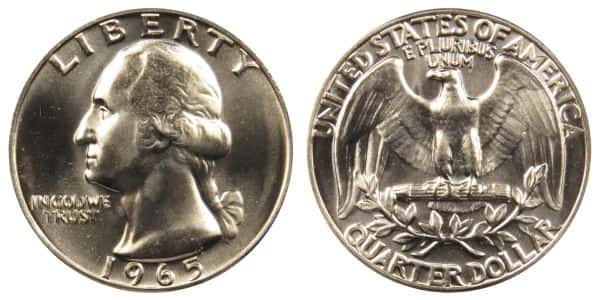
The 1965 Washington Quarter maintained the familiar design that had graced the denomination since 1932. Created by sculptor John Flanagan, the design pays tribute to America’s first president and stands as one of the longest-running coin designs in U.S. Mint history.
-
Obverse: Features a left-facing portrait of George Washington based on a Jean-Antoine Houdon bust. The inscriptions “LIBERTY” and “IN GOD WE TRUST” appear above and beside the profile, with the date “1965” below.
-
Reverse: Depicts a bald eagle perched on a bundle of arrows with olive branches beneath, symbolizing America’s balance between military readiness and peace. The inscriptions include “UNITED STATES OF AMERICA,” “E PLURIBUS UNUM,” and “QUARTER DOLLAR.”
-
Designer: John Flanagan (both obverse and reverse).
-
Artistic Legacy: This design remained unchanged until the 50 State Quarters Program launched in 1999, making the 1965 quarter a final link between traditional and modern U.S. coinage eras.
1965 Washington Quarter
Specifications and Mintages
The 1965 quarter introduced a new composition that would define U.S. clad coinage for decades.
-
Composition: Outer layers of 75% copper and 25% nickel, bonded to a pure copper core (no silver).
-
Weight: 5.67 grams (lighter than the 6.25-gram silver version).
-
Diameter: 24.3 mm.
-
Edge: Reeded.
-
Mintmarks: None — all mintmarks were suspended during 1965–1967.
-
Mintage: Approximately 1.82 billion coins struck, making it one of the highest-mintage quarters in history.
The absence of mintmarks and high mintage makes it challenging to trace specific mint origins, but most were produced at the Philadelphia Mint, with supplementary production at Denver and San Francisco under central authorization.
Key Dates, Varieties, and Rarities
While most 1965 quarters are common and trade for face value, a few varieties have earned legendary status among collectors:
-
1965 Silver Quarter Error: The most famous variety — struck on leftover 90% silver planchets from 1964. These weigh 6.25 grams instead of 5.67. Only a few confirmed examples exist, with values ranging from $5,000 to over $10,000 depending on condition.
-
Double Die Errors: Some minor doubled die obverse and reverse examples exist but command only modest premiums.
-
Struck on Wrong Planchets: Rare examples struck on dime planchets (smaller and lighter) or foreign coin blanks occasionally surface, highly prized for their uniqueness.
-
Proof-Like 1965 Quarters: While no official proofs were struck that year, certain coins exhibit semi-prooflike surfaces from freshly polished dies and are sought after for their eye appeal.
Collector and Investor Appeal
The 1965 quarter’s appeal lies not in precious metal content but in its place at the crossroads of U.S. monetary history. For collectors, it represents the official end of circulating silver coinage and the beginning of modern clad production.
-
Accessibility: Billions were minted, making it affordable for all collectors.
-
Historical Context: A pivotal coin from the Coinage Act of 1965, linking post-war America to the modern financial era.
-
Investment Perspective: The base-metal version carries minimal bullion value, but rare silver transition pieces and high-grade certified examples continue to attract strong auction interest.
-
Grading Trends: Mint State examples (MS65–MS67) remain relatively common, but exceptional strikes with deep luster can command premiums of $100–$200.
Collectors who appreciate numismatic history often include the 1965 quarter in type sets as the first clad issue of the denomination.
Recent Auction Highlights
While typical circulation strikes hold modest value, rare transitional errors have fetched impressive sums:
-
In January 2023, a PCGS MS62 silver planchet error 1965 quarter sold for $9,600 at Heritage Auctions.
-
A PCGS MS63 silver 1965 quarter realized $7,200 in a 2021 Stack’s Bowers sale.
-
Even circulated silver-error specimens can bring over $3,000, underscoring the rarity of authentic transition strikes.
These results highlight how transitional issues like the 1965 quarter bridge everyday coinage and elite numismatics — rare examples that transform a simple 25¢ piece into a four-figure collectible.
Unique Features and Anecdotes
The 1965 quarter holds a special place in American coin lore. It was one of the few coins produced over multiple calendar years with a single date — a Mint strategy to ease public confusion during the silver-to-clad transition. The Treasury also faced widespread hoarding, forcing them to flood the market with 1965-dated quarters well into 1966.
This policy means some 1965 quarters were technically struck after 1965 ended, making it one of the few U.S. coins to defy its own date.
Additionally, the controversy surrounding the removal of silver sparked public outrage and congressional hearings. Many Americans believed silver-backed coins symbolized trust and stability, while critics feared “cheapening” the nation’s money supply. Over time, however, the 1965 quarter became a symbol of monetary modernization and industrial efficiency.
Modern Relevance and Collecting Tips
Today, the 1965 quarter remains a mainstay of pocket change and an educational favorite among new collectors.
Tips for identifying potential rarities:
-
Weigh the coin: Silver planchet errors weigh 6.25g — a simple digital scale can confirm authenticity.
-
Look for edge color: Silver quarters have uniformly silver edges; clad coins show a distinct copper stripe.
-
Inspect under magnification: Die cracks, doubled dies, and off-metal strikes add value.
-
Consider certification: PCGS or NGC certification ensures authenticity and boosts resale potential.
-
Store properly: Keep high-grade examples in airtight holders to preserve luster and avoid tarnish.
Even as silver and gold prices fluctuate, the 1965 quarter continues to attract attention as a turning point in U.S. numismatic history — a bridge between the silver standard and modern currency.
The Legacy and Value of the 1965 Quarter
The 1965 Washington Quarter stands as a defining symbol of change in U.S. coinage, marking the transition away from silver and into the modern era of clad currency. While most examples remain common and accessible, the possibility of rare silver errors continues to capture the attention of collectors searching for hidden value in everyday coins.
For today’s numismatists, the 1965 quarter offers more than just historical significance—it provides a practical opportunity to learn how coin composition, rarity, and condition influence value. Whether you are examining pocket change or building a curated collection, understanding what to look for can make all the difference.
As interest in U.S. coins continues to grow, transitional issues like the 1965 quarter remain especially relevant. From affordable entry points to rare, high-value discoveries, this coin serves as a reminder that even the most common pieces can hold uncommon potential.
Explore more U.S. quarters and collectible coins at Bullion Exchanges, where numismatic expertise meets trusted precious metals investing.
Images sourced from: USA Coin Book