View Charts
1916-1945 Silver Mercury Dime: Winged Liberty Head Coin Guide
Few U.S. silver coins carry as much personality in such a small format as the Mercury dime. Officially known as the Winged Liberty Head dime, this 90% silver coin was struck from 1916 through 1945 and remains one of the most recognizable designs in American numismatics. Its appeal comes from more than silver content alone. The coin blends classical artistry, national symbolism, wartime history, and a collecting structure that can be as simple or as challenging as the buyer wants it to be.
For new collectors, Mercury dimes offer an approachable way to enter classic U.S. coinage. Circulated examples are widely available, often trading close to their silver value plus a modest premium. For advanced numismatists, the series opens into a deeper world of key dates, overdates, mintmark varieties, Full Split Bands designations, proof issues, and conditional rarities. Whether purchased as part of a 90% silver stack or pursued coin by coin in a date-and-mint set, the Mercury dime rewards careful observation.
Historical Background
The Mercury dime was born during a period when the United States was rethinking the look and feel of its coinage. By the early 20th century, Charles E. Barber’s dime design had become eligible for replacement under the 25-year redesign provision connected to the Coinage Act of 1890. The U.S. Mint, working with the Commission of Fine Arts, selected sculptor Adolph A. Weinman to redesign both the dime and the half dollar. Weinman’s Walking Liberty Half Dollar would become another American classic, but his dime made an equally lasting impression.
The new design debuted in 1916, a year that also introduced other major changes to circulating U.S. coinage. Weinman’s work reflected the artistic mood of the Progressive Era, when classical allegory, civic ideals, and refined medallic design were favored over simple portraiture. Instead of depicting a historical person, the obverse presents Liberty as an idea: alert, thoughtful, and forward-looking.
The series ran through a remarkable stretch of American history. Mercury dimes circulated during World War I, the prosperity of the 1920s, the Great Depression, and World War II. Those events shaped production patterns and collector demand. No Mercury dimes were struck in 1932 or 1933, when economic conditions sharply reduced the need for new coinage. Proof examples were later produced from 1936 through 1942, giving collectors another specialized segment of the series before wartime priorities interrupted proof coinage.
Design and Symbolism
Although the coin is almost universally called the Mercury dime, the name is technically a nickname. The obverse does not show the Roman god Mercury. It depicts Liberty wearing a winged Phrygian cap, with the wings symbolizing freedom of thought. The public quickly associated the image with Mercury, the swift Roman messenger, and the nickname has remained in use for more than a century.
The obverse includes the inscriptions LIBERTY, IN GOD WE TRUST, and the date. The portrait is compact but expressive, with Weinman using the limited surface area of a dime to create a design that feels far more substantial than its size suggests.
The reverse is equally symbolic. At the center is a fasces, a bundle of rods surrounding an axe, historically used to represent unity and strength. Beside it is an olive branch, a traditional emblem of peace. Together, the two symbols communicate a balanced message: peace is the goal, but national strength is necessary to preserve it. That combination carried particular weight during the years between two world wars.
Mercury dimes have reeded edges and were issued as business strikes for circulation, with proof versions produced from 1936 to 1942. Philadelphia coins carry no mint mark, while Denver and San Francisco issues show a D or S on the reverse near the fasces. Weinman’s design has also lived beyond the original dime series. The American Palladium Eagle, introduced in 2017, revived the Winged Liberty portrait on its obverse, reaffirming the design’s place in modern U.S. Mint artistry.
Mercury Silver Dime (1916-1945)
Designer - Engraver: Adolph A. Weinman Metal Composition: .900 Silver and .100 Copper
Diameter: 17.90 mm Mass / Weight: 2.50 grams
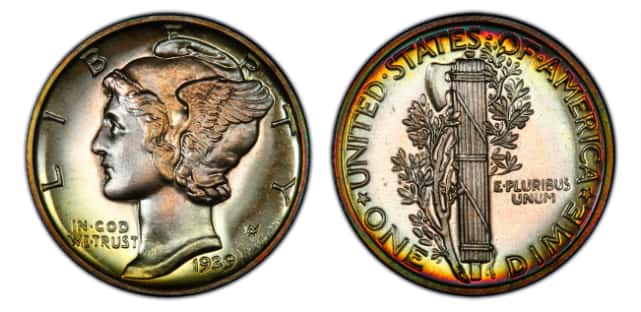
Images from PCGS.com
Mercury Dime Specifications
The Mercury dime follows the traditional pre-1965 U.S. silver composition: 90% silver and 10% copper. That alloy gave the coin durability for circulation while preserving meaningful intrinsic silver value. Today, circulated examples are often grouped with other pre-1965 dimes, quarters, and half dollars under the broad market term “90% silver” or “junk silver,” though collectible Mercury dimes can carry premiums far above melt value.
Each Mercury dime has a standard weight of 2.50 grams, a diameter of 17.9 mm, and a thickness of approximately 1.35 mm. Wear, striking pressure, and minor production variances can affect measurements slightly, but these specifications remain useful when evaluating authenticity. The coin contains approximately 0.07234 troy ounces of pure silver.
Business strikes were produced at Philadelphia, Denver, and San Francisco. Proof Mercury dimes, however, were struck only at Philadelphia from 1936 through 1942. Because the coin is small and finely detailed, strike quality plays a major role in collector value, especially on the reverse bands of the fasces.
Key Dates, Varieties, and Rarities
The Mercury dime series is popular partly because it offers more than one way to collect. Some buyers focus on affordable circulated examples. Others build complete date-and-mint sets. More advanced collectors study overdates, mintmark varieties, and strike designations. The result is a series with broad appeal: approachable at the entry level, but never shallow.
The most famous key date is the 1916-D Mercury dime, struck at the Denver Mint during the first year of issue. With a low mintage and strong collector demand, it remains the defining rarity of the series. Even heavily circulated examples can command serious premiums, and certified pieces with original surfaces are especially desirable.
The 1921 and 1921-D issues are important semi-keys. Their low mintages reflect the post-World War I slowdown in coin production, and both dates are actively collected across circulated and uncirculated grades. The series also includes two major overdates: the 1942/41 Philadelphia and 1942/41-D Denver varieties. These coins resulted from hubbing errors and are best identified with magnification and reliable attribution references.
Another favorite is the 1945-S Micro S, a late-series mintmark variety that adds interest to the final year of Mercury dime production. While not as rare as the 1916-D or the overdates, it remains a widely recognized subtype.
Strike quality deserves special attention. Collectors often look for Full Split Bands, commonly abbreviated FSB or FB, on the reverse. This designation refers to complete separation in the central horizontal bands on the fasces. A Mercury dime with sharply defined bands can command significantly stronger premiums than a coin of the same numeric grade without that detail. On certain dates, Full Split Bands examples are genuinely scarce.
Approximate Market Values and Pricing Signals
Mercury dime values are shaped by several forces working together: silver spot price, date and mintmark rarity, condition, eye appeal, strike quality, certification status, and market demand. Common circulated dates usually trade near silver melt value plus a retail premium, while scarce dates and high-grade examples can move deep into numismatic territory.
A common circulated Mercury dime contains about 0.07234 troy ounces of silver. To estimate its melt value, multiply that silver content by the current silver spot price. For example, at a $75.00 silver spot price, the melt value would be approximately $5.43 per dime. Retail prices for wholesome circulated examples often trade above melt, especially when the coins have readable dates, natural surfaces, attractive toning, and no major damage.
Uncirculated common dates cover a wide range. Lower Mint State examples may trade in the low hundreds, while stronger MS-65 coins often bring higher premiums. Superb coins, particularly those with Full Split Bands, can reach four figures depending on the date and population data. Proof Mercury dimes from 1936 to 1942 also command collector premiums, with originality, mirror quality, and overall eye appeal playing major roles.
As with any classic U.S. coin, published price guides should be treated as starting points rather than final answers. Recent auction records, certified population reports, dealer inventory, and coin-specific quality all matter. Two Mercury dimes with the same grade can sell for very different amounts if one has better luster, cleaner surfaces, stronger bands, or more attractive toning.
General Value Categories
Common circulated dates:
Often priced around melt value plus a modest premium, depending on silver spot price, condition, and dealer availability.
Common uncirculated dates:
Mint State examples can range from modest collector premiums to much higher prices when luster, surface quality, and strike strength are above average.
Proof issues from 1936–1942:
Proof Mercury dimes are a specialized area of the series, with values influenced by grade, originality, reflectivity, and cameo contrast.
Key dates and major varieties:
The 1916-D, 1921, 1921-D, 1942/41, and 1942/41-D remain central to most advanced Mercury dime collections.
1916-D Mercury Dime Auction Benchmarks
The 1916-D is the coin that defines the series for many collectors. Its low mintage, first-year status, and long-standing reputation have made it one of the most heavily pursued 20th-century U.S. silver coins.
One notable high-end benchmark came when a PCGS MS67 Full Bands 1916-D Mercury dime realized $207,000 at Heritage Auctions on August 12, 2010. Another top-tier example later brought $204,000 in Stack’s Bowers’ March 2020 Pogue sale. More recently, a 1916-D graded VF-35 by NGC sold for $4,800 in Stack’s Bowers Spring 2025 Showcase Auction.
These results show how dramatically value can change by grade and designation. A well-worn 1916-D may be attainable for serious collectors, while elite Mint State Full Bands examples belong to an entirely different market tier. Originality, certified grade, surface preservation, and eye appeal all influence the final price.
Collector and Investor Appeal
Mercury dimes sit comfortably between bullion and numismatics. That dual identity is one reason the series remains so active. A silver stacker may begin by buying circulated Mercury dimes for their 90% silver content, then gradually develop an interest in dates, mintmarks, and condition. A collector may approach the series from the opposite direction, drawn first by Weinman’s design and later by the coins’ intrinsic metal value.
The series also offers flexible collecting paths. A short set from 1934 to 1945 is more manageable than a full date-and-mint collection and avoids some of the most expensive early keys. A full set, by contrast, gives collectors a deeper challenge and a more complete view of U.S. Mint production during a turbulent period. Variety collectors can focus on the overdates, Micro S, and Full Split Bands examples.
Certification from PCGS or NGC can be especially helpful for key dates, high-grade coins, and major varieties. Encapsulation provides third-party confirmation of authenticity and grade, while also protecting the coin’s surfaces. That said, many circulated common-date Mercury dimes remain perfectly suitable for raw collecting, especially when purchased from reputable dealers.
Unique Features and Collecting Anecdotes
Part of the Mercury dime’s charm is the story behind its identity. The coin’s official name, Winged Liberty Head, is precise but rarely used in everyday conversation. The “Mercury” nickname emerged because Liberty’s winged cap reminded people of the Roman messenger god. The name stuck so firmly that even experienced collectors use it without hesitation.
A long-standing tradition connects the portrait of Liberty to Elsie Stevens, wife of poet and attorney Wallace Stevens. The Stevens family reportedly lived for a time in quarters rented from Adolph Weinman, creating a personal link between American literature and American coin design. While such stories can be difficult to prove in every detail, they add texture to the coin’s cultural history.
The reverse design also deserves more attention than it sometimes receives. The fasces and olive branch were not random decorative choices. They expressed strength, unity, restraint, and peace at a time when the United States was navigating a rapidly changing world. That symbolism remained relevant through both world wars and still gives the coin much of its emotional weight.
Modern Relevance and Buying Tips
Mercury dimes continue to attract buyers because they are compact, liquid, historically important, and widely recognized. For bullion-focused buyers, circulated examples can provide a familiar way to own fractional silver. For collectors, the series offers enough variety and depth to sustain years of study.
When evaluating raw Mercury dimes, start with the basics: date, mintmark, weight, diameter, edge, and surface condition. Avoid cleaned coins when possible. Cleaning can leave hairlines, unnatural brightness, or dull surfaces that reduce collector value. Original color and honest wear are usually preferable to a coin that has been harshly altered.
For higher-grade examples, pay close attention to luster, contact marks, strike quality, and the central bands on the reverse. A coin does not need Full Split Bands to be attractive, but the designation can make a significant difference in value. Buyers interested in the 1942/41 overdates should use trusted attribution guides or purchase certified examples, since misidentification can be costly.
Proper storage is equally important. Use inert holders, archival-quality flips, albums free of PVC, or certified slabs. Mercury dimes may be small, but their surfaces are still vulnerable to scratches, chemical residue, and environmental damage.
Closing Perspective
The Mercury dime has endured because it offers more than a silver price story. It is beautiful without being ornate, symbolic without being obscure, and collectible without being out of reach for most buyers. Its common dates welcome beginners, while its keys, overdates, proofs, and Full Split Bands pieces continue to challenge advanced collectors.
For bullion buyers, Mercury dimes provide recognizable 90% silver with strong market liquidity. For numismatists, they offer artistry, history, and a well-established collector base. For anyone drawn to classic U.S. coinage, the series remains one of the most rewarding places to begin or deepen a collection.
Whether you are building a short set, searching for a 1916-D, studying overdates, or simply adding pre-1965 silver to your holdings, the Mercury dime delivers a rare combination of accessibility and character. More than a century after its debut, Weinman’s Winged Liberty still feels alive on the coin’s small silver canvas.