View Charts
Why Silver Remains Essential to Modern Medicine
 0
0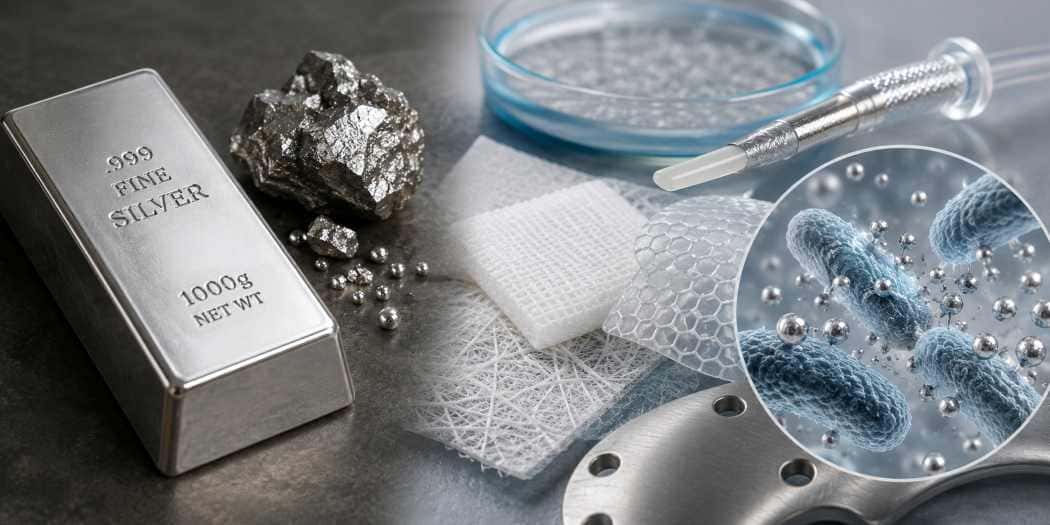
Medicine Uses Silver for Something Bullion Markets Cannot Price Alone
Silver's investment appeal is easy to see in a silver coin or bar, but its less visible hospital role reveals another side of the metal. Silver ions can interfere with microorganisms in several ways, a property that has made silver useful in wound dressings, burn care, antimicrobial materials, and selected medical-device applications.
Healthcare consumes far less silver than solar manufacturing or electronics, and medical demand is not a major independent price driver. Its importance is more revealing than that. Medicine is one of many industries willing to consume silver because its physical and chemical characteristics solve practical problems. As industrial silver demand has become increasingly important to the global market, specialized applications help explain why silver cannot be understood solely as a monetary metal. In healthcare, centuries-old antimicrobial knowledge is being refined through modern materials science.
Silver's Antimicrobial Advantage Is More Complex Than It Looks
The useful agent is not simply a shiny piece of metal. When silver releases ions in the right environment, those ions can interact with microbial cell membranes, proteins, enzymes, and genetic material. That multi-target activity helps explain why silver has remained relevant even after the development of modern antibiotics.
Medical technology has become better at controlling how that activity is delivered. Silver compounds, particles, and nanocrystalline forms can be incorporated into foams, fibers, gels, alginates, and other materials designed to release silver where it is needed. The objective is not to maximize the quantity of metal. It is to deliver enough antimicrobial activity for a particular clinical purpose while limiting unnecessary exposure to healthy tissue.
Silver is not a universal treatment for infection, and concentration, release rate, wound type, exposure time, and formulation can all affect performance. Its medical value lies as much in engineering as chemistry: manufacturers design products that use an inherent property selectively.
Wound Care Has Become Silver's Most Visible Medical Role
Wound management offers the clearest example of silver moving from raw material to medical technology. Silver-containing dressings are used in care settings involving burns, surgical wounds, diabetic foot ulcers, and other wounds where microbial burden is a concern. Products range from relatively conventional dressings treated with silver compounds to advanced materials engineered for controlled ion release.
The clinical evidence is nuanced. A 2026 systematic review and meta-analysis of 35 randomized trials involving more than 8,700 patients found that silver dressings probably reduced surgical-site infection risk in closed surgical wounds compared with standard dressings. Other research has found benefits in certain chronic-wound settings, while outcomes vary by wound type and the product being studied. The evidence supports targeted use rather than the assumption that adding silver automatically makes any dressing superior.
Burn treatment shows how the technology has evolved. Silver sulfadiazine became a familiar topical treatment, but newer nanocrystalline silver dressings can release silver through engineered materials and may require fewer dressing changes in some circumstances. A 2026 meta-analysis comparing nanocrystalline silver dressings with silver sulfadiazine in burn patients found shorter healing times and fewer dressing changes with the nanocrystalline products, while finding no significant difference in adverse events. The progression illustrates a recurring theme in silver technology: innovation often changes how efficiently the metal is used rather than replacing it.
Medical Devices Push Silver Beyond the Dressing
The same antimicrobial properties that make silver useful on wounds have encouraged research into medical devices and surfaces where microbial colonization can create complications. Silver has been incorporated or investigated in coatings for products such as catheters and other devices that remain in contact with the body. The goal is to make the material itself less hospitable to microorganisms rather than relying only on treatment after contamination occurs.
Bacteria can adhere to surfaces and develop biofilms that become difficult to manage. An antimicrobial coating may provide another defensive tool, but effectiveness depends on the device, formulation, concentration, and clinical setting; one successful application does not validate every silver coating.
Here, the economics look very different from bullion. A medical product may contain only a small amount of silver, yet the metal can perform a disproportionately important function within a higher-value device. That pattern appears elsewhere in industrial demand as well. Silver is often valuable not because manufacturers need large pieces of it, but because relatively small quantities can provide conductivity, reflectivity, or antimicrobial performance that is difficult to reproduce with another material without tradeoffs.
Antibiotic Resistance Has Kept an Old Metal Relevant
Silver predates antibiotics by centuries, but modern concerns about antimicrobial resistance have renewed interest in approaches that do not depend on conventional antibiotic mechanisms alone. Because silver ions can act on microorganisms through multiple pathways, researchers continue to investigate their role in wound management, coatings, and combination technologies.
Silver is not a substitute for antibiotics. Researchers continue to examine cytotoxicity, environmental effects, cost, appropriate duration of use, and possible microbial adaptation. The stronger case is that modern medicine has learned to use a familiar material more precisely. Silver-containing wound products already have an established role, while newer coatings and engineered materials vary in maturity and evidence; promising laboratory research does not automatically translate into commercial silver consumption.
Healthcare Adds Depth, Not Dominance, to Industrial Silver Demand
Silver's medical role is economically interesting precisely because it is not the largest industrial use. Electronics and electrical applications, photovoltaics, automotive technology, power infrastructure, and other manufacturing sectors consume far greater quantities. Healthcare adds another demand channel to an already unusually diverse industrial profile.
The Silver Institute reported record industrial demand in 2024, with growth tied primarily to electrical and electronics uses, solar applications, automotive demand, grid infrastructure, and technologies associated with artificial intelligence. Medical consumption sits well below those headline categories, so a surge in antimicrobial dressings alone is unlikely to move the global silver price. Still, specialized uses broaden the number of industries competing for refined metal.
Technological growth also does not guarantee equal growth in silver consumption. Manufacturers have incentives to reduce precious-metal content, particularly when prices rise. Better coatings, thinner layers, and improved deposition can allow a medical technology to expand while using less silver per unit, so growth in silver-enabled products is not necessarily growth in ounces consumed.
The Medical Story Shows Why Silver Is an Unusual Precious Metal
Gold's industrial applications matter, but silver occupies a particularly unusual position between investment asset and consumable technology. The same element held as bullion can disappear into solar cells, electrical contacts, vehicles, electronics, and medical products. Some of that silver can eventually be recycled; some is dispersed in quantities too small to recover economically.
Medicine captures this dual identity particularly well. Silver's antimicrobial properties have been known for generations, yet advanced materials are giving healthcare companies more sophisticated ways to put those properties to work. The opportunity is not simply to use more silver, but to use it more intelligently—in controlled-release dressings, engineered surfaces, and other applications where microbial control has tangible clinical value.
For the silver market, healthcare should remain in perspective. It is a specialized contributor rather than the central engine of industrial consumption, and medical advances should not be treated as a short-term price catalyst without evidence of meaningful volume. But the sector reinforces a broader fundamental point: silver demand is supported by an expanding range of technologies that value what the metal can actually do. That practical utility, alongside investment and monetary demand, is one reason silver remains unlike almost any other precious metal.
Related reading you may find interesting:
Why the Silver Market Keeps Running a Supply Deficit