View Charts
Why Precious Metals Move Before Interest Rate Decisions
 0
0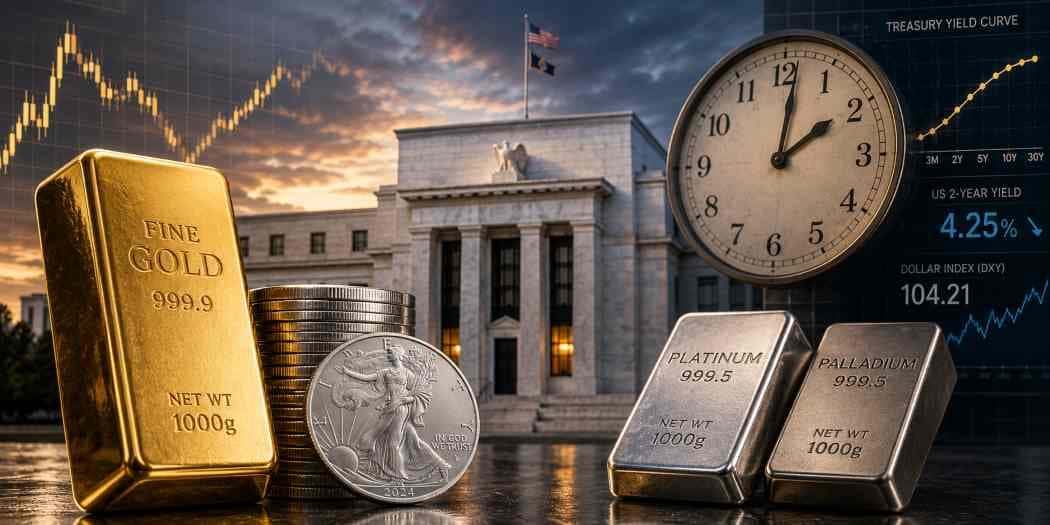
The Market Often Reacts Before the Fed Speaks
Gold can rally for several days ahead of a Federal Reserve meeting, then decline after policymakers deliver exactly the decision investors expected. That sequence may seem counterintuitive, but it reflects one of financial markets' defining characteristics: precious metals prices adjust to anticipated events before those events become official. Precious metals respond as investors interpret inflation reports, employment data, Treasury yields, Federal Reserve speeches, and shifting expectations for monetary policy—not simply when the Federal Open Market Committee (FOMC) releases its statement.
By the time policymakers announce their decision, much of the expected outcome has already been reflected in prices. The meeting therefore serves less as a catalyst than as a test of whether the Fed confirms, exceeds, or disappoints market expectations. Understanding that process helps explain why gold and other precious metals can appear to react "backward" to major interest rate announcements.
Markets Trade Expectations, Not Headlines
Financial markets are forward-looking. Every economic release prompts investors to reassess where inflation, growth, and interest rates may be headed over the coming months, then reposition portfolios accordingly. If inflation cools or the labor market softens, markets may anticipate lower interest rates, pushing Treasury yields lower, weakening the U.S. dollar, and supporting gold before the Fed changes policy. Stronger-than-expected economic data can produce the opposite reaction, encouraging expectations that rates will stay higher for longer.
The key is that investors are pricing probabilities rather than certainties. By the time a Fed meeting arrives, traders have often spent weeks adjusting positions based on incoming data. The announcement itself becomes important only if it changes the market's existing assumptions. A widely expected rate cut may have little effect, while an unchanged policy stance can lift gold if policymakers signal that easing is approaching sooner than investors anticipated.
Why Gold Usually Responds First
Gold tends to respond more directly than other precious metals because it competes with interest-bearing assets. Since bullion generates no income, higher Treasury yields increase the opportunity cost of owning it. Expectations for lower rates reduce that disadvantage, making gold relatively more attractive and often lifting prices well before the Fed acts.
The U.S. dollar reinforces this relationship. Expectations for tighter monetary policy generally strengthen the dollar, making gold more expensive for overseas buyers, while expectations for easier policy can weaken the currency and support precious metals. These forces help explain why gold often establishes the market's initial direction ahead of a Federal Reserve meeting.
Interest rates are not the only influence, however. Central-bank buying, geopolitical tensions, inflation concerns, and safe-haven demand can amplify or offset monetary policy expectations. Gold remains sensitive to interest rates because they shape its relative appeal, but its price ultimately reflects several market forces operating at once.
The Signals Investors Watch Before a Rate Decision
Professional investors rarely wait for the Fed meeting itself. Instead, they monitor indicators that reveal how expectations are evolving in real time. Federal funds futures—commonly summarized through the CME FedWatch Tool—provide a market-based estimate of how likely investors believe different policy outcomes have become.
Treasury yields offer another important clue, particularly the two-year Treasury note, which closely tracks expectations for near-term Federal Reserve policy. A sharp move in yields often reaches the precious metals market before policymakers make any public announcement.
Economic reports continually reshape those expectations. Inflation data such as the Consumer Price Index (CPI) and Personal Consumption Expenditures (PCE), monthly employment reports, retail sales, and GDP growth all influence how investors view the Fed's next move. Markets evaluate these releases collectively rather than individually, adjusting probabilities with each new piece of information. Precious metals respond to those changing expectations long before the official decision arrives.
When Expectations and Reality Diverge
The largest moves on Fed day usually occur when policymakers deliver something the market did not anticipate. If investors assign an overwhelming probability to rates remaining unchanged, that outcome is largely priced in before the announcement. Gold may barely react—or even decline—as traders lock in profits following the event.
Forward guidance often matters more than the rate decision itself. A quarter-point cut accompanied by cautious language about future easing may disappoint investors who expected a more accommodative outlook. Likewise, leaving rates unchanged can support precious metals if Chair Kevin Warsh signals that inflation is easing enough to justify cuts in coming meetings.
For experienced market participants, the central question is rarely whether rates changed. Instead, they ask whether the Fed sounded more hawkish or more dovish than markets expected. That difference frequently determines whether precious metals extend an existing trend or reverse course.
Why Other Precious Metals Don't Always Follow Gold
Silver often moves alongside gold because it serves both as an investment asset and an industrial metal. During periods when monetary policy dominates investor sentiment, silver may amplify gold's gains or losses. However, demand from manufacturing, electronics, and solar energy can sometimes push silver in a different direction.
Platinum and palladium respond even more to industrial fundamentals than to Federal Reserve policy. Automotive demand, mining supply, and geopolitical developments in major producing countries frequently outweigh changes in interest-rate expectations. Even so, a weaker dollar resulting from dovish Fed expectations can provide broad support across the precious metals complex.
Recognizing these differences helps explain why gold often leads ahead of Fed meetings while the rest of the sector may react with varying intensity.
Looking Beyond the Next Fed Meeting
Federal Reserve decisions remain among the most influential events for financial markets, but they are rarely the starting point for price discovery. By the time policymakers release their statement, investors have already processed weeks of economic data and adjusted their expectations accordingly. Precious metals reflect that evolving consensus long before the meeting begins.
For bullion investors, this perspective can reduce the temptation to interpret every post-meeting move at face value. Gold's direction often depends less on the rate decision itself than on whether the announcement confirms or challenges what markets already believed. The next time precious metals begin moving ahead of an FOMC meeting, the better question may not be what the Fed will do, but what expectations are already built into prices. That distinction often explains the market far better than the headline alone.